
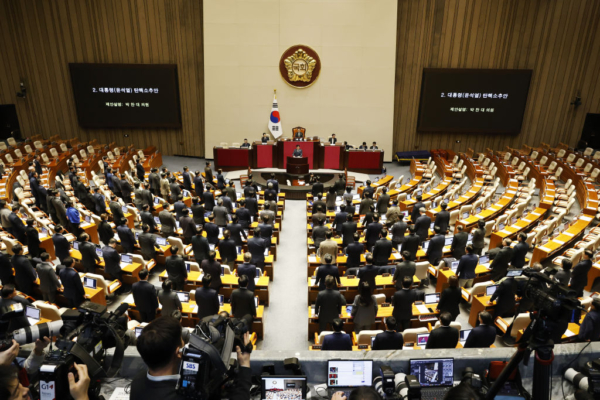
On Saturday afternoon, local time in South Korea, the National Assembly held a plenary meeting to vote on the impeachment of President Yoon Suk Yeo. Despite the boycott by most ruling party members, the motion failed to pass in the parliament.
Prior to the impeachment vote, out of the 108 ruling party members from the People Power Party, only Ahn Chul-soo was initially present, with another member Kim Ye-ji later returning to the chamber. Following the request from the Speaker Yu Won-sik for ruling party members to return to vote, another member Kim Sang-wook also returned to the chamber.
After the vote, Kim Sang-wook told reporters that he voted against the impeachment as he did not agree with it. However, he also expressed his belief that President Yoon Suk Yeo is not suitable to hold the presidency.
According to South Korean law, an impeachment motion requires the participation of over half of the sitting members of the parliament and approval from two-thirds of them to pass. With a total of 300 members in the National Assembly, the opposition parties hold 192 seats, meaning at least 8 members from the ruling party need to support the motion for it to pass.
The Chairman of the main opposition party, the Democratic Party, Lee Jae-myung, stated that if this impeachment attempt fails, they will submit another motion next Wednesday.
Last Tuesday, President Yoon Suk Yeo declared a temporary state of emergency, sparking political turmoil. On Saturday morning, he addressed the nation on television, apologizing for issuing the state of emergency and reassuring the public that it will not be imposed again.
Before the impeachment vote, the parliament first voted on the “Kim Keon Hee Special Prosecutor Law,” which called for a special investigation into the First Lady Kim Keon Hee. The results showed 198 votes in favor and 102 against. However, as the in favor votes fell short of the two-thirds majority threshold, the law failed to pass.
(Reference sources: Reuters and Yonhap News Agency)