
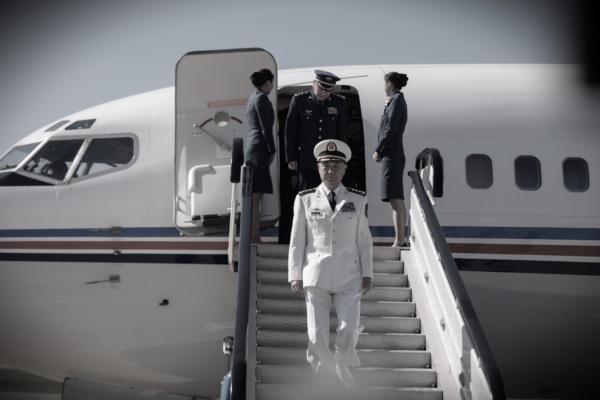
In the latest development within the Chinese military, member of the Communist Party’s Central Military Commission, Miao Hua, has been detained, sparking a new wave of power struggles within the military hierarchy. Analysts suggest that the carefully cultivated “Children of the Army” system in the 31st Army by Xi Jinping is now at risk of crumbling.
It is reported that an independent commentator with a “Red Second Generation” background, Xiang, stated on December 1st on a social media platform that Xi Jinping had close ties with the 31st Army stationed in Fujian during his tenure from 1985 to 2002. With the downfall of Miao Hua, who hails from the 31st Army, it is speculated that Xi Jinping’s legacy within the 31st Army, known as the “Xi Jinping’s Children of the Army” system, is under threat, signaling a crackdown on Fujian-based factions.
Xiang, the author of “China Duel,” which details an attempted coup within the Communist Party in 2012, emphasized that the recent developments indicate a significant blow to the Fujian bloc and suggest an intensifying power struggle within the Communist Party military hierarchy.
Renowned political commentator Chen Pokong highlighted in an interview that the downfall of Miao Hua could have been orchestrated by Zhang Youxia, especially considering Miao Hua’s close ties to Xi Jinping. With rumors swirling about the arrest of Lin Xiangyang, the Commander of the Eastern Theater Command of the People’s Liberation Army, and the shared military experience of both Miao Hua and Lin Xiangyang in Fujian’s army, suspicions arise about Zhang Youxia taking action to secure his position through such means.
Furthermore, writer Cai Shenkun pointed out that besides Miao Hua and Dong Jun, other high-ranking military officials currently under scrutiny include Hu Zhongming, the newly appointed Navy Commander, and Wang Houbin, promoted to lead the Rocket Force after a career in the Navy, all of whom were recommended by Miao Hua. This purge is expected to impact a significant number of senior officers associated with the Fujian group.
The 31st Army, which played a crucial role in various military operations, traces its origins back to the pre-Communist era and later transformed into the 31st Group Army stationed in Fujian. Following a restructuring in 2016, the 31st Group Army became the 73rd Group Army under the Eastern Theater Command, with its headquarters located in Xiamen.
The 31st Group Army, often referred to as Xi Jinping’s loyal force, has close ties to the Chinese leader dating back to his tenure in Fujian. Xi’s ambitions for Taiwan’s reunification have seen an increasing number of officers from Fujian being groomed for key positions within the military.
One notable example is the appointment of former 31st Group Army members, such as Vice Chairman of the Central Military Commission He Wenhong and Miao Hua, to prominent military roles. The unconventional promotions of figures like He Wenhong to the Central Political Bureau demonstrate Xi Jinping’s desire to consolidate power within the military ranks.
The intricate web of relationships within the military hierarchy underscores the complex dynamics at play, with various key military figures having ties to the Fujian faction and facing potential consequences in the ongoing shakeup.
These recent developments shed light on the intricate power plays and machinations within the top echelons of the Chinese Communist Party, hinting at a broader power struggle and reshuffling of allegiances within the party’s military apparatus.