
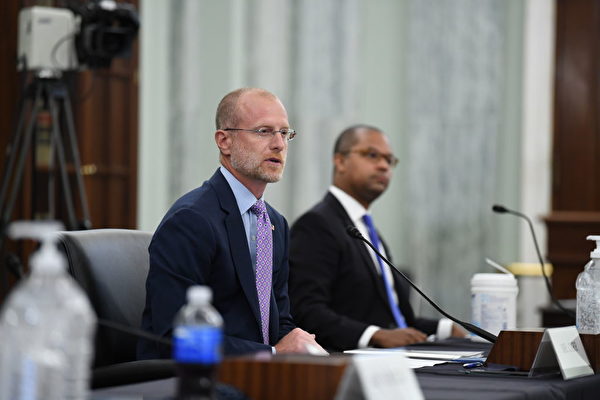
The Federal Communications Commission (FCC) commissioner in the United States stated on Sunday that the National Broadcasting Company (NBC) violated the FCC’s “Equal Time” rule by featuring Vice President Kamala Harris in the last episode of “Saturday Night Live” before Election Day.
One of the five commissioners of the FCC, Republican Brendan Carr, posted on social media platform X on Saturday night, criticizing Harris’s appearance on NBC’s comedy sketch variety show “Saturday Night Live,” saying, “This is a blatant and overt effort to circumvent the FCC’s ‘Equal Time’ rule.”
“The purpose of this rule is to prevent biased and partisan behavior – a licensed broadcast company using public airwaves to influence a candidate on the eve of an election,” continued the FCC commissioner appointed by Trump. “Unless the broadcast company also offers equal time to other qualified campaign teams.”
In this week’s “Saturday Night Live” episode, Harris performed a sketch with comedian Maya Rudolph, who often impersonates her. This was the first time the Democratic presidential candidate appeared on the show, encouraging voters to support her in the upcoming election on Tuesday.
The FCC’s “Equal Time” rule was established in 1934, requiring radio and television stations to provide equal exposure time for competing political candidates. There are exceptions, such as news broadcasts, documentaries, and political debates.
During this election cycle, “Saturday Night Live” did not provide equal airtime for Republican candidate Trump or other presidential candidates.
Harris’s surprise appearance on “Saturday Night Live” last Saturday was unexpected, as the show’s executive producer Lorne Michaels had previously stated in an interview that neither Harris nor Trump would appear on his show during this election cycle.
Michaels mentioned in an interview with The Hollywood Reporter two months ago, “Due to election laws and equal time regulations, you can’t have someone who is actually running for office on the show. If you don’t have all the candidates, you can’t have the main candidates, and there are a lot of candidates, these people who only have so many votes in three states. It becomes very complicated.”
The FCC regulations do not require television networks to provide candidates with identical types of appearance opportunities but stipulate that they must be “equal in time and scheduling.”