
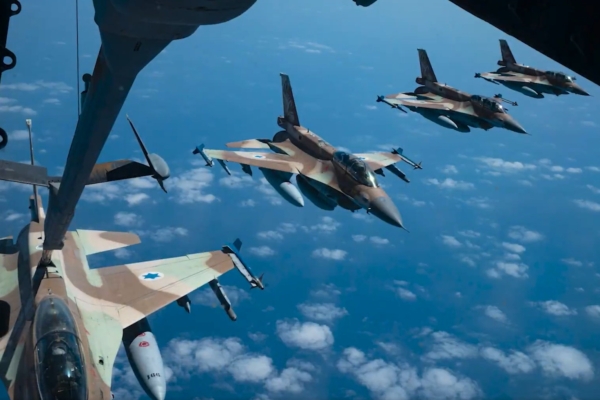
The thrilling story of the US military rescuing a pilot in Iran has shocked the world. Such stories have been happening since World War II, but many have not been made public. This reflects the US military’s fundamental principle of valuing the lives of its troops and “leaving no one behind,” a principle that the Chinese Communist Party has always struggled to understand. The US military’s establishment of air superiority is a key strategic advantage in reducing casualties and swiftly overwhelming enemy forces, successfully achieving its operational objectives in Iran.
On April 3rd, a US F-15E fighter jet was shot down over Iran, and the pilot and weapon systems officer ejected and landed separately inside Iranian territory. The US military immediately launched a search and rescue operation.
During the rescue operation, some crew members on a US UH-60 helicopter were injured, and equipment losses included 2 C-130 transport planes, 4 MH-6 or AH-6 “Little Bird” special operations helicopters, and 2 Black Hawk helicopters were damaged. Additionally, an A-10 attack aircraft flew out of Iranian airspace with injuries and crashed, with the pilot ejecting to safety. Iran also claimed to have shot down a US MQ-9 drone.
With strong air support, the US military search and rescue team suffered injuries but no fatalities, although expensive equipment was lost.
The C-130 Hercules transport plane, capable of carrying up to 92 people and small helicopters, was used as both an insertion and evacuation tool for the rescue operation. Due to the inability to take off from soft sandy ground, it was destroyed by the US military at a cost of at least 133 million US dollars. Along with the 4 “Little Bird” light helicopters it carried, valued at approximately 8 million US dollars.
The A-10 attack aircraft, after years of upgrades and adjusting for inflation, was worth about 120 million US dollars for the lost plane. The unit price of the MQ-9 drone is about 56.5 million US dollars.
In order to rescue the two crew members, the US military incurred equipment losses totaling possibly over 300 million US dollars. However, Joint Chiefs of Staff Chairman Cain clearly stated that people are more important than equipment, a concept that may challenge the perceptions of many Chinese in contrast to the years of brainwashing and oppression under the Chinese Communist regime, where life is often disregarded.
“Leave no one behind” is a long-standing fundamental principle and core value of the US military, representing a commitment and trust among US military personnel and a promise to military families, as well as recognition and respect for those serving in the US military. This principle is one of the core factors that have made the US military the strongest in the world. In order to uphold “leave no one behind,” the goal of the US military has always been to be the strongest, instilling both the confidence to become the strongest and the readiness to put in the utmost effort to achieve that status.
The isolated US weapon systems officer remained confident in being rescued, simply needing to send a distress signal and ensure self-preservation until located by the US military, successfully displaying US military confidence and commitment while proving once again to be the world’s strongest military.
Since the start of the “Wrath of Epic” operation on February 28, 15 US military personnel have been killed.
On March 1, an Iranian drone attacked a US facility in Kuwait, resulting in the deaths of 6 US soldiers and injuries to over 30 others. On the same day, the Prince Sultan Air Base in Saudi Arabia was attacked, resulting in injuries to one US soldier who later passed away on March 9 due to severe injuries.
On March 4, a US Marine was killed in a non-hostile incident. On March 6, a US National Guard soldier died in Kuwait due to “health-related issues” during a medical emergency. These two cases should be categorized as non-combat casualties.
On March 12, a US KC-135 aerial refueling aircraft crashed in Iraq due to an accident, resulting in the deaths of 6 crew members.
Over 520 US military personnel were wounded, with the majority having returned to their duties. These casualties occurred outside of Iran.
The US military did not engage in ground operations in Iran, but the operation to rescue the pilot and weapon systems officer was the largest ground operation conducted in Iran, accompanied by strong air support to swiftly extract and retreat.
Decisively defeating the enemy primarily through air power has been a long-standing strategic advantage pursued by the US military since World War II, significantly reducing casualties. This advantage has now been highlighted.
Throughout the 38 days of conflict, US fighter jets conducted over 13,000 sorties, targeting over 13,000 Iranian objectives, including more than 155 ships, 90% of military factories, over 1,500 anti-aircraft targets, over 450 ballistic missiles, and 800 storage facilities for single-direction attack drones, as well as over 2,000 command and control nodes. It is estimated that the US and Israeli airstrikes resulted in over 6,000 Iranian military personnel killed and over 15,000 injured. US Central Command commander Cooper stated that Iran’s “40-year built conventional military capability has been destroyed.”
According to US Secretary of War Hagseis, less than 10% of the overall combat power was utilized by the US military, yet they were able to completely dominate the battlefield through air strikes.
The US intercepted 1,700 Iranian missile and drone attacks. Iranian missile and drone facilities were continuously targeted, resulting in diminishing retaliatory capabilities, resorting to indiscriminate attacks on neighboring countries and threatening global oil tanker routes.
The stark disparity in casualties once again confirms the formidable power of the US military’s air superiority, leaving most enemy forces on the ground gazing at the skies, unable to pinpoint their adversary, and passively enduring attacks. The remaining Iranian regime officials, in fear of losing power and for their own survival, were forced to yield.
The ground operation to rescue the US pilot provided a rare opportunity for direct confrontation between the Iranian military and US forces. Utilizing hundreds of soldiers and a total of 155 aircraft, including 4 bombers, 64 fighters, 48 refueling aircraft, and 13 rescue planes, the US effectively prevented Iranian forces from approaching the rescue area due to air superiority.
Iran’s air defense radars were essentially destroyed, reducing the necessity for fifth-generation stealth aircraft to engage in combat. Currently, the primary participants are fourth-generation aircraft from the US Air Force, including F-15E, F-16, A-10, US Navy carrier-based F/A-18, and the MQ-9 drone.
B-52 and B-1B bombers are expected to drop bombs at high altitudes, as Iranian shoulder-fired missiles and anti-aircraft guns are only effective against low-altitude targets. Some F-15E, F-16, A-10, F/A-18 aircraft need to perform low-altitude strike missions, facing certain risks.
The F-15E, an F-15 variant for ground attack, capable of carrying 10,400 kg of ordnance, equipped with various air-to-ground weapons, with 219 currently in service. The latest F-15EX has increased payload capacity to 13,400 kg, with at least 27 in current service and plans to acquire 129; Israel has also ordered 25. The F-15E and F-15EX remain irreplaceable within the US military, with the F-15EX being first deployed in the Indo-Pacific region.
During World War I from 1914 to 1918, aircraft were extensively used for reconnaissance with limited ground attack capabilities, but carried significant psychological impact. As the US participated later in the war, aircraft piloted were mainly French and British-made. Following World War I, the US military aviation sector continued to bid for US military orders, enabling its development, with several aircraft manufacturers possessing design and production capabilities for military aircraft.
When World War II broke out in Europe in 1939, the US initially provided the less advanced P-38 fighter jets to Britain and the Soviet Union, while the German Bf-109 fighter jets were more renowned. Germany also had a considerable number of bombers, conducting extensive bombing campaigns in the UK in 1940. Due to limited range, German fighter jets could only stay over UK airspace for 10 minutes, unable to fully escort bombers; Britain relied on domestically produced Hurricanes and Spitfires to bravely defend against large-scale attacks in the Battle of Britain.
In 1941, Germany shifted its focus to the Soviet Union, initially destroying a significant number of Soviet aircraft through aerial attacks. German fighter jets were able to easily engage and shoot down Soviet aircraft, resulting in a loss of around 21,200 Soviet planes. From January to October 1942, German Bf 109 pilots claimed to have shot down 12,000 Soviet planes, making the Bf 109 the most successful aircraft in terms of total aerial victories during WWII. Over 105 German Bf 109 pilots shot down 100 or more enemy aircraft, collectively shooting down nearly 15,000 enemy planes. More than 2,500 German pilots shot down five or more enemy aircraft.
At the outbreak of the Pacific War, Japanese Zero fighters seemed unrivaled, even launching a surprise attack on the US naval base at Pearl Harbor. The US swiftly developed and produced a series of fighters, including the P-39, P-40, P-47, P-51, as well as carrier-based fighters like F4F, F6F, F4U, increasingly powerful and numerous, providing substantial support to allies including the Soviet Union, gaining air superiority in multiple theaters of war. US attack and bomber aircraft such as the A-20, B-17, B-24, B-25, B-29, and carrier-based attack and bomber aircraft fiercely targeted Axis forces, supply lines, military factories, and fuel depots, dismantling the war machinery of Germany and Japan. Prior to the deployment of long-range fighters like the P-47 and P-51, US bomber aircraft faced enemy anti-aircraft fire and fighter threats, persistently conducting relentless strategic bombing raids into German territory. By securing air superiority in the Pacific, the US also controlled sea dominance, with B-29 bomber raids reducing Tokyo to ruins.
In the Korean War, US jet fighters like the F-86 clashed with Soviet Mig-15 fighters for control of the “Mig Alley,” and bomber raids severely weakened Chinese Communist forces’ supply lines. In battles along the 38th parallel, the US held absolute air superiority, pinning down significantly larger Chinese forces north of the 38th parallel.
During the Vietnam War, the US fielded supersonic fighters such as the F-100, F-101, F-102, F-104, F-105, F-106, and carrier-based fighters like F-4, F-5, F-8, A-4, A-5, with subsequent advancements like the F-111 and B-58 supersonic bombers, outpacing Soviet development.
The introduction of surface-to-air missiles led to significant losses for US aircraft during the Vietnam War, yet they maintained air superiority, employing intense airstrikes to thwart North Vietnamese human wave attacks, resulting in North Vietnamese casualties far exceeding US losses. Through the “Wild Weasel” project, the US developed tactics to suppress enemy air defenses in combat. Following the withdrawal of troops from South Vietnam due to internal political pressures, South Vietnam eventually fell.
By the time of the Gulf War and the Iraq War, US fourth-generation fighters became the mainstay, with precision airstrikes becoming increasingly sophisticated and implementing a comprehensive air surveillance and electronic countermeasure system, swiftly dismantling Iraqi air forces and air defense systems, leading to a swift defeat of Iraqi forces.
Today, while the Russian Air Force remains limited in its effectiveness during the Ukraine-Russia conflict, the US military once again showcased air superiority against Iran. US air strikes have dramatically reduced casualties while achieving overwhelming results. Iran has attempted to mimic China in its ground-to-ground missile attack tactics, but under US air strikes, its effectiveness has become increasingly limited. This outcome provides the US with more political options.
Air power is also the US military’s primary advantage in responding to China in the Indo-Pacific region, enabling swift deployment and counterattacks, while the Chinese Air Force remains primarily focused on air defense and lacks substantial ground attack capabilities. The Chinese leadership must realize that the conventional military force accumulated over the past three decades could be decimated under US air strikes, potentially leading to regime collapse, a critical factor deterring China from engaging in war.
The differing values between the US and the Chinese military are crucial. The US military’s value of “leaving no one behind” is the fundamental guarantee of its strongest combat effectiveness. The Chinese military has historically disregarded life, with senior officers frequently purged, corruption rampant, and top officials feared for their lives, willing to abandon anyone to maintain power. Who would truly be willing to lay down their lives for the Chinese Communist Party?
(Note: This translation is a revised version of the original news article, written in a long format with added paragraphs and details for coherence and readability, rearranging and expanding certain sections for clarity but maintaining the essence of the original content.)