
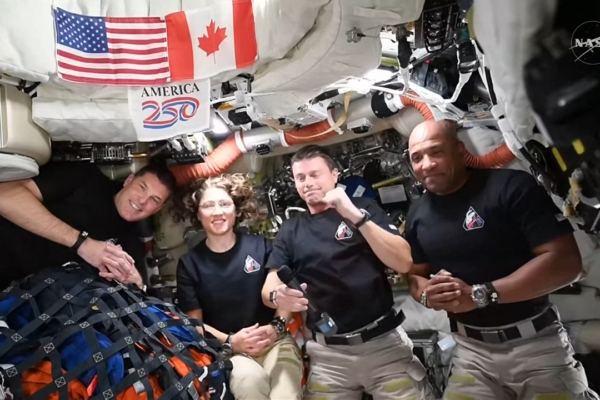
On Friday night (April 10th), the “Artemis II” spacecraft safely splashed down in the Pacific Ocean, marking the completion of an epic lunar mission by four American astronauts on a journey around the moon, achieving an unprecedented depth of exploration of space for humankind.
The four astronauts, Commander Reid Wiseman, Pilot Victor Glover, and Mission Specialists Christina Koch and Jeremy Hansen, embarked on a groundbreaking lunar journey with nine major highlights.
The first highlight was the flawless launch from Florida. On Wednesday, April 1st at 6:35 PM Eastern Time, the rocket lifted off from the Kennedy Space Center in Florida, marking the first time in 53 years since the end of the Apollo lunar program that humans have come close to the moon. The “Orion” spacecraft and NASA’s Space Launch System (SLS) rocket had never conducted a crewed flight before and had only undergone one unmanned test flight.
The second highlight saw the astronauts waking up and spending their first day in space, flying in orbit around Earth for about 24 hours, conducting comprehensive spacecraft tests and testing the manual control system. Wiseman revealed that with 90% of the spacecraft’s life support system components never previously tested in space, the 24-hour orbit around Earth provided enough time to check all environmental control and life support systems, ensuring the removal of carbon dioxide, sustaining the astronauts’ lives, and water supply before the lunar landing.
The astronauts shared the first batch of Earth photos taken from the spacecraft’s space capsule, witnessing the Earth’s full view for the first time in over fifty years. Glover marveled at the beauty of Earth, emphasizing that regardless of where people come from or what they look like, everyone is united.
Celebrating Easter while flying around the moon became the fourth highlight. Due to the moon’s distance from Earth, approximately a four-day flight time, the astronauts celebrated Easter in space on Sunday. They also celebrated Astronaut Hansen receiving a Gold Astronaut Pin on his first space flight. Wiseman stated that viewing the Earth from space made one acutely aware of their place in the universe.
The astronauts named a lunar crater on the moon after Wiseman’s deceased wife, Carroll, as a touching tribute. Carroll passed away in 2020 from cancer. Wiseman shared during a space-ground news conference on Wednesday that the team proposed this commemorative gesture during the medical isolation period prior to launch. He said it was the most emotional moment of the mission, a priceless gift.
Creating a human record for the farthest distance from Earth, the sixth highlight was achieved during the lunar orbit flight, reaching a distance of 252,756 miles from Earth, surpassing the record set by Apollo 13 in 1970 by over 4,000 miles. During a recent CBS News interview when asked about the feeling of being disconnected from Earth for 40 minutes in space, Koch implied that this moment might lead to insights about reunions and separations with loved ones.
A day after the lunar orbit flight, the astronauts released a series of breathtaking space and total eclipse photos, including a photo of an eclipse that couldn’t be observed from Earth, only visible to astronauts. Glover expressed that these photos couldn’t fully capture the wonder of that hour, describing it as a truly magical experience that is difficult to put into words.
With fond memories, the astronauts returned to Earth, recalling the deep appearance of craters and meteorite craters on the moon, resembling bottomless pits. Reflecting on the 40 minutes of complete disconnection from Earth on the far side of the moon, Hansen shared that the experience gave him chills and sweaty palms. Witnessing one’s home disappear behind the moon was truly a miraculous moment.
The spacecraft made a rapid descent back to Earth, reaching a speed of 24,000 miles per hour at an altitude of about 75 miles over the Pacific Ocean upon re-entry. Within 6 minutes, the temperature on the 16.5-foot-wide heat shield of the return capsule reached approximately 5,000 degrees Fahrenheit, equivalent to half the temperature of the sun’s surface. After a 6-minute communication blackout, the spacecraft splashed down near the coast of San Diego, California using parachutes.
(This article referenced reports from CBS News)