
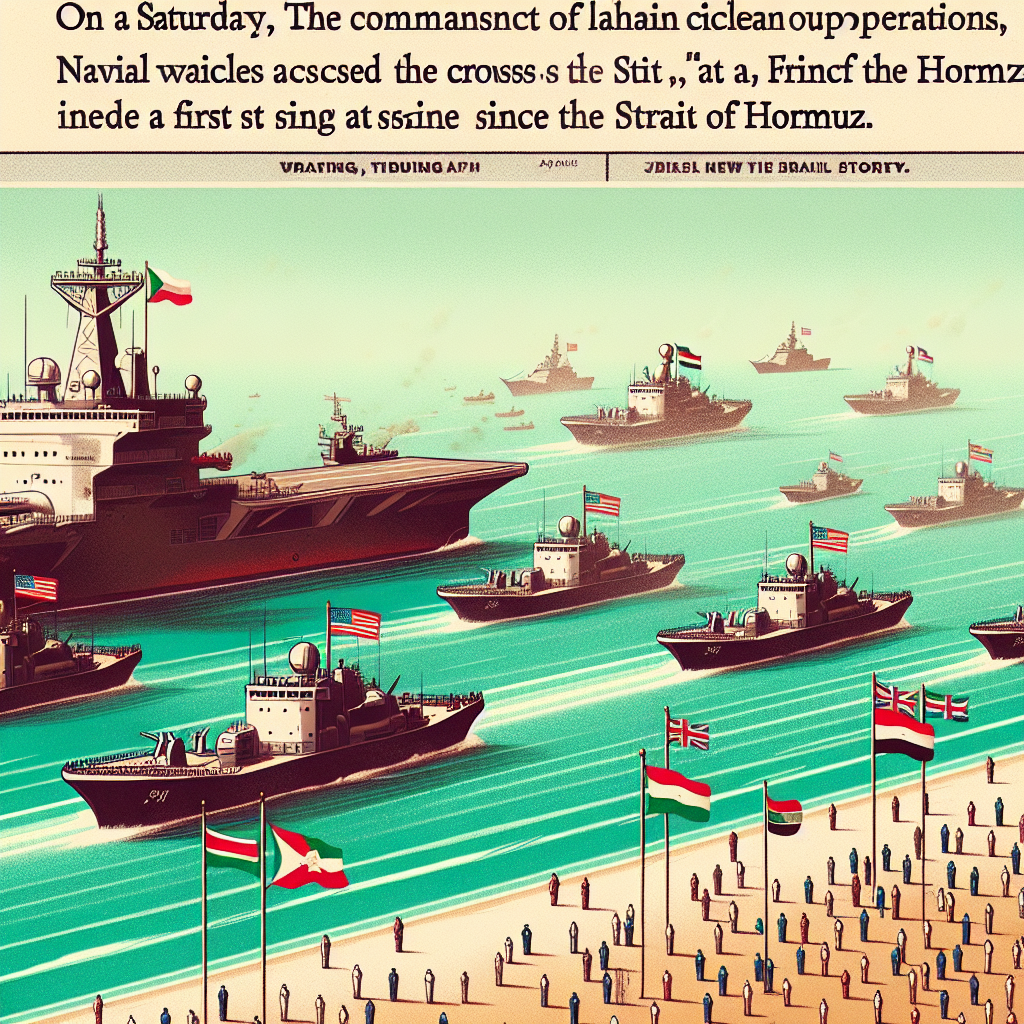
On Saturday (April 11th), US President Trump (Trump) announced the beginning of the cleanup of the Hormuz Strait. Reports in the media stated that several US Navy ships crossed the Hormuz Strait on Saturday, marking the first time since the start of the conflict.
President Trump posted on the social media platform Truth Social saying, “We are now starting the cleanup of the Hormuz Strait to assist countries including China, Japan, South Korea, France, Germany, and others.”
Trump continues to insist that countries should take action on their own to address the issues of restrictions in the Hormuz Strait. The President wrote, “It is incredible that they have neither the courage nor the willingness to do this work themselves. However, it is very interesting that oil tankers from many countries are sailing to the United States to load oil.”
Trump also mentioned that the mainstream media likes to claim that Iran is “winning,” but in reality, Iran is facing continuous defeats and in a very dire situation.
He wrote, “Their navy is gone, air force is gone, air defense systems are nonexistent, radars are also down, missile and drone factories along with the missiles and drones themselves have been completely destroyed, and most importantly, their long-time ‘leaders’ are no longer in this world… Their only recourse is to threaten that ships may ‘hit’ the mines they laid, and by the way, all their 28 mine-laying boats have sunk to the bottom of the sea.”
According to Axios, a US official revealed that several US Navy ships crossed the Hormuz Strait on Saturday, entering the Arabian Sea from east to west before returning to the Persian Gulf.
Sources said that this action aims to boost confidence for commercial ships passing through the Hormuz Strait. The US official stated, “This is an operation aimed at maintaining freedom of navigation in international waters.”
The report mentioned that the US did not coordinate this move with Iran, and this was the first time such an incident occurred since the start of the conflict.
As per reports by Iranian state media, the Iranian government claimed that the passage of US military ships violated the ceasefire agreement and threatened to attack these vessels.
The Hormuz Strait is a critical channel for around 20% of global oil transportation, which has essentially been closed off due to Iran’s retaliation. As of Friday, approximately 3200 ships, including 800 oil tankers and cargo ships, were backed up on the western side of the Hormuz Strait.
The US and Iran agreed on a temporary ceasefire for two weeks on Tuesday (7th), increasing the likelihood of stranded ships leaving the area. However, the vast majority of ships are still hesitant to move without ensuring complete safety.
Reports on Saturday morning indicated that at least three super oil tankers had passed through the strait. However, this is just a preliminary sign of passage, and there is still a long way to go for normalcy to be restored.
On Saturday, both the US and Iran initiated face-to-face negotiations in Islamabad, Pakistan, mediated by Pakistan. This meeting itself holds historical significance as the highest-level contact between US and Iranian officials since 1979. However, there are not high expectations from the external world. Even though both sides understand that a failed negotiation could lead to another outbreak of conflict, their visions for peace currently remain starkly different.