
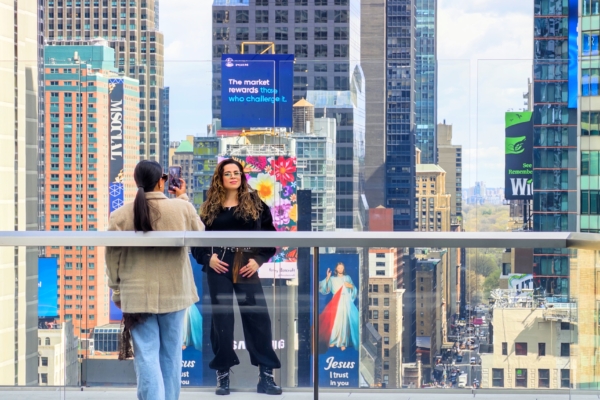
One Times Square, a landmark in Times Square, launched an upgraded “Times Square Skywalk” viewing experience on April 7th. For the first time, the core historical installation of the New Year’s Eve crystal ball drop is now a permanent exhibition, signaling a transformation of the building from a traditional advertising landmark to an experience-driven tourism asset, aiming to extend the annual New Year’s celebration into year-round tourist activities.
The new experience is located on the 19th floor, accessible by a glass elevator, providing a 360-degree panoramic viewing platform and a glass walkway for visitors to overlook Times Square from high above. The view spans across the Manhattan streets between the Hudson River and the East River, offering a glimpse of the “Manhattanhenge” phenomenon during the summer.
Delfin Ortiz, the general manager of One Times Square, expressed in an interview that the design of this new attraction aims to combine visual experiences with cultural memories. “We hope to remind people of the significance of New Year’s culture while also offering a fresh perspective on Times Square. I believe these two aspects can coexist.”
He pointed out that most audiences have been watching the New Year’s countdown on TV for years, and being able to experience this symbolic ritual up close holds emotional value for visitors. “Everyone has grown up watching the ball drop on New Year’s Eve. Now, being able to witness it up close is a truly special experience.”
The tradition of the New Year’s Eve ball drop started in 1907, and except for a brief interruption during World War II, it has continued for over a century. The current crystal ball is made of Waterford crystal and has evolved into a high-tech lighting installation.
One of the major highlights of this upgrade is the transformation of the New Year’s core installations into permanent displays, including: (1) Centennial Ball: created in 2007 to commemorate the hundredth anniversary of the New Year’s celebration, first featuring LED technology; (2) New Year’s digital and countdown stages: the core visual elements of the annual New Year’s Eve celebration; (3) Confetti Wishing Wall: where visitors can write their wishes to be released during the next year’s New Year’s event.
Ortiz mentioned that showcasing the different generations of crystal balls aims to demonstrate how technology and culture have evolved in harmony. “We want people to see how this tradition has changed with technological advancements, from the early structures to the current scale and technology, it has been an evolutionary process.”
In addition to cultural elements, the experience also emphasizes a shift in viewing perspective. Ortiz emphasized, “We are used to looking at Times Square from the street, but when you step onto the Skywalk and overlook the entire square through glass walls, even seeing from the Hudson River to the East River, it gives you a completely different understanding of Times Square.” This shift from a bottom-up tourism model to a top-down “urban narrative perspective” is a key design element of this experience.
With international events and tourism revival boosting foot traffic, Times Square, as a global tourist hub, continues to increase its commercial value. Operators hope to extend visitor stay times through the viewing experience.
The Times Square Skywalk viewing experience officially opened to the public on noon of April 7th, with tickets priced at around $30, and offering discount packages for New York City residents. [Link to more information](https://onetimessquare.com/)