
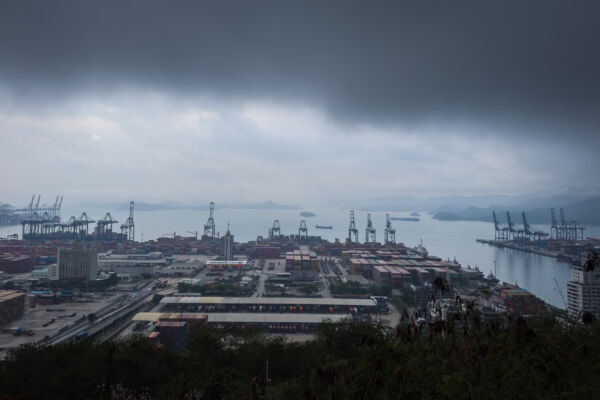
【Epoch Times March 22, 2026】The Pearl River Delta in China, once known as the “heart of global manufacturing”, now sees deserted streets, factories coming to a halt, and workers losing their jobs. Official data also shows a sharp decline in real estate investment, with manufacturing PMI falling below the boom-bust line and a high youth unemployment rate. Insiders within the system point out that the fundamental cause of this situation is the systematic suppression of the private economy, and the collapse of consumer confidence is making it difficult for any stimulus policies to be effective.
Dongguan, the third largest city in Guangdong after Guangzhou and Shenzhen, was renowned nationwide for its dense manufacturing industry and bustling migrant worker population. In the evening after work hours, the streets used to be bustling with people, motorcycles, and pedestrians crowding the surrounding restaurant streets and markets.
However, this scene is now a thing of the past.
Han Chengrui (pseudonym), a long-time resident of Guangzhou, told Epoch Times reporters that when he revisited Dongguan in the spring of 2025 at 5 pm – usually peak hours after work – he saw deserted streets, trucks parked on the side of the road without drivers, and many stores closed.
“There were hardly any people on the streets, and the stores and factories were empty and deserted,” he said.
This stark contrast to his memories of the city over the past decade left a deep impression on him: “The factories have closed down, the workers have left, the hotels, shops have no customers, can’t make money, and these restaurant and retail business owners have also left.”
Yang Jiancheng (pseudonym), who works in the building materials and decoration industry in Guangzhou, also shares a similar feeling. He told Epoch Times that at the end of last year, many neighbors near his residence moved out, saying, “Many people have moved out, the houses are all empty.” Former colleagues who returned to their hometowns also reported that their hometowns were similarly devoid of people.
“I feel that the whole society now is shrouded in a very gloomy atmosphere,” he said.
Official data also indicates that the Chinese economy is slowing down. Data released by the National Bureau of Statistics of China on March 16 showed that from January to February this year, national real estate development investment declined by 11.1% year-on-year, the newly started construction area dropped significantly by 23.1%, and the sales of new commercial buildings saw a 20.2% year-on-year decline, with residential sales plummeting by 21.8%.
The situation is even more severe: in 2021, the national sales of commercial buildings reached about 18 trillion yuan, but by 2025, it had plummeted to about 8 trillion yuan, nearly halving in size.
The manufacturing industry is also facing an urgent crisis. The Manufacturing Purchasing Managers’ Index (PMI) released by the National Bureau of Statistics on March 4 for February was 49.0%, down 0.3 percentage points from the previous month, falling below the boom-bust line of 50% that represents expansion and contraction; the non-manufacturing business activity index and the comprehensive PMI also declined simultaneously.
Facing downward pressure, Chinese Premier Li Keqiang lowered the GDP growth target for 2026 to 4.5% to 5% in the government work report on March 5. The Wall Street Journal reported that this is the lowest specific growth target set by China since 1991.
Behind macroeconomic data are the real struggles of countless ordinary workers.
Yang Jiancheng had noticed abnormalities while working in a factory in Shenzhen: “Many factories no longer require overtime work, and there are few factories operating on Saturdays and Sundays because they cannot afford to keep the employees. It has reached this point.” He chose to resign in April last year and struggled to find stable work for several months thereafter.
He planned to work as a temporary laborer to earn some money for the Chinese New Year at the end of the year, but found that the labor market had shrunk significantly. “It was easy to find temporary work in previous years, with job advertisements everywhere online, but last year, very few factories were hiring.” He ended up only working for five or six days, as by mid-December, the companies stopped taking orders completely.
As a skilled worker, Yang Jiancheng’s income was relatively high among workers, but he admitted, “Earning seven to eight thousand or five to six thousand yuan a month is already very low for us,” and colleagues with family responsibilities “couldn’t make ends meet and couldn’t continue.”
In line with these individual struggles are the broader labor market data. According to CNBC’s analysis, one of the major reasons for the weak consumption in China is inadequate income growth. A survey showed that among 16 industries, only mining, public utilities, and information technology IT service industries had wage growth outpacing GDP; the labor market has contracted across the board, with youth unemployment remaining high, and more than half of those surveyed believing that the job market has become more difficult.
It’s not just workers leaving, but businesses are also fleeing.
Han Chengrui told reporters that a large number of manufacturing companies have successively relocated their production lines to Vietnam, India, and other Southeast Asian countries. This migration is not an overnight change but the inevitable result of years of accumulation.
In his view, the root cause lies in the loss of policy trust. He observed a recurring pattern: when private enterprises face difficulties or funding shortages, the authorities introduce preferential measures to attract investment and encourage factory construction; however, once the companies stabilize and expand, they are often met with suppression and restrictions.
“When you need money, you entice private entrepreneurs to invest and build factories; once they start, you suppress them, which leads to a loss of trust with the business owners.”
He believes that the withdrawal of funds by prominent businessmen, including Li Ka-shing, in the early years is an early recognition of this risk: “They had already sensed it long ago and slowly moved their businesses to other countries.”
Official credit data confirms this economic contraction: in 2025, new bank loans in China fell to 16.27 trillion yuan, reaching a seven-year low; People’s Bank of China data showed that in January this year, new loans were 4.71 trillion yuan, lower than analysts’ expectations and last year’s 5.13 trillion yuan during the same period.
Han Chengrui pointed to a deeper structural contradiction.
He stated that private economy occupies around 30% to 40% of resources and capital but contributes 50% to 60% of tax revenue and economic benefits; whereas, the highly profitable core industries that dominate are almost all controlled by state-owned enterprises.
“All the backbone, resource-rich, and highly profitable industries are monopolized by state-owned enterprises.”
He described a long-standing paradox: wherever state-owned enterprises enter, they tend to continually operate at a loss; wherever private enterprises take over, they often revitalize and increase efficiency. However, as the private economy continues to grow, instead of policy support, tangible and intangible suppression follows.
Han Chengrui believes that there is a political rationale behind this: “When private enterprises develop and strengthen economically, they will speak up for their political interests. The authorities are wary of this, hence restricting and suppressing private enterprises.”
The cost of this suppression has now manifested in the desolation of Dongguan’s streets, the quietness of Guangzhou’s building materials market, and the plight of countless ordinary workers who can’t find employment. “If you suppress private enterprises like this, can the economic situation in this society be good?” he said.
Between the macro and micro aspects, there is also a psychological chasm that is difficult to bridge – the collapse of consumer confidence.
The People’s Bank of China survey showed that in 2025, nearly two-thirds of households tended towards saving rather than consumption or investment. The South China Morning Post in Hong Kong cited data from the Beijing think tank “National Financial and Development Laboratory,” indicating that the annual growth rate of household debt in 2025 was only 0.5%, a historical low, and negative growth even occurred in the third and fourth quarters, the first time since 1995.
The effects of multiple rounds of economic stimulus policies are clearly diminishing. The aftermath of the government’s 300 billion yuan “trade-in for new” consumer subsidy program was lackluster, with national retail sales only increasing by 3.7% in 2025, significantly lower than the 5% GDP growth rate.
Yang Jiancheng voiced the sentiments of many ordinary workers: “What’s the point of earning money these days? Even if you earn a lot of money, if you have a minor problem and need to go to the hospital for a check-up, it’ll cost hundreds or thousands, and you might not even find out what’s wrong. If you do find something, you can’t afford treatment.”
In stark contrast to this is the continued operation of Beijing’s propaganda machinery. The official Communist Party media “Qiushi Net” criticized reports about the “collapse theory” of the Chinese economy on March 16, highlighting that “confidence is more important than gold” and urging for the “singing of China’s bright economic theory.”
However, the emptiness on the streets of Dongguan and the grandeur on Qiushi Net create a contrasting picture that seems irreconcilable.