
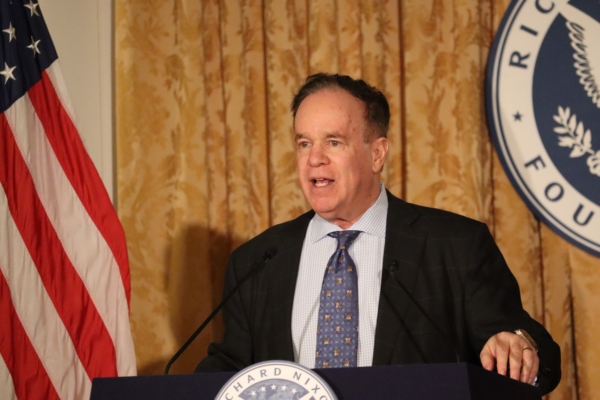
On March 17th, the new book “If There Is No God: The Battle Over Who Defines Good and Evil” was introduced at an event held at the Nixon Library. The author, Dennis Mark Prager, was unable to attend in person due to injuries, but his close friend presented the background of the book, emphasizing that it is not just the author’s personal monologue. Regardless of whether the readers believe in God, they can gain deep and persuasive insights from the arguments in the book.
The book was only listed on Amazon for less than a month before ranking second. Prager, a veteran conservative radio host and writer who was paralyzed from the shoulders down in a fall at home in November 2024, expressed gratitude that his cognitive and linguistic abilities remained intact and credited Joel Alperson for the publication of his new book. Alperson, the president of Omaha Fixture International, Inc., introduced the book titled “If There Is No God: The Battle Over Who Defines Good and Evil” to the readers in place of Prager.
Over 30 years ago, Alperson, as a consultant to a Jewish youth group, organized a weekend camping event with 74 participants from major cities in the American Midwest such as St. Louis, Kansas City, Omaha, Lincoln, and Des Moines. Prager’s presence at the camp sparked intense intellectual debates and verbal jousting on hot-button issues of the time, such as abortion, euthanasia, and the death penalty.
Alperson revealed that a post-camp survey showed about half of the youths were dissatisfied because Prager posed the question, “I know you hold beliefs and are passionate, but what consequences will you face if you insist on these views in society?” They were asked, “If you were walking your dog by a river and both your dog and a stranger were drowning, who would you save first?” The results, saving the dog, the stranger, and an undecided response each accounted for a third, later becoming a famous moral dilemma associated with Prager.
At the 30th anniversary, Alperson sent the records of that time to Prager and suggested he write a book. Prager, somewhat reluctantly, said, “Maybe.” Alperson mentioned they were collaborating on one volume of Prager’s “Rational Bible” series at the time. They were unexpectedly offered a generous publishing contract by Harper Collins, which Prager could not refuse.
For more than 10 months, the two have been compiling materials from the past while incorporating contemporary hot topics in the hospital. When asking professional nurses about the “save the dog or the stranger” dilemma, who dedicate their lives to caring for severely disabled patients facing significant challenges in the most personal and direct ways, the majority chose to save their dogs first.
This choice, as Alperson explains, is not about who to save but involves questions of values and emotions. He noted that if everyone opted to save the dog first, we would be in a world where “emotion” overrides “values.”
The introduction of the book on Amazon underscores a prevalent trend where people increasingly rely solely on their emotions for moral judgments, considering actions like murder, rape, and theft as matters based purely on personal perspectives. Prager argues that without objective moral standards, the world will descend into chaos, leading individuals to act solely based on what they believe is “right.”
When asked about believing in the Bible as the ultimate source of objective existence, Prager suggested living as if it were true, even if one has not reached unwavering faith. Alperson mentioned that many immigrants choose the United States or other nations founded on “Judeo-Christian values” as their homes, fostering a sense of community and belonging.
Alperson discussed the increase in depression, suicide rates, a decline in marriage and child-rearing, and the abandonment of churches, emphasizing the consequences of stripping away life’s most precious and beautiful elements, leading to unhappiness. He recalled youths being asked if they believed they had the right to say Hitler was wrong. Prager challenged one child’s response, highlighting the perils of remaining silent in the face of opposing beliefs or ideologies.
The book contains numerous debates on hot-button issues, acknowledging that it may not be suitable for those who do not believe in “reason” or “common sense.” Alperson stressed that the book does not offer absolute truth or the sole ultimate answer, but it is essential to have the ability to identify and refute those with drastically different viewpoints.
Reflecting on his friendship of over 40 years with Prager, Alperson expressed gratitude for being able to share these ideas with audiences, emphasizing the courage needed to confront others and express dissenting opinions, even when it may be uncomfortable.
In conclusion, the dialogue and thought-provoking discussions within the book serve as a reminder of the importance of critical thinking and the willingness to engage with differing perspectives in a world where moral judgments are increasingly swayed by individual emotions rather than objective standards.