
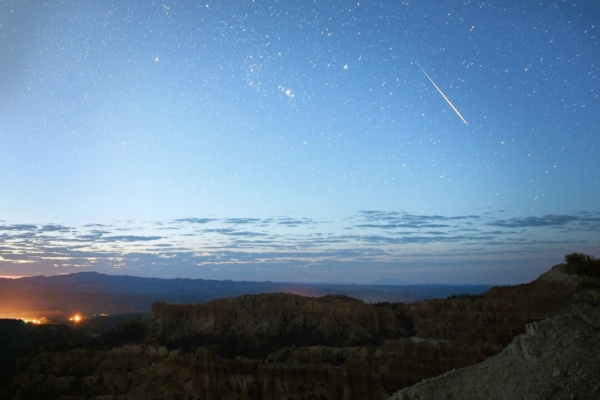
On March 17th, a bright fireball streaked across the sky over Cleveland, Ohio in the United States, traveling at a speed of 45,000 miles per hour. The fireball produced a deafening sonic boom upon disintegration, causing panic among local residents who initially mistook it for an explosion.
According to reports from the Associated Press, residents from several states reported sightings of the fireball around 9 a.m. The American Meteor Society received witness reports ranging from Wisconsin to Maryland.
NASA confirmed that this was a small asteroid, approximately 6 feet in diameter and weighing around 7 tons, that entered the Earth’s atmosphere and transformed into a meteor.
Executive director of the American Meteor Society and astronomer Carl Hergenrother stated, “This celestial body indeed appeared as a fireball, indicating that it originated from a small asteroid.” The society described it as a “fireball meteor” from a small asteroid, shining much brighter than typical re-entering artificial satellites.
Hergenrother mentioned the abundance of objects being launched into space, noting that while burning objects are often observed as satellites re-enter the atmosphere, they usually do not display such remarkable brightness.
Bill Cooke, director of NASA’s Meteoroid Environments Office in Huntsville, Alabama, stated that the meteor was initially detected about 50 miles above Lake Erie and disintegrated over Valley City after traversing more than 34 miles in the upper atmosphere.
The explosion upon disintegration released energy equivalent to about 250 tons of TNT, resulting in the loud boom heard by the National Weather Service staff in Cleveland, who also felt vibrations but received no reports of recovered fragments.
Meteorologist Brian Mitchell mentioned, “There might be some small fragments, but most likely they have burned up completely in the atmosphere.”
As per reports from WJW TV station, satellite images indicated that the meteor first disintegrated over Lake Erie but continued flying in a north-south direction, causing a second massive explosion over land. The shockwave from the explosion was reportedly detectable up to 600 miles away.
Cooke revealed that preliminary trajectory comparisons suggest the meteor likely originated from the asteroid belt situated approximately 200 million miles away between the orbits of Mars and Jupiter.
Expressing a wish for a meteorite to fall closer for potential fragment search, Cooke humorously anticipated a surge of meteorite hunters in Ohio in the near future.
Hergenrother mentioned that meteors usually fall once a day within the United States, while smaller space dust particles may fall up to 10 times per hour. Scientists track meteors through a network of specialized cameras capturing celestial events in the night sky, although more individuals are now using smartphones and monitoring cameras to photograph meteors.