
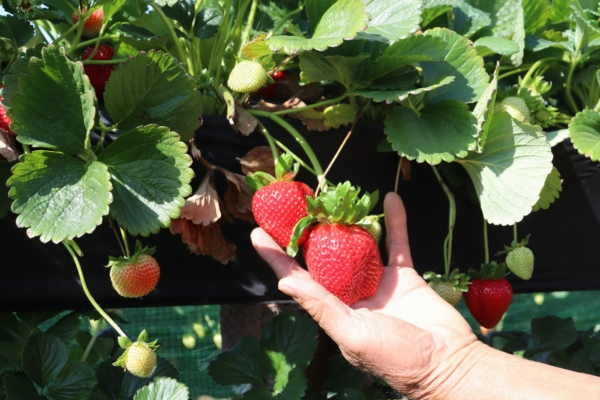
Over the past weekend (14th and 15th), Tanaka Farm in Irvine held its 86th annual “Spring Open House” event, allowing residents to pick fresh strawberries and organic vegetables, ride on wagons, purchase farm products, participate in raffles, and taste strawberry delicacies.
“We are no longer traditional farmers in the pure sense, now focusing on ‘agritourism’,” farm owner Glenn Tanaka told reporters. Every year, approximately 300 schools organize student visits, while weekend visitors are mostly families; with April and May being peak seasons.
After the winter season, strawberries are the earliest fruit to mature and hit the market at this farm, also being one of the main products for external supply. Tanaka mentioned that in California, there are around 20 varieties of commercial strawberry planting, with them cultivating three varieties.
“The unique thing about our farm is that we only pick strawberries when they turn completely red – when they are truly ripe, that’s when the flavor is the best, and that’s why people are keen on picking strawberries themselves,” Tanaka said. “Stored strawberries lose their flavor and even rot and deteriorate; the longer they are stored, the more they lose their freshness and vitality.”
March is cooler in California; picked strawberries can be stored for two to three days. By the time May arrives with hot weather, they can only be kept for a day. Tanaka explained, “People usually pick strawberries when they are half red or 3/4 red, then they are transported to supermarkets… although strawberries continue to turn red or fully red during the process, they do not reach the best taste of full ripeness.”
He emphasized that while strawberry variety is important, the picking time is key to the flavor. The strawberries at this farm are not grown on the ground but at waist-high or shoulder-high positions for easy picking.
When do they plant and harvest strawberries? Tanaka said, “We usually plant in October and have the first harvest in January of the next year. Strawberries like cooler weather and continue to fruit, so they can be picked until early June when the weather gets hot.”
Over four thousand people visited the farm during the weekend open house. Resident Yasim and his family were seen holding strawberries and vegetables. They have been attending the “open house” every year for the past three years. Yasim said, “It feels great! You can pick your own.”
During weekdays, the farm mainly hosts preschools, kindergartens, and elementary school students, with parents accompanying them. Tanaka stated, “Kids are excited to see a real farm; like pulling out carrots, you see the green leaves, and then pull out the orange carrot, the feeling is different.”
Tanaka is a third-generation farmer in the family. At its peak, the farm had 300 acres and distributed agricultural products throughout the U.S.; but due to urban land reclamation and farm sales, they now only retain 30 acres, which is being handed over to his son.
Strawberry cultivation holds a significant position in the Japanese American community. In the early 20th century, a large number of Japanese immigrants flooded into the U.S., many coming from rural areas, with about half of Japanese Americans engaged in farming at that time. Before World War II, around 90% of strawberries in California came from Japanese American plantations.
Today, there are very few Japanese Americans engaged in strawberry cultivation. Tanaka mentioned that during World War II, the U.S. government interned 120,000 Japanese Americans, leading to about 7,000 farms being abandoned; after the war, only 30% of Japanese Americans returned to farming, and 2,000 farms resumed operation.
Apart from the spring “Strawberry Picking Tour,” Tanaka Farm’s tour programs also include the summer “Watermelon Picking Tour,” the fall “Pumpkin Picking Tour,” and the “Christmas Light Show” with hundreds of thousands of lights. The pumpkin festival is the grandest celebration of the year at the farm, “We grow edible pumpkins, not just for decoration,” Tanaka emphasized.