
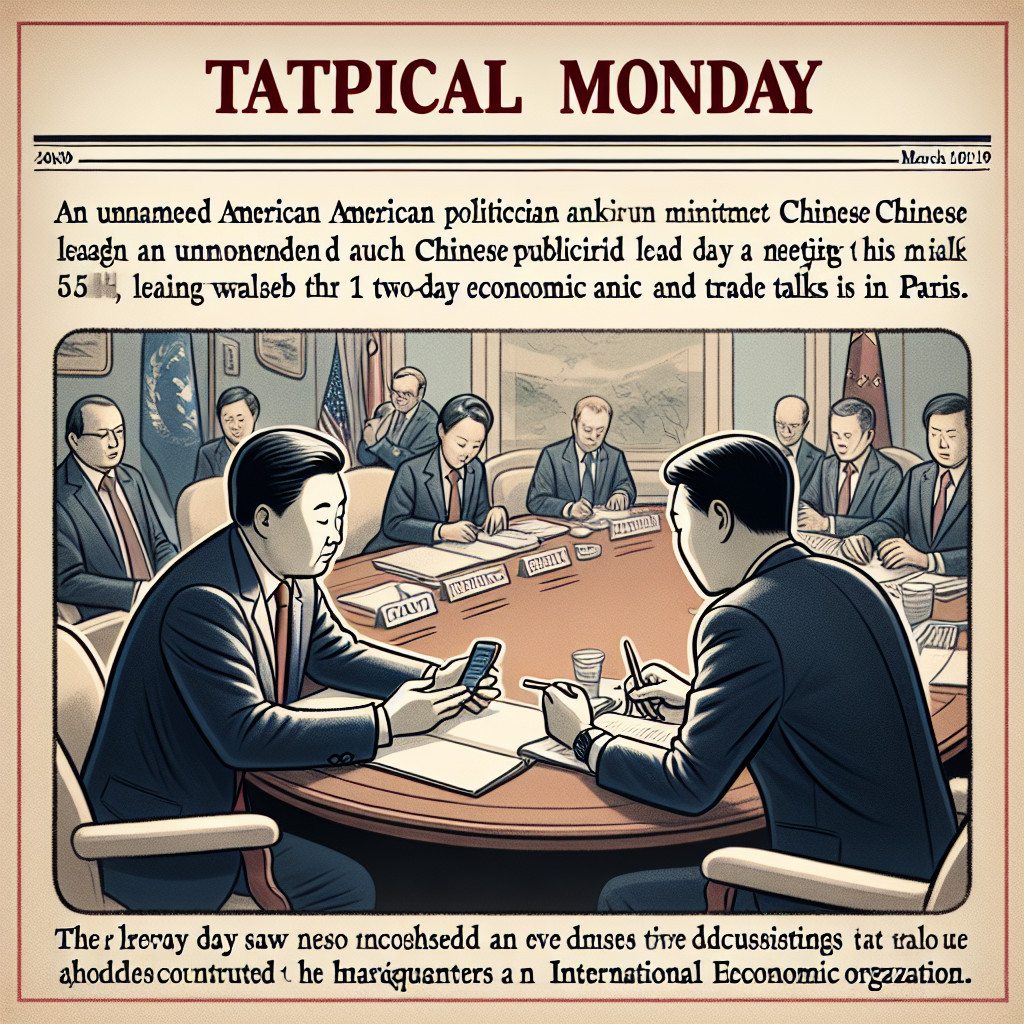
On Monday, March 16th, US Secretary of the Treasury Benson and Chinese Vice Premier He Lifeng led their respective teams to conclude a two-day economic and trade talks in Paris. The day before, the two sides had engaged in discussions for over six hours at the headquarters of the Organization for Economic Cooperation and Development (OECD) in Paris.
Following the meeting between US Treasury Secretary Benson and US Trade Representative Greer with Chinese Vice Premier He Lifeng and Chinese international trade negotiation representative Li Chenggang, they made statements to the media.
Benson stated that the talks were “constructive.”
The Paris meeting aimed to prepare for US President Trump’s visit to China and his meeting with Chinese President Xi Jinping, looking ahead to potential agreements that the two sides might reach.
Greer noted that the talks actually laid out a rough framework for a work plan from now until the meeting of the two leaders, with the goal of achieving some potential outcomes during the Trump-Xi meeting.
“We also discussed the implementation of the ‘Busan Agreement,’ including issues related to rare earths. We occasionally receive information on rare earth supply from US companies or relevant parties, so we also discussed such issues related to the agreement,” Greer said.
“In addition, we also discussed expanding trade, including exports of agricultural and energy products to China,” Greer added.
The US Trade Representative also stated that the two sides discussed establishing a potential mechanism, the US-China “Board of Trade.”
A source told Reuters that the goal of the “Board of Trade” is to find products and industries that can achieve balanced growth in trade without jeopardizing the national security or critical supply chains of each other’s countries.
Chinese international trade negotiation representative Li Chenggang told the media that the US had informed China of its latest adjustments to tariff measures and considerations for the next steps.
He also said that both sides agreed to work together to maintain the stability of bilateral tariff levels. They also discussed the idea of “establishing a mechanism to promote bilateral trade and investment cooperation.”
Li Chenggang stated that China opposes the US-initiated Section 301 investigations and expressed concerns about the potential consequences of these investigations and the damage they may cause to the stability of China-US economic and trade relations.
“Through this meeting, the two sides have reached preliminary consensus on some issues. Moving forward, we will continue negotiations,” he said.