
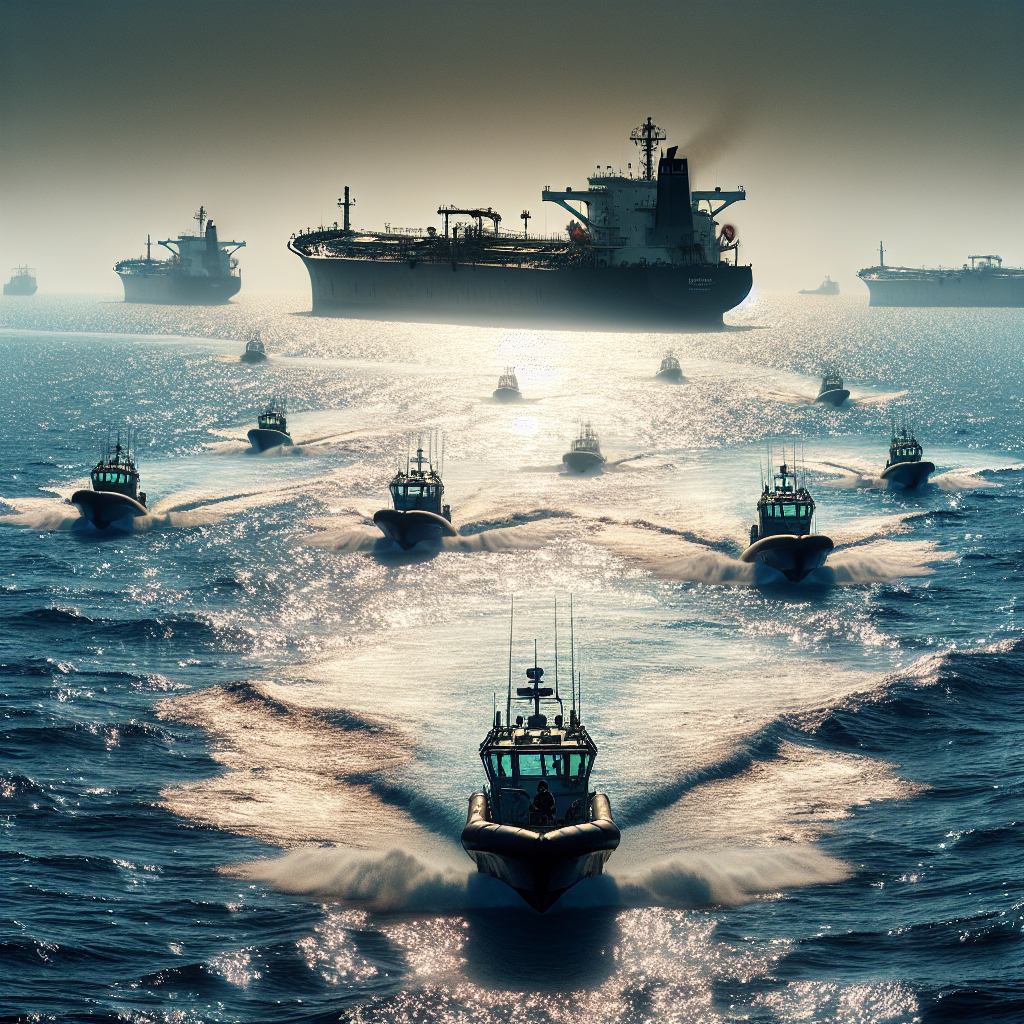
The conflict in Iran continues to escalate, with a new type of threat emerging in the form of “suicide unmanned boats” beginning to attack oil tankers in the Persian Gulf. Combined with the substantial blockade of the Strait of Hormuz, this situation is having a serious impact on global energy supply and economic security.
According to reports from Reuters, at least two attacks on oil tankers using unmanned boats loaded with explosives, known as Sea Drones, have been confirmed since the outbreak of the war. This tactic is quickly becoming a new threat in this strategic waterway.
Currently, the Strait of Hormuz, through which one-fifth of the world’s oil and natural gas transportation passes, remains impassable and effectively blocked.
Maritime security expert Robert Peters told Reuters that the destructive power of suicide unmanned boats on the sea should not be underestimated. The amount of explosives they carry far exceeds that of aerial drones and can even be compared to ballistic missiles. If they hit the right areas, they can directly disable commercial ships.
“If your ship loses power, and the other party intends to launch further attacks, you will be in an extremely vulnerable state,” he said.
Due to the blockade of the strait and attacks on commercial ships, international oil prices have experienced significant fluctuations. According to the latest data, Brent crude oil prices have surpassed the $100 per barrel mark, soaring to $120 at one point. The price of West Texas Intermediate crude oil has also risen by about 8%, hovering between $94 and $95 per barrel.
To stabilize the energy market, the International Energy Agency (IEA) has agreed to release the largest-ever 400 million barrels of emergency oil reserves.
U.S. Energy Secretary Chris Wright also announced that the U.S. will start releasing 172 million barrels from the emergency reserves next week, with the plan to complete the deployment within 120 days. President Trump stated that the government will release reserves slightly to stabilize prices and will replenish them later.
In terms of the military situation, the conflict has spread to neighboring countries’ infrastructure.
Iran recently launched drone or missile attacks on the world’s busiest Dubai International Airport, fuel tanks near Bahrain Airport, and Iraq’s Port of Basra, trying to force the U.S. and Israel to cease hostilities through “economic pain”.
Iran has declared that the world should be prepared for oil prices to reach $200 per barrel.
In the attacks on Basra port, two foreign oil tankers were attacked by Iranian naval drones, causing explosions resulting in at least one fatality and forcing the country to close all oil terminals.
Oman has taken preventive measures, demanding ships to evacuate critical oil export terminals.
In the face of worsening situation, the UN Security Council passed a resolution on Wednesday with a 13-0 vote, demanding Iran to immediately cease attacks on neighboring countries, with China and Russia abstaining.
However, ceasefire negotiations have made no progress. Russia’s Ambassador to the UN, Vassily Nebenzia, stated that while Iran has expressed willingness to negotiate, currently “there are no negotiations taking place”.
Meanwhile, the U.S. and Israel continue to exert pressure on targets within Iran. President Trump claimed on Wednesday that the U.S. has “won” the war and pointed out that Tehran “had no idea this was going to happen”.
The Israeli Defense Forces also announced a “large-scale aerial assault” on Tehran and simultaneous strikes on Hezbollah targets within Lebanon.
The U.S. military has already destroyed almost all of Iran’s navy and air force, rendering it without air defense and radar detection capabilities. Thousands of Iranian missiles were destroyed before launch, and 16 naval vessels attempting to block the passage were sunk by the U.S. military.
According to Pentagon data, the cost of war in the first week amounted to $11.3 billion, with ammunition expenditure alone reaching $5 billion over the first weekend, showcasing a high level of firepower deployment.
The U.S. emphasizes that they have inflicted the heaviest blow in history on Iran and are evaluating providing security for oil tankers passing through the Strait of Hormuz.