
During the 2026 National People’s Congress held by the Chinese Communist Party, local governments had already initiated the “zero petition” policy. When key personnel for stability maintenance arrived in Beijing, their movements were accurately tracked. Villages for petitioners on the outskirts of Beijing were cleared out, petitioners from various regions were forcibly sent back, detained, or sent to secret prisons with violence. Some petitioners even experienced mental health issues due to the intense stability maintenance during the National People’s Congress, making their situation increasingly challenging!
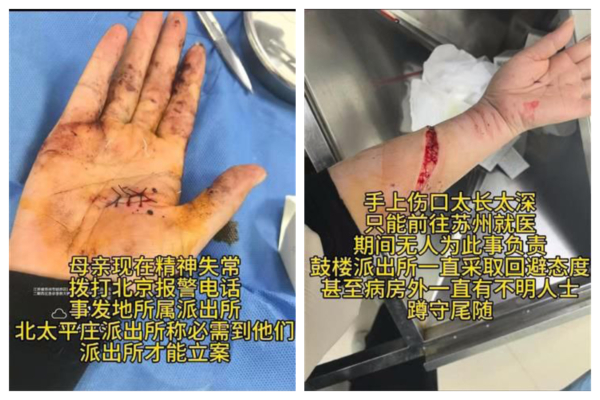
Recently, petitioner Zhang Ping from Taixing, Jiangsu, became mentally unstable after being violently assaulted by stability maintenance personnel in Beijing. Her husband, petitioner Hou Zhiqiang from Taixing, arrived in Beijing on March 8 because the police in Suzhou refused to file a case, forcing him to report the incident in Beijing. Upon his arrival at Beijing South Railway Station on the afternoon of March 8, Hou Zhiqiang was followed by a group of unidentified individuals and lost contact.
Hou Zhiqiang’s daughter posted a distress call online, stating that her mother, Zhang Ping, had gone to Jishuitan in Beijing to have her leg injury checked. On February 28, she was taken from her residence at Room 301, Unit 5, Building 27 in Jiaomen Dongli by police from Yangqiao Police Station in Fengtai District, Beijing, and went missing. After petitioner friends actively reported to the police, Taixing government sent Zhang Ping to seek medical treatment near Jishuitan Hospital on the same night.
Around 3 p.m. on March 4, Zhang Ping was forcibly broken into at her rental place by a group claiming to be Beijing police officers, and she went missing once again. On March 5, Zhang Ping, covered in blood with multiple wounds on her arms, including a 12 cm long wound left unattended, showed up at the Gulo Police Station in Taixing in a mentally deranged state. She was sent to Taixing Hospital by 120 emergency services, but due to the length of the wounds and prolonged exposure, the hospital refused to suture the wounds and she was later transferred to Suzhou Guangji Hospital.
Hou Zhiqiang’s daughter pleaded with fellow petitioners to help call the Beijing police hotline to try to locate her father’s whereabouts.
Chongqing petitioner Wei Wenyuan was sentenced to four years in prison for inciting trouble during a petition, and after being released on December 3, 2025, he arrived in Beijing to work and continue petitioning. Due to stability maintenance during the National People’s Congress, he was forcibly taken to a rural farmhouse in Chongqing where seven black security guards were stationed to watch him 24/7.
Wei Wenyuan was dragged into a small room near the entrance of the National Petition Bureau by stability maintenance personnel during his second visit to the bureau during the National People’s Congress. On March 4, together with Chongqing petitioner Zou Maoshu, they were detained in the small room and later released. On March 6, while queuing at the National Petition Bureau again, he was taken away by local stability maintenance personnel and brought back to Chongqing where he was locked up in a secret prison.
On March 9, while in the secret prison, he obtained the phone number of the National Petition Bureau through the Beijing 12345 hotline (01068015310) and tried to report the illegal kidnapping incident. He called the bureau for two consecutive days, but either the line was busy or no one answered.
On March 6, Fujian petitioner Chen Guangang bought a train ticket to Beijing online. Local government stability maintenance personnel called him to inquire, and he was forced to cancel his ticket.
Chongqing petitioner Jiang Xunlan was attacked and severely injured in the eye, causing bleeding by a group of unidentified individuals at the You Supermarket in Fangshan on the evening of March 5. He was held in a nearby small pavilion. Fortunately, passersby helped to call the police.
When the police arrived, they asked if he wanted to go to Jiujing Zhuang or to the Beijing Office. He chose Jiujing Zhuang, but the Beijing Office disagreed. Later that night, he was deceived by the Beijing office, and after being detained for three days, he was returned to his local area for medical treatment. By then, his eye was severely swollen, and upon examination, doctors found a serious injury to his eyeball, suggesting hospitalization, but due to financial constraints, he had to return home.
Around 7 a.m. on March 4, Fujian petitioner Deng Zhichun was barred from entering the National Petition Bureau by Wang Jian, a police officer from Xiannong Tan Police Station in Beijing, and was handed over to black security guards, after which all contact was lost. Deng Zhichun’s wife urgently requested assistance from the public to report the incident.
On March 4, Gansu petitioner “Liangmin” endured the wind and snow while queuing outside the National Petition Bureau for two days. Finally reaching the first security checkpoint, the guards confiscated his identification card and detained him in the small building at the gate.
He stated, “The guards and police at the Petition Bureau treat us like criminals. If we don’t obey, they resort to violence. The corrupt officials from Chengxian in Gansu drove into the National Petition Bureau and forcibly took me away. How much money do local governments need to spend to manipulate the guards and police at the National Petition Bureau? It’s terrifying!”
Netizen “Xinxiangshicheng” commented, “During the National People’s Congress, governments across the country are frantically intercepting petitioners. Once a ticket is purchased, relevant information is transmitted to the local authorities within 2 minutes; high-speed rail stations and airports implement facial recognition matched with mobile positioning, triggering automatic alarms within 10 seconds; coordination between 32 inspection stations in the six surrounding provinces and municipalities around Beijing ensures that key individuals entering Beijing are accurately located. Local governments would rather spend huge amounts on maintaining interception teams and constructing secret prisons than resolving the issues of a single petitioner.”