
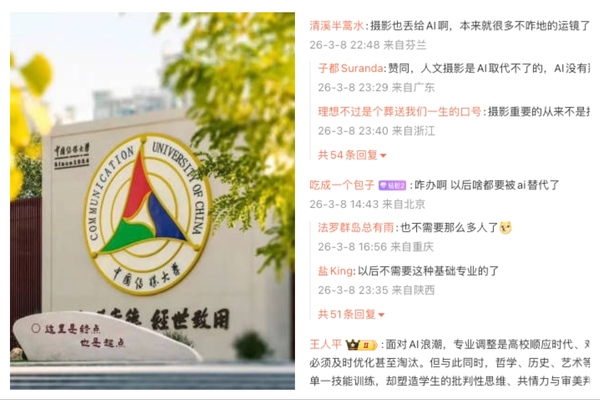
Recently, the Party Secretary of the Communication University of China stated that due to the impact of AI, the university has decided to eliminate 16 undergraduate majors and directions, sparking attention online.
During the National People’s Congress and the Chinese People’s Political Consultative Conference (CPPCC), Liao Xiangzhong, a member of the CPPCC National Committee and the Party Secretary of the Communication University of China, announced that majors such as translation and photography have been cut. He emphasized the upcoming era of “human-machine division of labor,” highlighting the imminent need for educational reform. He mentioned that classroom teaching needs thorough restructuring, with teachers needing to clarify their role within the entire knowledge system, leaving the rest to AI.
This statement quickly sparked public attention and debate.
Netizens expressed their views, with some stating, “Collaboration between humans and machines is essential, humans are the subject, without learning anything, how can AI be effectively utilized? Moreover, photography is an art form that embodies human emotions and thoughts. Handing it over to AI would strip away its artistic essence.”
“Translation is not merely about execution but also creation. Great translators engage in creative work, their contributions are significant, on par with the original authors. Who would enjoy reading translations that are purely AI-generated?”
“The top media institution in the country embracing AI by giving up and retreating is surprising. Photography, as an independent art form and means of documentation, fundamentally differs from AI generation. Especially in capturing critical historical events like war conflicts, real moments, and documenting images that carry humanistic concerns, photographers need to be present on-site to feel, perceive, witness, and convey, something that AI can never replace. It is unimaginable that a prestigious institution representing professional standards and excellence would implement such a rash approach, entrusting years of accumulated professional practice and professional dignity entirely to AI, abandoning cognitive orientations for thinking and judgment. It seems absurd.”
Renowned parenting blogger Wang Renping posted on social media, stating, “Facing the wave of AI, professional adjustments are an inevitable choice for universities to adapt to the times and align with industries. Professions that cannot adapt must be optimized or even eliminated promptly. However, at the same time, seemingly ‘useless’ humanistic majors like philosophy, history, and art, while not focusing on singular skill training, shape students’ critical thinking, empathy, and aesthetic judgment. These are the core human abilities that AI cannot replace in the short term and should be valued and preserved.”