
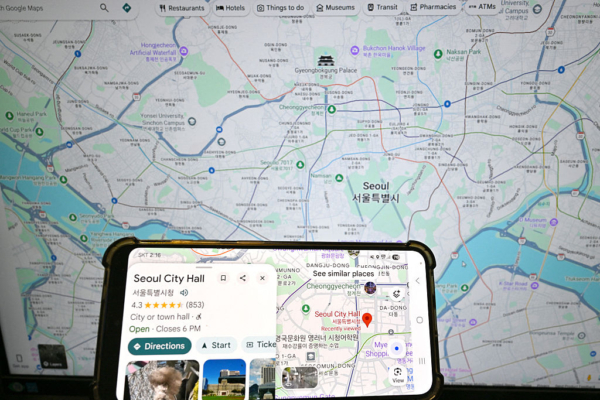
On Friday (27th), the South Korean government lifted a nearly twenty-year ban and approved the export of high-precision map data to overseas servers. This means that Google Maps could now provide full navigation functions in Korea, but sensitive information such as military facilities will still be blurred or not displayed.
According to Reuters, the South Korean government approved the project on the condition that it “must meet strict security requirements.”
The Ministry of Land, Infrastructure and Transport said in a statement that these requirements include blurring military facilities and other sensitive security installations, and restricting the display of latitude and longitude coordinates of South Korean territory in products like Google Maps and Google Earth.
This decision is expected to impact South Korea’s domestic internet giants Naver and Kakao, which currently dominate the digital map services market in South Korea. However, this move is seen as good news for Washington as the U.S. government had previously urged South Korea to address discrimination against American tech companies.
Google Vice President Cris Turner said in a statement, “We welcome today’s decision and look forward to continuing to collaborate with the local government to provide Korean users with fully functional Google Maps services.”
Considering that technically South Korea and North Korea are still in a state of war, the South Korean government had previously rejected Google’s request to export precise map data in 2007 and 2016 citing the risks of leaking information on military-sensitive facilities.
In fact, South Korea did not completely ban Google Maps services. Google Maps is only heavily restricted or entirely unavailable in a few countries worldwide, including mainland China, North Korea, Syria, and Vietnam.
The controversial data is the 1:5000 scale map data, where 1 centimeter on the map corresponds to a 50-meter distance in reality. Google stated that exporting this data is necessary to provide global real-time navigation services, including meeting the demand of overseas users searching for destinations in South Korea.
Under the data export agreement, Google must process map data on local servers in South Korea and is only allowed to export navigation and route service-related data approved by the government beforehand.
At the same time, the South Korean government retains the right to request modifications to the map. Google must establish a security incident prevention mechanism to deal with emergencies.
Jinmu Choi, a geography professor at Kyung Hee University, expressed concerns about this decision potentially triggering worries about market control and national security.
He said, “Google can now enter the market, drastically reduce fees, thereby capturing market share. If Naver and Kakao are weakened or pushed out of the market, then Google will subsequently raise prices and form a monopoly. At that point, companies such as logistics companies relying on map services will become dependent on Google Maps. In the long term, even the government’s Geographic Information System (GIS) may ultimately rely on Google or Apple.”
Following the announcement of this decision, on Friday Naver’s stock price fell by 2.3%, while Kakao’s rose by 1.5%.