
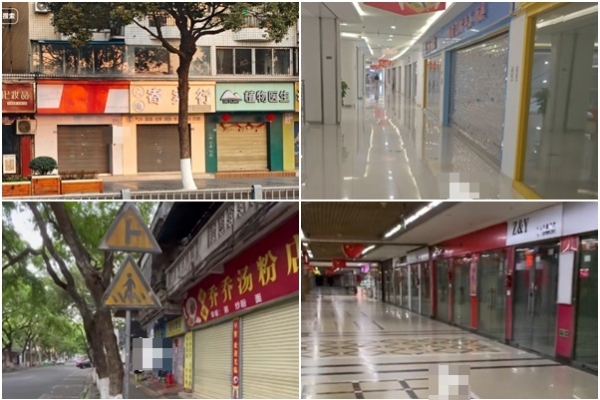
During the Chinese New Year period, which should be a peak time for businesses to make money, many areas in China this year appear less lively than usual. Numerous videos shared online by netizens show that many shops have closed down, there is a sparse crowd, and the traditional festive atmosphere of the Lunar New Year has noticeably weakened.
Before and after the Lunar New Year, many netizens have reported that the bustling scenes of people rushing to buy New Year goods in shops in previous years are no longer present. Wholesale markets have seen a decrease in customers, with numerous street shops closing down, leading to a fading festive spirit. Even during the peak evening hours when there used to be bright lights and bustling crowds in commercial streets, such scenes are now rare.
A resident of Wuhan, Ma Wen, living in a bustling commercial area, expressed to a media outlet that many shops have closed down this year, making the place unusually desolate. “The location of my house is very good, but many storefronts are empty, with no one doing business, and the properties cannot be rented out,” he said.
He mentioned that since the outbreak of the Wuhan pandemic, it has become increasingly difficult to earn money, with people’s incomes drastically decreasing. “Nowadays, it’s really hard to make money, everyone says it’s hard to earn. The government hasn’t solved any problems in these past few years, and they always say that they lack money.”
Similar situations have also emerged in coastal cities. Li Zhi, a resident of Qingdao, mentioned that he lives in a commercial area and due to the economic impact, most of the surrounding shops closed down last year. With people returning home for the Lunar New Year, even fewer new businesses opened before the holiday.
“In the past, physical stores used to stay open late, but now they are basically closed, and there aren’t as many people around,” he stated.
Not only is the festive atmosphere in communities lacking, but also the New Year celebrations organized by some street communities have noticeably decreased in scale. Many residents in various areas have noted that this year, the street decorations, New Year markets, and temple fairs are generally smaller in scale compared to previous years, resulting in a subdued festive ambiance.
Yang Ke, a resident of Xi’an, told a media outlet that his street and neighborhood have departed from the usual practice of hanging lanterns early this year, with no decorations at all. “This year, the conditions are indeed not favorable. In previous years, before the New Year, the streets were filled with lanterns of all colors, but this year, there’s nothing at all. I even asked them (the street office), why aren’t you hanging lanterns this year? They said, where would the money come from!”
In recent years, due to the continuous economic downturn, the growth rate of the total retail sales of consumer goods in Chinese society has been slowing down, evident by the increasing operational pressures on the catering, clothing, and small retail industries. The vacancy rates in core commercial areas of some cities have significantly risen, making the period before and after the Lunar New Year a rare “off-season” in recent years.
At the same time, with the public lacking confidence in income expectations, consumer spending has become more cautious, further affecting the business of physical stores.
Despite the authorities implementing a series of measures to boost consumption, including stimulus policies, interest rate cuts, consumer vouchers, trade-in programs, and relaxing consumer credit conditions, the effectiveness has been limited. In 2025, the national retail sales (a key indicator of consumption) only grew by 3.7%, lower than the 5% GDP growth rate.
(All interviewees are anonymized)