
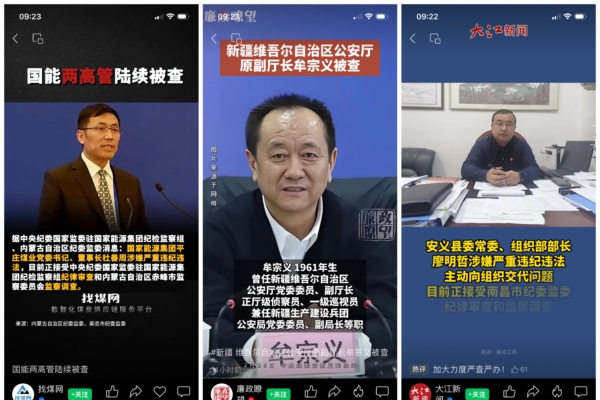
In the past two days, the Chinese Communist Party’s disciplinary system has unusually issued a series of notifications, with investigations launched into the financial regulatory system, central state-owned energy enterprises, public security system, and several local party and government officials. The scope of these notifications covers key departments such as the central financial regulatory authority, the national energy conglomerate, deputy mayors at the municipal level, directors of county-level organization departments, and former deputy directors of the autonomous region’s public security department, causing ripples across multiple power networks simultaneously.
According to Mr. Ye, a source familiar with the CCP’s disciplinary system, “In January and February this year alone, 7 officials at the ministerial level have been investigated, along with approximately 30 officials at the deputy ministerial level and below. Additionally, 9 military generals have been toppled. The frequency of these arrests is unprecedented. With high-ranking officials mostly captured now, the focus is shifting towards investigating events of the past 20 years, reaching down to county-level officials, department heads in state-owned enterprises, and even hospital directors and chief physicians.”
Mr. Ye believes that this current wave of crackdowns significantly differs from previous isolated anti-corruption efforts, transitioning into a systematic retrospective phase. Starting from ministerial-level officials and filtering down to grassroots departmental staff, the scope of investigations is progressively expanding.
On February 26, the Jiangsu Economic Daily revealed details of the case involving Liu Zhangjun, former director of the illegal fund-raising office of the former China Banking Regulatory Commission, spanning from 1998 to 2021. The notification disclosed that Liu Zhangjun committed 50 illegal criminal acts, involving an amount of 1.9 billion yuan. He exploited regulatory resources to facilitate the employment of several individuals within the banking system and charged fees ranging from hundreds of thousands to millions per person. Official reports further revealed that even after retirement, he continued to assist companies with loans and hiring personnel, accumulating bribes totaling 37.03 million yuan.
Ms. Fang, an insider in the financial regulatory system in Nanjing, informed reporters that relevant departments in Jiangsu are conducting a concentrated investigation into the assets of targeted individuals. “The Jiangsu Provincial Commission for Discipline Inspection and Supervision has established a special task force, led by the secretary, with the commission secretary directly responsible for the investigations. Officials’ financial situations, including bank deposits, real estate, and companies, stocks, and securities held directly or indirectly, are all within the scope of review. Even retired personnel will undergo secondary and tertiary investigations despite passing audits upon retirement. The financial systems in various provinces are required to cooperate.”
Simultaneously, the disciplinary inspection and supervision team stationed at the state-owned National Energy Group issued a notification suggesting that Du Shanzhou, the party secretary and chairman of Pingzhuang Coal Industry of the National Energy Group, is under investigation for serious violations of discipline and law. The CCP’s National Energy Group is a significant player in the state-owned energy sector, particularly in coal assets.
Zhao Youlin (pseudonym), a former researcher at the former Institute of Nonferrous Metals of the CCP, mentioned during an interview with reporters that corruption in the energy sector has long been prevalent and severe. He stated, “This industry is highly specialized, making it difficult for external interference. In the energy sector, projects are highly concentrated, with procurement, resource allocation, and project approvals all flowing within the internal system. Once an aspect is investigated, the entire network of relationships is uprooted. As the Communist Party is in dire need of funds now, they are looking to recover money to fill the national treasury.”
Currently, for the sake of consolidating their own power, the CCP’s crackdown on officials has expanded to include officials at the grassroots levels within the local party and government systems, leading to a surge in exposure of corruption cases at the grassroots level. “Clean Jiangxi” in Jiangxi Province announced on February 25 that Liao Mingzhe, member of the Standing Committee of the Anyi County Party Committee and Minister of the Organization Department, is suspected of serious violations of discipline and law. He voluntarily confessed to the authorities and is now undergoing scrutiny by the Nanchang Municipal Commission for Discipline Inspection and Supervision.
Mr. Chen, familiar with the party and government structure in Jiangxi, explained, “When the head of the organization department encounters issues, it often implicates a large group of local officials. The organization department holds the power to promote local officials, and their means of enrichment is through selling positions. The secretaries of party committees in state-owned enterprises, hospitals, schools, town governments, and sub-district offices are all lined with the head of the organization department. Once a local party secretary is investigated, it tends to expose corruption cases among grassroots party and government officials.”
In Shandong, the Shandong Provincial Commission for Discipline Inspection and Supervision announced on February 25 that Jiao Weixing, former party member of the Jinan Municipal Government, deputy mayor, and former party secretary of the Laiwu District Committee, has been expelled from the party and dismissed from public office due to acts such as using power for personal gain and engaging in corrupt practices. In Heilongjiang, Li Qing, former Deputy Secretary and Deputy Chairman of the Harbin Municipal Political Consultative Conference, was investigated and expelled from the Party. In Xinjiang, Mou Zongyi, former Deputy Director of the Public Security Bureau of the Xinjiang Uygur Autonomous Region, was also reported to be under scrutiny and investigation.
Mr. Chen further commented, “The Party’s notifications this time cover finance, energy, public security, and organization – all crucial nodes of power and relationships. The investigation teams of the discipline inspection committee understand the operations of these relational networks and the pathways of benefit transfer. Investigating grassroots officials is not difficult. The current wave of concentrated notifications across various regions sends a deterrence signal. This is a psychological warfare.”
Additionally, based on official reports, Yang Haitao, former chairman of Huacheng Financing Guarantee Co., Ltd. in Fengtai County, Anhui, has been expelled from the Party and dismissed from public office for suspected crimes related to his duty, with the case handed over to the procuratorial authorities.