
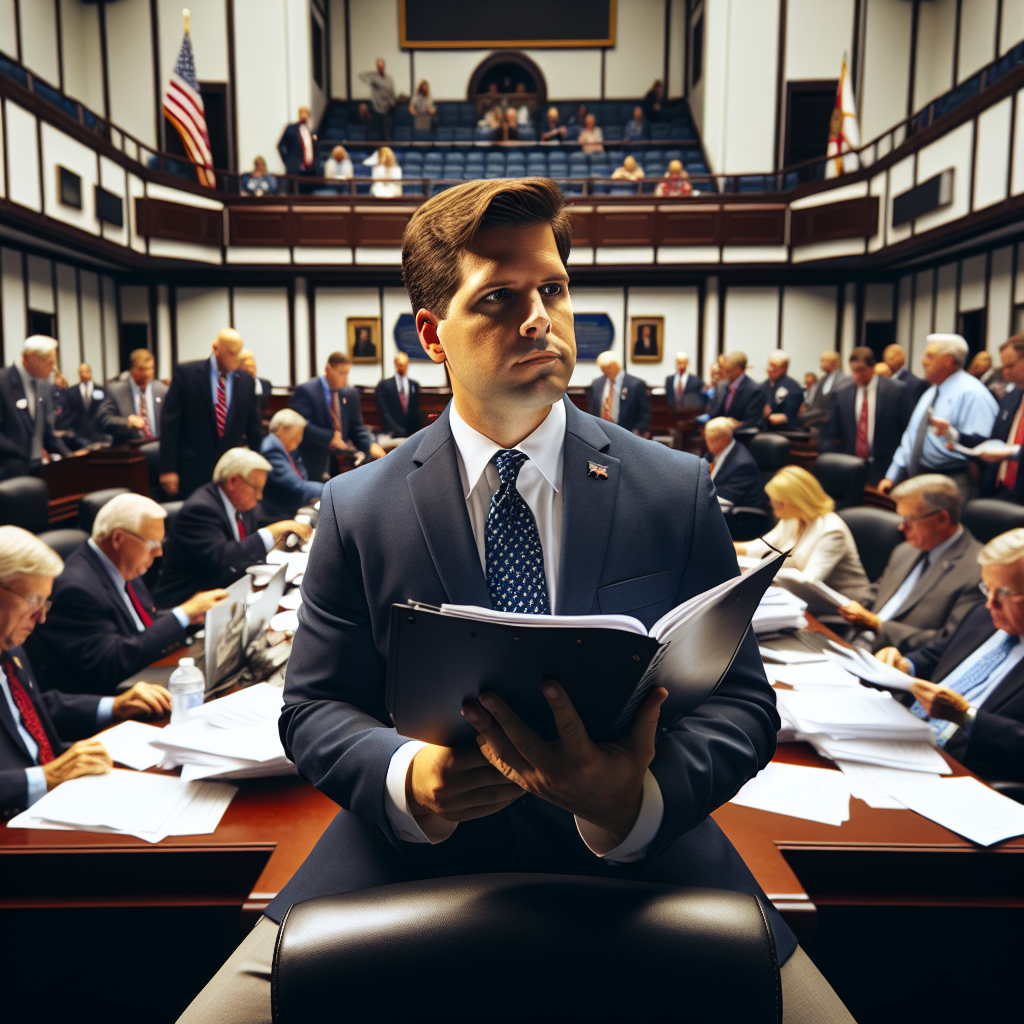
Florida legislators are debating important legislation in the state capital of Tallahassee, while Governor Ron DeSantis is pushing hard to pass a significant bill.
Governor DeSantis, a 47-year-old Republican, is currently in the final year of his second four-year term as governor and is not eligible for re-election.
In an interview with The Epoch Times at the Florida Governor’s Mansion, he stated that he is in a “sprint phase” given his limited time in office and is trying to utilize his political capital as much as possible.
He is eagerly anticipating the passage of his proposed “AI Bill of Rights,” which he believes is crucial for protecting residents and natural resources in Florida from the potential harms of unchecked growth in artificial intelligence.
The Senate Bill 482, also known as the “AI Bill of Rights,” and its counterpart House Bill 1395 are advancing through the legislative process in Florida. Committees in both chambers have initiated reviews, with legislators required to pass the bills by mid-March.
Governor DeSantis hopes these bills will be approved, merged into one, and sent to his desk for signing. He also aims to sign another bill aimed at regulating the growth of data centers necessary for developing artificial intelligence.
He acknowledges that these legislative measures may put him at odds with former President Donald Trump, who has cautioned against excessive regulation of AI by states. Trump had aided DeSantis in his 2018 gubernatorial election and has been his political mentor. While their relationship has been tumultuous, it has softened in the past year.
DeSantis, a Harvard Law graduate and former congressman, emphasizes the need to contain the spread of artificial intelligence without delay.
He argues that protective measures must be established now to safeguard the people, jobs, economy, and the environment of the state from potential harms.
In December 2025, DeSantis proposed the AI Bill of Rights covering data privacy, parental controls for children’s interactions with AI, and requirements for consumer notifications when using AI.
He stresses that these measures are necessary as AI technology rapidly permeates various aspects of daily life, from retail shopping to healthcare, often without individuals realizing they are interacting with tools, not humans.
DeSantis highlights the importance of ethical development of new technologies, emphasizing the enhancement rather than replacement of human experiences by technology.
He voices concerns over the potential misuse of power associated with data usage, emphasizing the need for protective measures to prevent such abuses in society.
The proposed legislation aims to enhance protections against deepfakes and explicit content generated by AI, including those depicting minors. Deepfake technology manipulates images, videos, or audio to appear authentic, often used to deceive others.
The bill prohibits unauthorized use of AI to depict real individuals in advertisements or criminal activities and mandates notification when users engage with AI, such as chatbots.
Chatbots simulate human conversations and are commonly used in customer service phone lines or instant messaging tools.
Additionally, the new measures prohibit state and local government agencies from using AI tools developed by “concerned foreign entities” and require the confidentiality of user input on AI platforms, banning their sale.
DeSantis’ proposal also bans businesses from providing “licensed” therapy or mental health counseling to customers seeking services through AI interactions.
The legislation establishes control mechanisms for parents to limit and oversee children’s interactions with AI. If children exhibit concerning behavior during interactions with AI, parents must be alerted under the proposal.
Furthermore, the bill restricts insurance companies from using AI to determine insurance claims eligibility.
There are global concerns that infrastructure for AI could have negative impacts on the environment, natural resources, and the health of nearby residents.
Data centers used for AI processing consume substantial resources. According to the U.S. Department of Energy, data centers consumed 4.4% of the national electricity supply in 2023, projected to increase to 12% by 2028.
Large data centers use up to 5 million gallons of water daily, which is equivalent to the water usage of a small town with a population of 10,000 to 50,000 people, as reported by the Environmental and Energy Study Institute in Washington, D.C.
DeSantis acknowledges that mega data centers can create job opportunities and generate substantial tax revenue for the state but emphasizes that they need stringent regulation.
A related bill he is pushing would prohibit taxpayer subsidies for large tech companies, curb energy costs, and grant local governments the authority to reject the development of facilities supporting AI workloads.
This bill aims to strengthen the protection of Florida’s natural environment while addressing the increasing energy and water demands associated with data centers. It also prohibits utilities from charging residents higher rates for electricity, gas, and water due to AI-related activities.
DeSantis warns that the widespread adoption of AI applications may lead to job losses for Florida residents. Amazon announced layoffs of 16,000 employees on January 28, attributing the downsizing to increased AI utilization within their operations.
However, those taxpayers facing unemployment due to AI expansion are often forced to help fund AI growth through federal subsidies to data centers.
DeSantis expresses concerns over the power of data usage, warning of the potentially abusive nature of such power and advocating for protective measures to prevent misuse.
While the proposed AI Bill of Rights has garnered support, the Computer & Communications Industry Association (CCIA) based in Washington D.C. officially opposes the legislation, emphasizing concerns over broad and ambiguous regulatory scope with potential privacy implications.
Former President Trump has also criticized state efforts to regulate AI. It remains unclear whether the proposed AI Bill of Rights and data center restrictions in Florida will conflict with an executive order signed by Trump a week after DeSantis announced the legislation.
The executive order directs federal agencies to identify states with “onerous laws” affecting AI and limit certain federal funding to these states. The key focus is to establish a national AI framework to avoid a chaotic situation of “50 different regulatory systems” due to varying state laws.
The order seeks to eliminate “cumbersome regulation” on AI companies in order to spur innovation and secure America’s competitive edge in the AI race.
Under the leadership of then-President Joe Biden, the White House is actively exploring safe avenues for promoting AI development. The White House Office of Science and Technology Policy released a blueprint for an AI Bill of Rights in 2022.
The blueprint emphasizes fair algorithm use, privacy protections, and user notifications when engaging with AI to ensure its safety, reliability, and effectiveness. It also advocates allowing users to opt-out of AI services when they prefer human interactions.
Despite opposing views, the AI Bill of Rights could likely pass with the loyalty of Florida’s Republican lawmakers to their governor, given the political trifecta in place.
As DeSantis concludes his term, Florida’s regular legislative session began on January 13 and is scheduled to end on March 13.
DeSantis refused to endorse any candidates for his successor among the 11 Democratic and 11 Republican contenders, including Jay Collins, Florida’s lieutenant governor. Additional candidates from various political affiliations are also vying for the position.
Supporters include former President Trump, billionaire Elon Musk, Senator Ted Cruz from Texas, among others, who back federal Congressman Byron Donalds from Naples, Florida, as the leading candidate.
Meanwhile, DeSantis remains focused on fulfilling his commitments to the voters and maximizing his efforts during his remaining time in office.
As Florida navigates the complexities of AI legislation, the outcome will likely shape the state’s approach to AI regulation and its impact on diverse sectors of society.
In summary, Governor DeSantis’ proactive stance on regulating AI in Florida reflects his commitment to ensuring responsible AI development and safeguarding the rights and well-being of the state’s residents.