
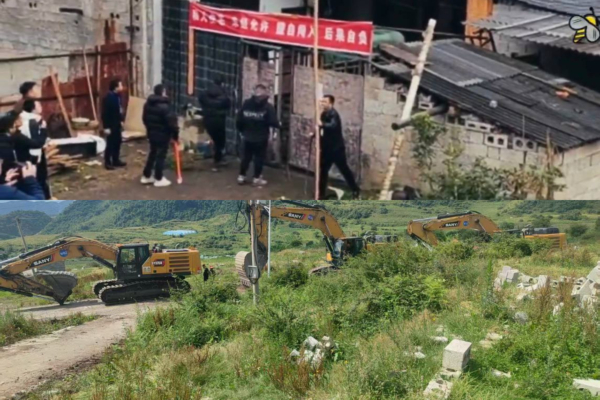
Recently, there have been cases of violent forced demolitions in Weixin County and Zhenxiong County in Zhaotong City, Yunnan Province. In Weixin County, villagers in Zaxi Town resisted the demolition personnel with bricks, while in Zhenxiong County, residents in Huashan Township faced their houses being forcibly sealed off with no means of complaint.
According to a social media platform blogger named “Yesterday,” on January 20th, a number of residential buildings in Huangjin’ao Village, Tianba Community, Zaxi Town were identified by the local government as “illegal constructions” and the homeowners were ordered to “demolish on their own” within 3 days.
The villagers strongly objected to this because these “illegal” houses had been inhabited for over twenty years and were the only dwelling places for the villagers. It is reported that the sudden classification as “illegal constructions” was due to the local government’s plan to advance a real estate project called “Hot Spring Town” in the area. After facing the villagers’ rejection of the low compensation standard, the government resorted to pressure using the excuse of “illegal constructions.”
Starting from January 13th, villagers began to gather around the houses day and night to resist the demolition. On January 20th, dozens of government officials, including the town secretary, arrived at the scene, wielding hammers, iron bars, and other demolition tools with great momentum. In front of a house with a banner hanging that read, “Private residence, unauthorized entry, consequences at your own risk,” when government personnel began to dismantle the door, villagers on the rooftop started throwing bricks down, eventually driving away the demolition crew.
It is understood that the local government’s forced demolition could not proceed, and the local villagers are seeking justice through legal means.
There were also forced demolition incidents in Huashan Township, Zhenxiong County. Last year, the local government colluded with the owner of an open-pit coal mine to confiscate villagers’ land in the government’s name for house demolition and relocation.
Villager Li Yong (pseudonym) revealed to a reporter from Dajiyuan that the demolition started last summer, and most villagers in the village had signed agreements. They now rent houses in town without resettlement fees. “Those who signed to demolish either have houses in town or houses bought outside the village, where the old houses in the village are left uninhabited,” said Li.
He only has one house himself. Previously, he worked in Zhejiang and returned home last year because of the demolition in his village. On July 30th last year, his brother’s house was demolished, and as their houses were connected, part of his house was also damaged. However, he persistently refused to relocate without a negotiated compensation solution.
Li Yong disclosed that on the night of December 24th last year, government personnel sealed his family’s house when they were not at home. Later, they moved furniture, appliances, and daily necessities from the house to the yard without permission, and on the 25th, everything was taken away, and their whereabouts remain unknown.
Currently, Li Yong’s family can only stay with relatives. He has gone to government departments to seek explanation with no results, and is now in a situation where there is no one to complain to.
Li Yong opposes the demolition because it leads to more poverty and an uncertain future. The compensation for his family’s demolition is only enough for building a house but with no place to settle the house foundation.
He expressed concerns about survival and retirement, as the economic situation is dire, finding jobs in town is difficult, and the future is uncertain. His demand is not only compensation for the house but also a guarantee from the government for people’s livelihoods in the future.
Li Yong said he would persist in safeguarding his rights and might use legal means to protect his basic rights.