
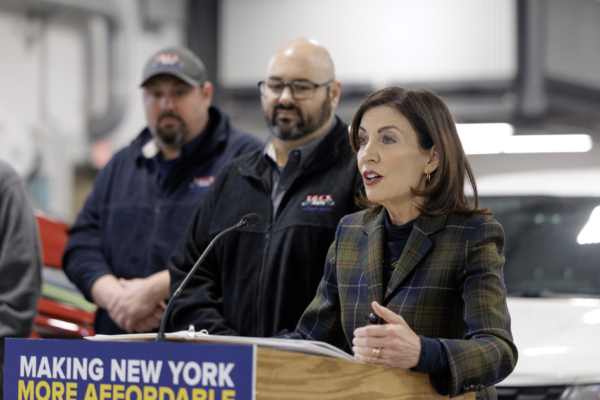
New York Governor Hochu announced a series of reform proposals on Tuesday (February 3) to address the persistently high car insurance costs in the state of New York. The primary goals of these proposals are to reduce car insurance costs, crackdown on fraudulent activities, and ensure that any savings are passed on to consumers rather than being pocketed by insurance companies.
According to state data, the average annual expenditure on car insurance in New York exceeds $4,000, which is nearly $1,500 higher than the national average, ranking it among the highest in the country. The state government pointed out that deliberately causing car accidents, insurance fraud, frivolous lawsuits, and legal loopholes are key factors driving up overall premiums.
Some estimates suggest that fraudulent activities alone could result in each driver paying an additional $300 in premiums annually.
In recent years, the tactics of deliberately staging car accidents and defrauding insurance companies have become increasingly sophisticated and prevalent. In 2025, insurance companies reported 43,811 suspected cases of car insurance fraud to the New York Department of Financial Services (DFS), an 80% surge compared to the 24,238 cases reported in 2020.
In response, Hochu proposed several measures to combat fraud, including:
– Reinforcing the “Auto theft and insurance fraud prevention committee” to enhance investigation and prosecution capabilities.
– Amending laws to allow prosecutors to hold masterminds behind orchestrated accidents accountable, not strictly limited to the actual drivers.
– Collaborating with prosecutors across regions to dismantle organized fraud rings.
– Intensifying efforts to investigate medical institutions that collude in fraud by providing false diagnoses.
– Cracking down on car owners who register their vehicles in other states unlawfully to lower premiums while shifting costs to law-abiding New Yorkers.
Current laws give insurance companies only 30 days to identify and report fraud cases, a restriction viewed as overly stringent by the state government. Hochu proposed extending the investigation and reporting deadlines and lowering procedural barriers in court for alleging fraud, giving insurance companies more time to avoid making fraudulent payouts.
The reform proposals also target the compensation system, including:
– Limiting non-economic damages such as emotional distress compensation for individuals involved in accidents linked to criminal activities (e.g., drunk driving, uninsured motorists, serious crimes, or hit-and-runs).
– Restricting the amount of compensation for drivers deemed “primarily at fault” in accidents, introducing more concepts of liability attribution.
– Tightening the definition of “serious injury” with more objective and medicalized standards to prevent minor or temporary injuries from being exploited to file high-value lawsuits.
Under current New York law, in multi-defendant car accident cases, even if one party is found to be less than half responsible, they may still be required to bear all non-economic damages. The state government proposes aligning with 28 other states where defendants found less than 50% liable would only be responsible for the actual damages caused, thereby reducing the risk of future premium hikes.
Hochu also stated that if the aforementioned reforms successfully reduce insurance costs, he would instruct the Department of Financial Services to review the “excess profits law” that has been in effect since the 1970s. This would ensure that if insurance companies exceed profit thresholds, they must return the excess profits to policyholders rather than solely benefiting from the reform.
Another proposal by the state government requires insurance companies to clearly inform policyholders of the reasons for premium adjustments. Additionally, it encourages companies to offer premium discounts through technology solutions for drivers who voluntarily participate in safe driving programs to reduce accident and fraud risks.
Hochu emphasized that these measures are part of his policy to “reduce the cost of living and enhance affordability,” with the aim of easing economic pressures on New Yorkers who rely on cars for commuting and daily travel.