
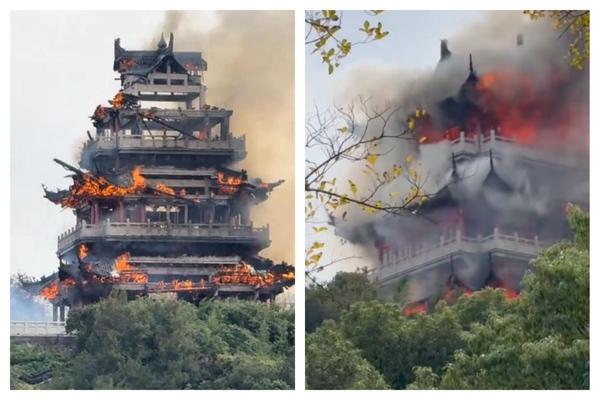
On November 12, a fire broke out at Yongqing Temple, which was established in the second year of Datong in the Southern Liang Dynasty (536 AD). The iconic building, Wenchang Pavilion, was burned down to its frame. Yongqing Temple is one of the “480 Temples of the Southern Dynasties,” along with Lingyin Temple in Hangzhou and Jinshan Temple in Zhenjiang.
At 11:24 a.m. on November 12, a sudden fire occurred at Yongqing Temple in Fenghuangshan Scenic Area in Zhangjiagang City, Suzhou, Jiangsu Province. The iconic building, Wenchang Pavilion, was engulfed in flames. Other buildings within the temple, such as Luo Han Hall and Main Hall, as well as the surrounding forest area, were not affected.
Video circulating online shows a multi-story wooden building in Yongqing Temple engulfed in raging flames from top to bottom, leaving only a concrete frame behind as the wooden structure was completely destroyed. Even from residential areas several kilometers away from the scenic area, the fire and smoke on the mountain were still clearly visible.
Public records show that Yongqing Temple was initially built during the Eastern Wu period, and in the second year of Emperor Wudi of the Southern Liang Dynasty (536 AD), it was expanded by Imperial Secretary Lu Xiaoben. With a history of over 1500 years, Yongqing Temple is one of the “480 Temples of the Southern Dynasties,” alongside Lingyin Temple in Hangzhou and Jinshan Temple in Zhenjiang.
The temple currently houses buildings such as the Main Hall and Luo Han Hall, and it retains the “Three Wonders” consisting of ancient cypress trees, the incorruptible body of a Bodhisattva, and a natural stone well. The Main Hall enshrines three statues of Shakyamuni Buddha. During the Ming and Qing Dynasties, the temple underwent six renovations, with the temple’s foundation reaching as wide as 86 mu at its peak.
In the late Yuan Dynasty, Shi Nai’an resided at Wenchang Pavilion and created “Water Margin,” leaving behind remnants such as the inkstone pool and sword grinding stone. In the twelfth year of the Tang Tianbao period, Master Jianzhen, before his eastward journey, also visited the temple to pay his respects.
After the establishment of the People’s Republic of China, monks and believers were severely persecuted. In 1958, Yongqing Temple was completely destroyed and left in ruins. In 1993, reconstruction of Yongqing Temple commenced, and it was opened to the public in 1999. In 2007, it was designated as a cultural relic protection unit in Zhangjiagang City.
The fire at Yongqing Temple has sparked widespread attention.
A gaming blogger and prominent Weibo user, “Zhang Jia ZHJ,” lamented, “The ancient architecture of Yongqing Temple Wenchang Pavilion, with a history of over 1500 years at Fenghuangshan, Suzhou, was engulfed in flames. It’s a pity as it had undergone six reconstructions in the Ming and Qing periods in 1993. The loss of ancient value is substantial, with precious timber destroyed, affecting the skills of carpenters, carvers, and lacquer workers…”.