
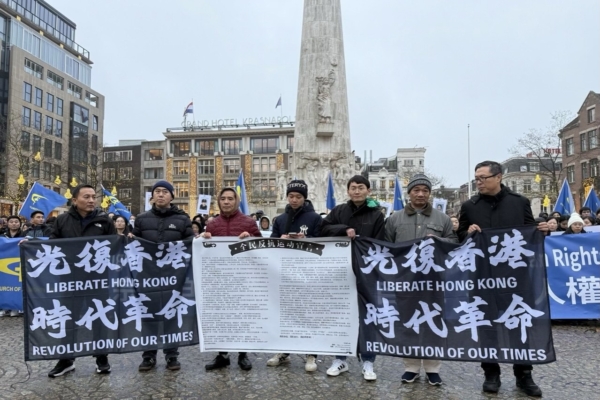
In an interview, Rao Xing said, “My sleep quality has improved a lot since I left. I used to suffer from insomnia frequently in China due to various pressures, especially being pursued by the police. Every time I received a text message with a police badge icon on my phone, I would be terrified.”
Rao Xing, a 30-year-old, fled to the Netherlands with his family in early October. Over a decade ago, he was a paramilitary police officer and later transitioned to self-employment by opening a store. Faced with unbearable taxes, he chose to work as a high-level executive in a chain of bakery and cake shops. The increasingly harsh economic conditions made him realize the hardships of people’s livelihoods.
He mentioned his experience of going from a “party guard” of the Chinese Communist Party to displaying protest banners calling for the autocrat to step down during the CCP military parade this year, indicating that “those who are 30 years old in China are already waking up.”
Rao Xing stated that he started using VPN to access blocked websites since 2019 and systematically discovered the true nature of the Chinese Communist Party. In August this year, he was contacted by a local armed forces unit in China regarding his activities of interacting frequently with overseas anti-Communist organizations through VPN. This sudden contact raised concerns about his safety.
In early September, during the CCP’s military parade, Rao Xing posted online about the inauthenticity of CCP’s anti-Japanese stance, leading to him being reported. One night, the police visited him, harshly warned him, and forced him to delete all his posts. This incident made him realize that his online activities were being monitored.
Prior to the CCP’s National Day, Rao Xing posted protest banners demanding “Xi Jinping step down” in public parks and toilets in China, and also made online posts declaring statements like “No National Day, only national mourning,” “CCP is not China,” and “Down with the autocrat.” Subsequently, the police quickly located him.
“This time was more serious. They questioned me about why I wrote those things. I mentioned the right to freedom of speech as stated in the constitution. Before I could finish, I was pushed down, my legs were beaten black and blue with a baton, and I was detained overnight. It was only due to my boss’s connections that I was eventually released,” Rao Xing recounted.
Feeling unsafe in the current political environment, Rao Xing witnessed many vocal individuals around him being taken away, admonished, or sentenced. He described feeling anxious, worried, afraid, and fearful during that period, fearing that he might face similar consequences. Realizing that China was becoming increasingly unsafe, he felt the urgent need to leave.
Reflecting on his military service over a decade ago, Rao Xing had harbored a determination to leave China, having endured forced indoctrination and persecution within the armed forces. The stringent regulations and harsh treatment he experienced instilled a resolve to depart the country someday.
In the year when Xi Jinping came into power, 18-year-old Rao Xing served as a soldier at the Nanyang branch of the Henan Armed Police General Corps. Initially excited about his military service, he recalled the camaraderie and the disciplinary songs sung within the military, only to later realize their falsehood.
Rao Xing highlighted the prevalence of corruption within the armed forces, emphasizing instances where individuals with financial means and connections arranged for their children to serve in the military, benefiting from preferential treatment and opportunities for advancement.
Despite the military’s coercive indoctrination, Rao Xing eventually left the armed forces and embarked on a journey to escape the oppressive environment in China, leading him to seek refuge in a free world where he could voice his concerns without fear of repercussions.
Upon reflecting on his experiences, Rao Xing acknowledged the deep-rooted imprint of indoctrination from his time in the military, expressing struggles associated with overcoming psychological barriers and occasionally reliving traumatic memories.
Having completed the process of quitting all affiliations with the Chinese Communist Party, Rao Xing affirmed his commitment to continue advocating for the freedom of Chinese people from abroad, standing in solidarity with those who seek to challenge the authoritarian regime’s oppressive measures.
Rao Xing noted a growing awakening among individuals in China, particularly in the age group of 30 to 40, who utilize VPNs to access uncensored information and understand the underlying issues contributing to their societal struggles. However, due to strict censorship, their voices often go unheard and are suppressed by the CCP propaganda machinery.
Transitioning from a life of struggle in China to a newfound sense of freedom in a foreign land, Rao Xing expressed gratitude for the kindness he encountered in his new surroundings. He contrasted the lack of fear displayed by birds and animals in free societies with the perpetual state of unease prevailing in China’s repressive environment.
Although initially tempted to revert to his past beliefs after leaving the authoritarian backdrop, Rao Xing ultimately decided otherwise, recognizing the importance of personal growth and embracing new perspectives.
In conclusion, Rao Xing’s journey from a disillusioned paramilitary officer entangled in China’s repressive systems to a vocal advocate for freedom and justice exemplifies the transformative power of introspection and resilience in the face of oppressive conditions. His determination to speak out against injustices, despite facing challenges, serves as a beacon of hope for marginalized voices seeking to resist the suppressive forces of authoritarian rule.