
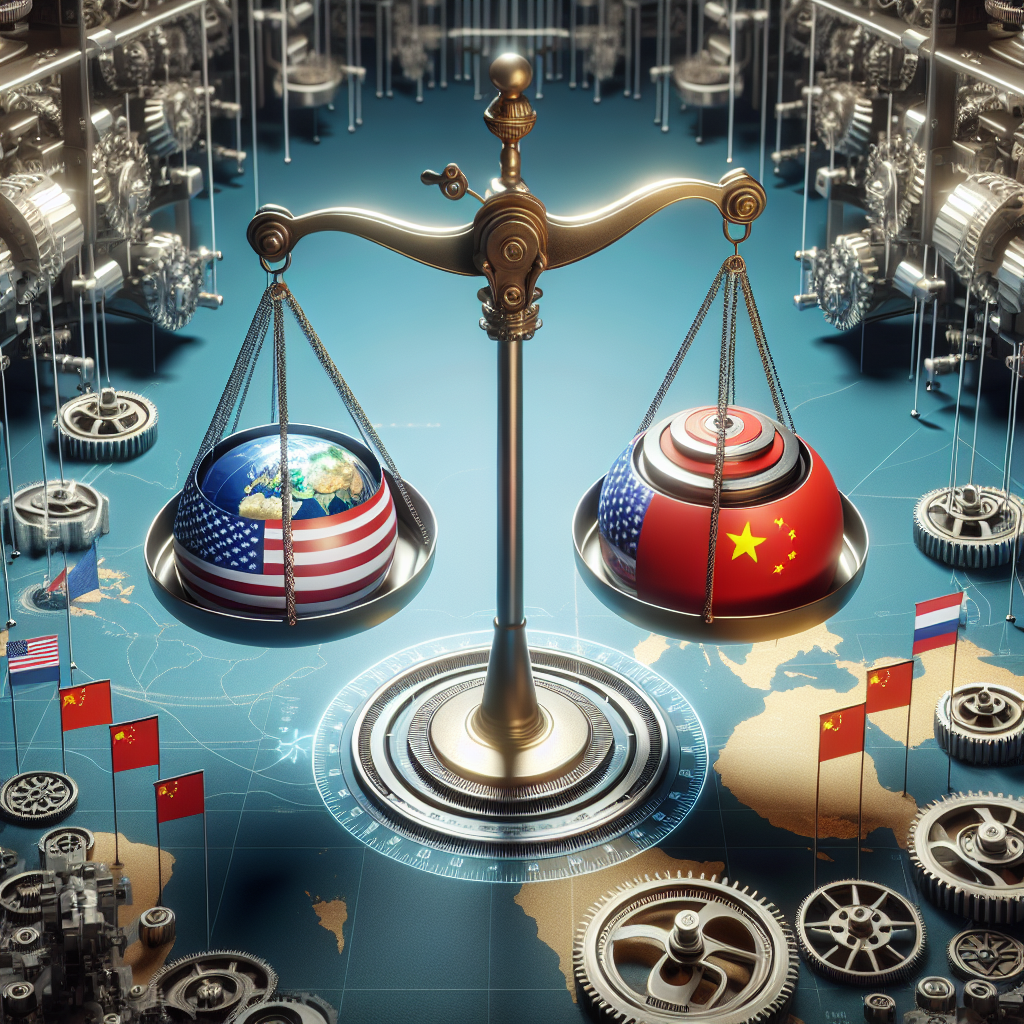
In the midst of the United States’ efforts to address the imbalance in its trade relationship with China, Beijing’s growth model of “making enemies as neighbors” at the expense of other countries’ interests has come under scrutiny. Europe and more countries are considering imposing tariffs on Chinese products. Experts analyze the reasons behind China’s trade model and how far it can go in the future.
The ancient Chinese saying “making enemies as neighbors” metaphorically refers to pushing difficulties and disasters onto others like using neighbors as a drainage ditch. The concept is now being used to describe shifting burdens onto others.
As China prepares for the upcoming Central Economic Work Conference, its earlier released “14th Five-Year Plan” reiterated the proposal to “accelerate the construction of a manufacturing powerhouse.” However, the domestic and international situations in China are changing. The outside world is deepening its understanding of China’s “making enemies as neighbors” trade model.
Currently, the United States imposes high tariffs on Chinese products, but according to the agreement reached by both countries at the end of October, tariffs have decreased from 57% to 47%. The U.S. continues to monitor China’s adherence to trade commitments.
Since the second term of President Trump, the U.S. has found that China has adapted to the changes in U.S. tariff policies since 2017. China, instead, routes its supply chain of Chinese goods through other lower-income countries and then re-exports them to the U.S.
According to data released by China’s customs on December 8th this year, exports to the U.S. in November declined by 28.6% year-on-year. However, due to manufacturers shipping large quantities to other markets, China’s overall export performance still exceeded market expectations. Measured in U.S. dollars, overall exports in November grew by 5.9% compared to the same period last year, especially with exports to ASEAN and the EU increasing by over 8% and nearly 15%, respectively. In contrast, China’s imports in November grew by 1.9% year-on-year, lower than the market’s expected 3%.
Greg Ip, Chief Economic Commentator of the Wall Street Journal, recently wrote that while U.S. trade data may be an exception, reflecting early imports to counter tariff increases, China has experienced soaring exports and sluggish imports for the past five years, indicating China’s increasing share of the global manufactured goods market at the expense of other countries. Beijing is sacrificing the interests of other countries and following a growth model of “making enemies as neighbors.”
Economists at Goldman Sachs concluded in their latest forecast that China’s economic relationship with the rest of the world has turned inversely correlated. As China demands further enhancement of manufacturing competitiveness and promotes exports, its growth model will increasingly face resistance from Europe, other East Asian industrial economies, Canada, and Mexico.
Western countries adhere to the international order, are not afraid of economic interdependence, and do not attempt to eliminate imports, while China follows a completely different approach. Especially under the current Chinese Communist Party leader Xi Jinping, emphasizing China’s “dual circulation” economic strategy, tightening reliance on international industrial chains, ensuring domestic production independence, and self-sufficiency. China does not give up low-end manufacturing industries such as toys and clothing nor does it encourage Chinese companies investing overseas to transfer key technologies such as battery production.
Associate Professor Fan Jiazhong from National Taiwan University’s Economics Department told Da Ji Yuan that in recent years, China has pushed its export-oriented model to an extreme level, including manipulating the renminbi exchange rate, lowering manufacturing costs through various policy subsidies, tax cuts, etc.
“Firstly, because China’s economy has been declining in recent years, exports have become the last engine to maintain growth, providing some political legitimacy. The second reason is that the Chinese Communist Party has found that the manufacturing industry can be a symbol of national power while also weakening the power of other countries, such as the U.S. shipbuilding industry.”
He pointed out that China’s growth model of “making enemies as neighbors” has been ongoing for many years. Now that the U.S. is no longer accepting it and other countries can no longer tolerate it, international trade conflicts are receiving increased attention.
Juan-Jun Qiu, a finance and finance professor at Northeastern University in Boston, told Da Ji Yuan that China disrupted the global economic order through price wars, causing severe shrinkage in labor markets in other countries, damaging workers’ rights, and depriving the manufacturing industry of its ability to innovate.
This trade model of China faces inherent dilemmas: “Firstly, domestic consumption in China is collapsing, facing serious deflation issues, where people are afraid to consume, and companies are hesitant to invest. The second issue is overcapacity, which can only be stimulated by exports for economic growth, such as industries like steel, electric vehicles, and solar panels. Of course, this is related to the political system, where the Chinese Communist Party has long emphasized the importance of production over consumption.”
Qiu believes that since the outbreak of the COVID-19 pandemic, countries have been focusing on de-risking their supply chains, leading to the formation of trade blocs worldwide. The trade relationships between the EU and the U.S. are becoming closer, while China’s trade bloc is part of Xi Jinping’s declared dual circulation strategy, including countries like Russia and Iran facing economic sanctions from Europe and the U.S., along with North Korea, African countries, and other economically weaker small countries bound to accept China’s threats and inducements. On the other hand, Southeast Asia, Latin America, the Middle East, and countries like India are attempting to balance between China, Russia, the U.S., and the EU to maximize their benefits without offending any party.
China’s vast surplus products are facing resistance worldwide.
On December 4th, the Trump administration released the “National Security Strategy of the United States,” proposing to rebalance U.S.-China economic relations, prioritize reciprocity and fairness to restore America’s economic independence. The report states, “Trade with China should maintain balance and focus on non-sensitive areas.”
The U.S. also encourages allies to address the imbalance in trade relations with China. The report stated, “We must encourage European, Japanese, Korean, Australian, Canadian, Mexican, and other major countries to adopt a rebalancing trade policy toward China, promoting Chinese economic reorientation towards household consumption, as Southeast Asia, Latin America, and the Middle East are incapable of absorbing China’s enormous excess capacity alone.”
French President Emmanuel Macron, who recently concluded his visit to China, made a strong stance against China in an interview with the French newspaper Echo of the Globe on December 7th. He emphasized that China’s trade surplus with the EU is “unsustainable,” and is “hurting its own customers,” particularly by almost ceasing to import goods from Europe.
Macron said, “In the coming months, we Europeans will be forced to take tough measures to delink, just like the United States.” He has discussed this issue with the President of the European Commission, Ursula von der Leyen.
Data shows that last year, France had a trade deficit with China of approximately 47 billion euros (about 54.7 billion U.S. dollars), while China had a nearly $143 billion surplus with the EU in the first half of the year, the highest in history.
An article by Robin Harding published in the Financial Times on November 26th argues that China is making trade impossible, and Europe is left with difficult choices.
The author suggests that the best solution in Beijing is to completely eliminate deflation, remove structural barriers hindering domestic consumption, significantly appreciate the yuan, stop providing hundreds of billions in subsidies and policy loans to industries, which also benefit the lives of the Chinese people. However, with Beijing’s newly released next five-year plan, any illusions have been shattered: consumption ranks third in priority, with manufacturing and technology always taking the lead.
The author contends that if Europe wants to retain any industry, it must resort to extensive protectionism. Beijing is likely to retaliate, marking further unraveling of the global trade system.
The Mexican Congress is set to vote this week on a proposal by President Claudia Sheinbaum to impose tariffs on Chinese imports. This move is seen as a significant signal from Mexico to align itself with the United States in terms of trade policy.
Fan Jiazhong believes that due to the imbalances caused by China’s economic model globally, more countries will adopt tariffs and non-tariff trade barriers. However, as China refuses to address the issue of overcapacity, persisting in this economic model, it is expected that future trade conflicts will become increasingly severe.
According to the 2025 Sustainable Trade Index released in October 2025 by the Hinrich Foundation and the IMD World Competitiveness Center, among the 30 major economies evaluated, China currently ranks 16th, falling behind in the primary economic circles of Asia.
Qiu argued that the trade sustainability index is based on visible and shareable economic benefits, a fair and transparent competitive environment, and a resilient social safety net. The Chinese government has largely resorted to deficit spending to stimulate the economy, but the effectiveness is diminishing. The real estate crisis is worsening, local governments are immediately facing debt issues, and the financing platforms of local governments are ticking time bombs. In the absence of a robust social safety net, people are forced to rely on high savings to cope with risks.
Qiu believes that China’s “strong export” strategy will not go far. Strengthening exports assumes that products will be in demand abroad, but ultimately, economic prosperity depends on domestic consumption. In China, the money earned from exports is not evenly distributed among all citizens, preventing them from sharing in the benefits of economic growth. Thus, the more China exports and the larger its capacity, the weaker domestic demand becomes. A vicious cycle ensues, where China must export more to compensate, potentially facing obstacles if international trading partners increase barriers.
“Strengthening exports for exchange might have worked 30 years ago, but times have changed. Boosting exports cannot save the economy,” he said.
Fan Jiazhong is convinced that China’s dumping practice will not last much longer. He believes that by constantly disrupting the established balance and international trade order, China is likely to face resistance. After the international market shuts its doors and domestic demand remains insufficient, China’s current economic model will either collapse or undergo a forced transition, with only the question of how long this process will take.