
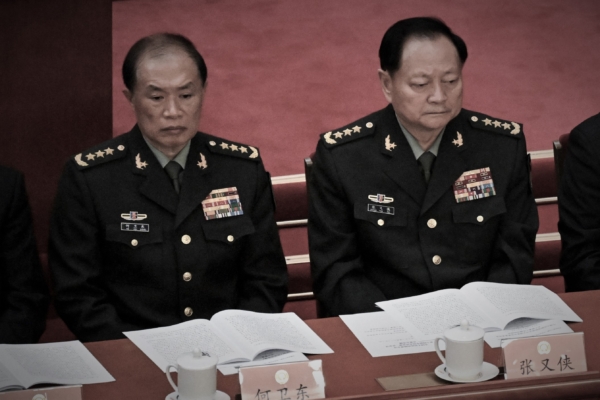
The recent purge of top Chinese Communist Party (CCP) military leaders, including Zhang Youxia and another senior officer Liu Zhenli, has sparked significant attention to the internal power struggle within the CCP. This development has led experts to speculate on the impact of this power struggle on the combat capability of the CCP’s military. Experts suggest that the CCP’s military is currently in turmoil and facing a serious “leadership vacuum,” which will likely result in turbulent times in the coming years and present long-term challenges for CCP leader Xi Jinping.
The Central Military Commission, the highest military command structure in the CCP, is traditionally composed of seven members, but now it remains with only Xi Jinping and Zhang Shengmin. Several others, including Zhang Youxia and Liu Zhenli, have been sidelined in a series of anti-corruption campaigns. The Central Military Commission is responsible for overseeing millions of military personnel, wielding significant power, with the Chairman of the Central Military Commission being a key position, even during Deng Xiaoping’s de facto leadership in the 1980s.
According to a report from the BBC, Lyle Morris, a senior researcher at the Asia Society Policy Institute, stated that the current situation of having only Xi Jinping and one other general remaining on the Central Military Commission is unprecedented. He highlighted that the CCP’s military is currently “in chaos” and faced with a “significant leadership vacuum.”
Analysts mentioned in The Wall Street Journal suggest that the void created by the dismissal of top officials could potentially impact operational effectiveness, especially as Xi Jinping shifts towards a more cautious strategy, possibly decreasing the short-term risk of a Chinese invasion of Taiwan.
The report cited M. Taylor Fravel, Director of the Security Studies Program at MIT, who stated, “Given the scale and complexity of overseeing a massive and intricate military organization, this type of void at the top is unsustainable.” He also pointed out that this would inevitably have an impact on the CCP’s military preparedness for executing major and complex military operations in the short to medium term.
Morris believes that Zhang Youxia’s ousting poses long-term challenges for Xi. He stated that this development is highly unfavorable for Xi Jinping’s image and anticipates significant turmoil within the CCP’s military in the coming years, affecting Xi and his leadership team.
Zhang Youxia and Liu Zhenli, the latest casualties, were considered core figures in the military and two of the few generals in the CCP with combat experience. Their removal is expected to have a significant impact on the military.
Despite Zhang Youxia once being seen as a close ally of Xi Jinping, with their fathers having fought side by side, this special relationship did not spare Zhang Youxia from being purged. This adds to the atmosphere of “every man for himself” within the CCP, potentially leading to negative implications within the military as suspicions could result in cautious or weak decision-making by officers.
BBC noted that the purge of top-level leaders has also unsettled lower-ranking officers, who may fear who will be the next target. Observing the fate of senior officers, they may be reluctant to be promoted to what could be a “deadly zone” that might become the focus of Xi’s anti-corruption campaign.
The opacity of the Chinese political system makes it difficult for outsiders to determine the exact motives behind Xi Jinping’s removal of figures like Zhang Youxia. When asked about the reasons for the downfall of numerous senior leaders, Morris told BBC, “There are many rumors circulating. We currently cannot distinguish what is true from what is false… but this is detrimental to Xi Jinping himself and his leadership and control within the military.”
Associate Professor Chong Ja Ian from the National University of Singapore also expressed uncertainty about the real reasons for Zhang Youxia’s downfall, noting diverse speculations from leaking nuclear secrets to plotting coups and factional struggles. There are even rumors of gunfire in Beijing.
He highlighted that obtaining information in Beijing is extremely limited, fostering uncertainty and various speculations.
BBC mentioned that while the actions against these leaders may be related to corruption issues, considering the historical outcomes of such purges, it is also likely linked to power struggles, using anti-corruption campaigns to eliminate potential political rivals or those deemed insufficiently loyal.