
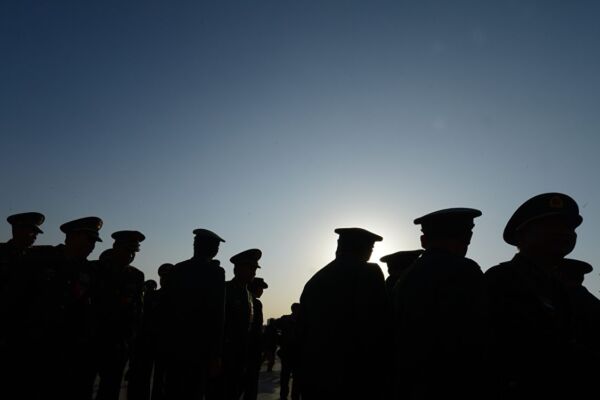
On January 24, former Vice Chairman of the Central Military Commission of the Chinese Communist Party Zhang Youxia and former Chief of the Joint Staff Department Liu Zhenli were officially announced to be under investigation by the authorities, sparking widespread attention from various sectors. Political analysts believe that this is the first “devastating” blow to the command chain of the CCP’s military since 1949, and Xi Jinping’s move has completely disrupted the internal operation mechanism of the CCP. The eerie phenomenon of collective silence within the military indicates that this political storm is far from over, and similar power purges in history have led to serious consequences.
The news of the investigation of Zhang Youxia and Liu Zhenli had been circulating for some time, but major military regions have yet to make public statements. This abnormal silence has raised concerns among the public. In the program “Good Morning China,” senior media personalities and political commentators Shishan and Qin Peng expressed different views on the investigation of Zhang Youxia and Liu Zhenli announced by the authorities.
Shishan pointed out in the program that in the past, following events involving figures like Lin Biao, Guo Boxiong, and Zhou Yongkang, major military regions would swiftly declare loyalty, emphasizing “loyalty is not absolute, and absolute loyalty is not loyalty.” However, this time the major military regions have remained silent, indicating an unusually tense political atmosphere.
Political commentator Qin Peng analyzed that this silence stems from the unique rules of power struggles within the CCP: “No one knows what to do, and no one wants to take the lead in making a statement. The person leading the way in making a statement will run into problems, as it has been in the past. Because power struggles are about factions clashing, but you can’t figure out which faction will win.”
Shishan further explained the complex mindset within the current military. He pointed out that Zhang Youxia’s personnel adjustments within the military had actually “won the hearts of most military officers.” Previously promoted by Xi Jinping, the “Fujian Gang” such as Miao Hua and He Weidong “rose too quickly, without much merit,” and did not gain popularity within the military. Zhang Youxia’s reshuffling based on achievements and seniority principles made the officers feel that selections were made based on experience and seniority, rather than just factional relationships.
Shishan used historical power struggles within the CCP to analyze the situation. He noted that even Mao Zedong did not resort to extreme measures right from the start in his quest for ultimate power.
” Mao Zedong despised Zhang Guotao the most,” Shishan said. “During the meeting of the Red Army, the Central Red Army only had over ten thousand soldiers left, while Zhang Guotao had over eighty thousand. But Mao Zedong did not take extreme measures until he had one hundred percent power.”
He particularly emphasized Mao Zedong’s use of the system: “In doing all these things, Mao Zedong also used a system, saying let’s all have a meeting, if you two disagree, we will expand the meeting and bring in five of my trusted people, and we will vote. But it always ended up with a decision through a meeting.” When Deng Xiaoping dealt with Hu Yaobang and Zhao Ziyang, it also had to go through meeting resolutions or party inner-life meetings.
In comparison, the uniqueness of Xi Jinping’s recent actions lies in the lack of procedural legitimacy. Shishan questioned, “Decisions by the Party Central Committee are deceitful. The Party Central Committee consists of 205 central committee members, not one person. When the Party Central Committee makes a decision, did the Central Committee hold a meeting? Did the Political Bureau hold a meeting?” He believed that without a Central Committee meeting, “they just picked up a pen, fabricated something about the Party Central Committee and the Military Commission, it’s totally fake, it’s a coup.”
Qin Peng, drawing lessons from Soviet history, analyzed in detail the fatal impact of power purges on military capabilities.
He recalled, “During Stalin’s great purge, four out of five Marshals of the Red Army were eliminated, 70% of the army commanders, 60% of the division commanders were purged, basically wiping out the entire command chain. As a result, when they first fought against Finland, with 500,000 against 40,000 enemy soldiers, plus maybe 70,000 militias, they suffered a major defeat.”
Even more disastrous was their performance during the German invasion: “Then they faced off against the Germans in Operation Barbarossa, and the surrender of the Soviet army was on a level of millions, which was a complete joke. In the end, they persevered, relying on the vast land area of the Soviet Union, the cold climate, and the massive supply of weapons and resources sent by the Americans via the North Pole.”
Shishan added historical details of Stalin’s later years: when Stalin had a stroke and fell on the floor, Beria and Khrushchev didn’t dare call a doctor because “whoever made the decision for him, that’s equivalent to depriving me of my highest leadership power.” It took eight hours before they collectively decided to get a doctor, but it was too late.
Both commentators particularly emphasized the uniqueness of the CCP’s internal operation mechanism and the seriousness of its disruption.
Qin Peng pointed out, “The Communist Party’s system is different from the old autocratic system, its operation relies on an internal coordination mechanism.” Previously, why Zhang Youxia had military authority was because “he must have been authorized by the system, authorized by that temporary coordination group.”
Shishan further explained, “In the so-called legitimate mechanism within the CCP, that temporary coordination group is the rule. By breaking this rule now, you have also dismantled the so-called legitimate temporary mechanism.”
He believed that this aligns with Xi Jinping’s consistent behavior: “How did Xi Jinping rise to power? It was this mechanism that propelled him to the top. Back then, Hu Jintao, Wen Jiabao got rid of Bo Xilai, and then let Xi Jinping come up. But now you’ve shattered that group that Hu Jintao belonged to directly.”
Qin Peng, however, stated, “Xi Jinping can establish temporary authority through absolute terror, but ultimately the authority established through this method will inevitably disintegrate.”
Both commentators agreed that fundamental changes are unlikely to occur in the short term, but in the long run, this destructive power struggle method will lead to serious consequences. As Qin Peng put it, “Actually, there are two outcomes: one is when the military needs to go to war, the whole system collapses; the second is exhaustion, when your organs fail, eventually it will lead to exhaustion, and the whole thing slowly dies out.”