
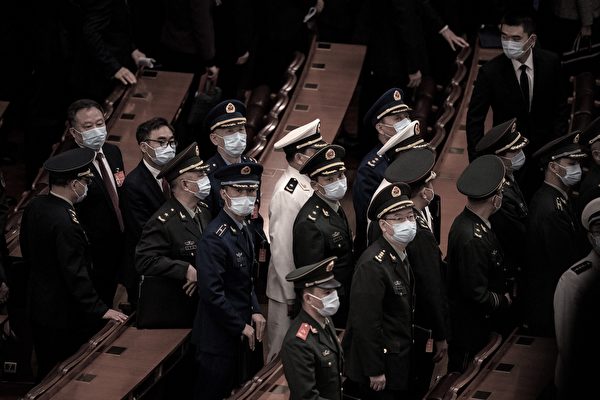
The Chinese Ministry of National Defense confirmed on January 24 that Vice Chairman of the Central Military Commission, Zhang Youxia, and Chief of the General Staff of the Joint Staff Department, Liu Zhenli, have both been removed from office. Analysts point out that since the 20th Party Congress, Xi Jinping has been systematically targeting Zhang Youxia. The related purges are not sudden moves in the anti-corruption campaign, but rather a result of the highly centralized power structure, repeated cleansings within the military, and the failure of succession mechanisms, reflecting the increasing crisis of trust within the CCP system.
According to China’s Central Television News on January 24, the Ministry of National Defense quoted that Central Political Bureau member and Vice Chairman of the Central Military Commission, Zhang Youxia, and member of the Central Military Commission and Chief of the General Staff of the Joint Staff Department, Liu Zhenli, are suspected of serious violations of discipline and law. The Central Committee has decided to launch an investigation. This announcement confirmed previous rumors circulating over the past few days.
Just before the official announcement of the investigation into Zhang Youxia and Liu Zhenli on January 24, Australian independent media personality Jiang Wang leaked on X platform on January 20 that Zhang Youxia had been summoned, and his son, confidential secretary, and Liu Zhenli were also under investigation.
Independent commentator Cai Shunkun revealed on X platform on January 23 that the news of the arrest of Zhang Youxia, Liu Zhenli, Xiao Tianliang, Zhong Shaojun, and seventeen other senior commanders was “absolutely accurate”, with the Special Task Bureau of the Ministry of Public Security, the Central Guard Bureau, and the Central Discipline Inspection Commission participating in the arrests.
On January 27, Cai Shunkun stated on social media that Xi Jinping’s actions against Zhang Youxia were not impulsive decisions but had been part of a long-term plan since the 20th Party Congress.
The CCP convened the 20th Party Congress in October 2022, where Xi Jinping secured his third full term as the top leader of the CCP after Mao Zedong.
Cai Shunkun noted that after the 20th Party Congress, Xi Jinping’s core strategy was to allow and promote He Weidong and Miao Hua to purge Li Shangfu and the Rocket Force system. By exerting continuous pressure, Xi weakened Zhang Youxia’s influence within the military, forcing his passive exit. However, this process did not go as smoothly as planned.
According to analysis, Zhang Youxia retaliated by obtaining and retrieving more incriminating materials about He Weidong, Miao Hua, and others, creating a “checkmate” situation against Xi Jinping. The situation escalated into high tension, ultimately forcing Xi Jinping to choose to “cut off the chess piece,” with almost no senior officers above the rank of major general in the 31st Army system emerging unscathed.
Following this round of confrontation, both sides entered a brief but dangerous “surface balance.”
Cai Shunkun pointed out that after the purge, Xi Jinping chose to remain silent for quite some time. Earlier this year, he appeared with Zhang Youxia at a ceremony to confer the rank of general, creating an impression that the situation was stable, catching Zhang Youxia off guard.
Therefore, the swift arrest of Zhang Youxia this time carries significant political symbolism: it not only serves as a strong warning to the red second-generation military forces but also as a powerful deterrent to the party’s elder group—clearly laying down the rules of not daring to criticize or challenge the established power structure.
In Cai Shunkun’s view, this is a “showdown” action, indicating an open rupture between Xi Jinping and traditional military forces.
It is worth noting that after the news of Zhang Youxia’s investigation was made public, there was a rare wave of sympathy and questioning on domestic networks. This reflects the decreasing trust within both society and the military toward “selective anti-corruption,” where the perception that “loyalty no longer guarantees security” is spreading.
As the situation continues to escalate, various revelations keep emerging. According to a retired officer from the 31st Group Army of the CCP who leaked information, following Zhang Youxia’s arrest, the CCP army has descended into chaos, with officers at the regimental level and above submitting resignations or reports to transition to civilian roles.
Current affairs commentator and host of “True Perspective,” Zhen Fei, disclosed on January 25 that the leaker used to be a senior officer in the PLA 31st Group Army, where Miao Hua and He Weidong previously served. The leaker had frequent contact with Miao Hua and He Weidong before their transfer to Beijing, providing insights into the internal situation of the military.
The officer revealed that after Zhang Youxia’s arrest, the internal situation of the CCP military had “fallen into chaos.” Officers at the regimental level and above were shocked—this experienced old commander had been taken down “so easily,” causing widespread panic. In order to avoid being implicated, officers at higher levels submitted resignation or transition reports, overwhelming the organizational departments with a deluge of requests.
Furthermore, Xi Jinping demanded public support from the commanders of various group armies, but most remained silent. The leaker explained that the military values seniority and camaraderie, and Zhang Youxia held high prestige within the military; no one was willing to be the first to switch sides and support Xi Jinping.
The leaker described the current chaotic state of the military: the entire army is displaying a “passive resistance” stance. He predicted that if this trend continues, “the entire military will slack off,” and everyone will engage in “sitting on the sidelines, slacking off, and protesting.”
The leaker forecasted that Xi Jinping would promote a new group of individuals akin to “He Weidong and Miao Hu,” but there are doubts as to whether these individuals will heed his directives or dare to act. He criticized Xi Jinping’s methods as “extremely cowardly”—using Wang Qishan to eliminate enemies and then turning against Wang Qishan, and employing the same tactics with Zhang Youxia after removing Zhou Yongkang and Xu Caihou, resulting in a wave of distrust where “people simply cannot trust him.”
Joining the fray, the cycle continued to unfold as more insights and perspectives emerged on the unfolding events within the Chinese military and political landscape.