
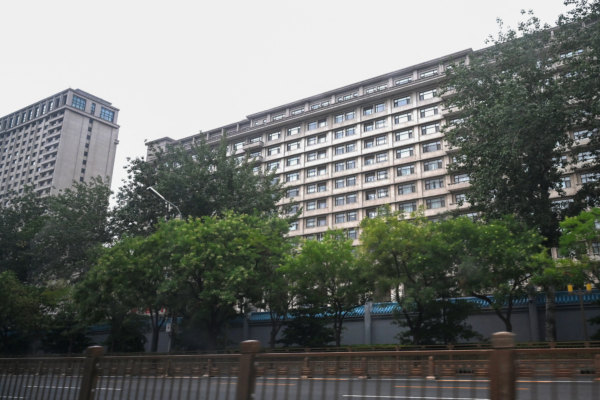
Amid the recent downfall of Vice Chairman of the Central Military Commission Zhang Youxia and Chief of the Joint Staff Department of the Central Military Commission Liu Zhenli, the official channels in China have remained silent on the details of the case. However, overseas social media platforms have been flooded with revelations, further highlighting the already highly sensitive political situation in China.
Following the investigation of Zhang and Liu, discussion surrounding an alleged “failed coup” quickly spread in foreign public opinion circles. Various sources, including some within the Chinese Communist Party system, have pointed to the same time and place – the Beijing Jingxi Guesthouse.
Overseas pro-democracy leader Sheng Xue recently disclosed information from her mainland Chinese friend (alias Mr. X), who revealed that on the night of January 18th, Xi Jinping was planning to stay at the Beijing Jingxi Guesthouse. That same evening, Zhang and Liu had intended to take action against Xi, but their plans were leaked about two hours before the operation. Xi promptly evacuated the guesthouse and deployed countermeasures. However, unaware that their plan had been exposed, Zhang and Liu’s side still sent people to the guesthouse, leading to a shootout resulting in casualties on both sides. Soon after, Xi Jinping’s faction swiftly took control of Zhang Youxia and Liu Zhenli, immediately detaining their family members.
Former media personality Zhao Yan disclosed further details of the shootout outside the Jingxi Guesthouse on social media on January 27. He mentioned that the Central Guard Bureau 61889 unit and the Special Operations Bureau were responsible for the arrest of Zhang and Liu, during which there was an exchange of gunfire between their security details, resulting in the deaths of dozens. Several Special Operations personnel from the Guard Bureau and Special Operations Bureau also lost their lives.
The 61889 unit is a security force under the leadership of the Central Guard Bureau responsible for safeguarding senior leaders, historically known as the Central Guard Regiment. Given the limited public information about this unit’s specific activities, confirming such reports through official channels is often challenging.
On January 24, the official announcement of the investigation into Zhang Youxia and Liu Zhenli came as a surprise to many. This swift public disclosure is highly unusual among recent high-ranking officials’ downfall cases in the Chinese Communist Party. Past cases involving senior military figures were often announced after a long period of “disappearance-observation-preparation,” whereas this instance had almost no buffer period, indicating the difficulty in containing the situation.
In response, Zhao Yan stated that the sounds of gunfire outside the Jingxi Guesthouse in Beijing were impossible to ignore, suggesting that transparency would be preferable to speculation.
An editorial in the People’s Liberation Army Daily stated that Zhang and Liu “seriously trampled on and destroyed the Chairman’s responsibility system of the Military Commission,” their actions causing “serious damage to the political ecology and combat readiness development of the military,” and having “extremely negative effects on the Party, the state, and the military.”
In the Chinese political context, the characterization of “seriously trampling on and destroying the Chairman’s responsibility system of the Military Commission” represents a high-level political judgment, exceeding typical corruption or disciplinary issues, often indicating a substantial challenge to the authority of the supreme commander-in-chief. Therefore, the strong language used by the military paper is seen by observers as an indirect acknowledgment of the claims of an attempted coup by Zhang Youxia and Liu Zhenli.
Amidst the mysterious operations of the Chinese Communist Party’s top echelons, public attention has shifted from the whereabouts of Zhang Youxia and Liu Zhenli to whether there are cracks in Beijing’s current overall power structure.
Videos circulating online show tightened security measures around Tiananmen Square in Beijing following the Zhang Youxia incident, with roads near the square classified as high-security zones.
Liu Junning, an active political commentator on an overseas platform, revealed that over 50 personnel were reassigned from the central committee and discipline inspection commission to the military discipline inspection commission. It is anticipated that more than 2,000 cadres at regimental level and above will face consequences, such as reassignment, retirement, or other forms of disciplinary action. An internal announcement within the Central Military Commission declared full military alert, ordering all units to stand ready and prohibiting any movements. The potential for chaos is imminent, urging individuals to prepare for various scenarios.
Another political commentator, Liu Min, leaked information that in various regions of China, military districts are simultaneously circulating documents known as “Eliminating Xi Jinping proclamations,” using exceedingly strong language to call for a correction of the current situation, demanding Xi Jinping’s exit from the Zhongnanhai leadership compound and central decision-making positions, as well as the relinquishment of all party and state duties.
Liu Min expressed that if these reports are accurate, it would mark an extremely rare instance of military political expression in the history of the Chinese Communist Party, suggesting open dissent within the military against the current power structure. Currently, official Chinese media outlets have remained silent, with related information swiftly being censored, leaving the authenticity and future direction of these events to be observed.
“Truth Signal”: The situation is far from settled, and uncertainties still exist…