
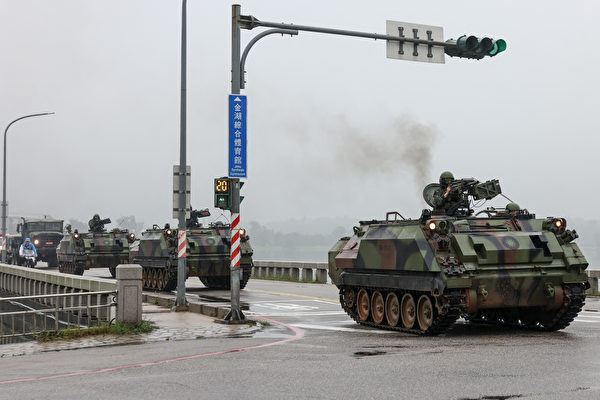
The Chinese Communist Party’s two-day multi-service military exercise surrounding Taiwan ended last Friday. The large-scale military exercise, dubbed as a comprehensive blockade of Taiwan, did not cause panic in Taiwan, and the Taiwanese military demonstrated its capability to shoot down advanced Chinese fighter jets at any time. Experts believe that the flaws in the Chinese military exercise show a disconnect from real wartime conditions, with the primary purpose being internal propaganda rather than military readiness.
The Chinese military exercise, labeled as “surrounding Taiwan,” targeted the Taiwan main island, as well as the offshore islands of Kinmen and Matsu.
During the two-day exercise, Chinese state media was filled with videos and reports of the Eastern Theater Command conducting joint operations of ships and aircraft, sea assaults, and land strikes in the sea and airspace around Taiwan. The Eastern Theater Command also released animated simulations of the troops approaching Taiwan’s main island and the offshore islands from multiple directions.
Taiwan’s Ministry of National Defense stated that on the 24th, a total of 62 instances of Chinese military aircraft and 27 instances of vessels were detected in the airspace around Taiwan, with 47 instances of military aircraft crossing the unofficial dividing line between the two sides of the Taiwan Strait known as the median line. This included Su-30 fighters and nuclear-capable H-6 bombers operating over the Taiwan Strait and the Bashi Channel between Taiwan and the Philippines.
Taiwan military closely monitored the situation using integrated surveillance means and promptly dispatched aircraft, ships, and land-based missile systems as appropriate. On the 24th, the Ministry of National Defense also released footage captured by the Taiwanese Air Force of Chinese J-16 fighters and H-6 bombers, without specifying the exact location where the footage was shot.
One video showed J-16 fighters and H-6 bombers being locked onto by Taiwanese F-16V fighters, demonstrating the capability to shoot them down with air-to-air missiles at the press of a button.
Director of the Institute of National Defense Strategy and Resources at Taiwan’s Institute for National Defense and Security Studies, Su Zi-Yun, stated to Epoch Times on the 26th that the Chinese military exercise was clearly aimed at domestic propaganda, diverting attention from the economic downturn. The so-called “six cross-sea killer” weapons promoted by state media, including concerns about a threat to Chiashan Base by some Taiwanese residents, do not actually exist.
Su Zi-Yun stated, “Taiwan’s Chiashan Base in Hualien has long-range air defense missiles and anti-ship missiles. In a real situation, the People’s Liberation Army’s aircraft and ships would not be allowed to approach. Taiwan has shown some of its strengths, including the mobile deployment of anti-ship missiles with a range of about 200 kilometers. It is very difficult for Chinese ships to break through the Bashi Channel or the Miyako Strait.”
Regarding the video released by the Taiwanese Air Force showing sniper targeting of Chinese aircraft, Su Zi-Yun mentioned that the sniper cockpit can capture targets up to approximately 180 kilometers in air-to-air mode. This means that Chinese military aircraft could be locked onto by Taiwan without their knowledge, and if necessary, Taiwan could launch long-range AIM-120 missiles for an attack. He believes that the disclosure of this information by the Taiwanese Ministry of National Defense serves as a warning to the Chinese military and also helps reassure the Taiwanese public.
The Chinese exercises over the two days did not involve live ammunition, Su Zi-Yun stated that the Chinese military exercise was more about public opinion than actual military operations, omitting live firing to reduce backlash from neighboring countries.
According to Voice of America, the U.S. Department of Defense stated that such exercises by the Chinese military provided a rare opportunity for the U.S. military to gain a deeper understanding of the operations of the Chinese military. These activities show how difficult it would be for the People’s Liberation Army to successfully carry out the type of mission they were practicing.
Su Zi-Yun mentioned to Epoch Times that Taiwan adopts a defensive strategy, making it relatively easier to concentrate local strengths; modern air defense missiles and anti-ship missiles can be conveniently combined with the geography of the strait for defense, assisted by other allied nations.
“The Chinese military exercises also provide a good observation opportunity for the U.S. military. It reveals some of the flaws in the Chinese military. In fact, if China truly wants to attack Taiwan, this kind of amphibious operation is very challenging, and once a link is broken, they would be defeated entirely,” Su commented.
Dr. Chung Chih-Tung of Taiwan’s Institute for National Defense and Security Studies told Epoch Times that the Chinese military exercises are disconnected from the reality of a war scenario. In the event of military conflict in the Taiwan Strait, if China cannot effectively neutralize Taiwan’s land-based air defense, anti-ship missiles, and mobile missiles, it would be highly unlikely for Chinese aircraft and vessels to freely operate in the airspace above Taiwan’s western coast as they do now. The same applies to the eastern coast.
Dr. Chung pointed out that Taiwan’s current missile density is second only to Israel. In a real conflict in the Taiwan Strait, it would be challenging for Chinese vessels to easily breach the first island chain and carry out exercises on the eastern coast as seen during their recent drills. This also involves issues of transoceanic attack and supply. Even if China manages to eliminate Taiwan’s air defense and anti-ship missile systems, conducting an amphibious landing would pose significant difficulties.
“The situation in the Taiwan Strait is quite different from the Russia-Ukraine conflict because China would need to launch a transoceanic attack, which is the biggest weakness.,” he added.