
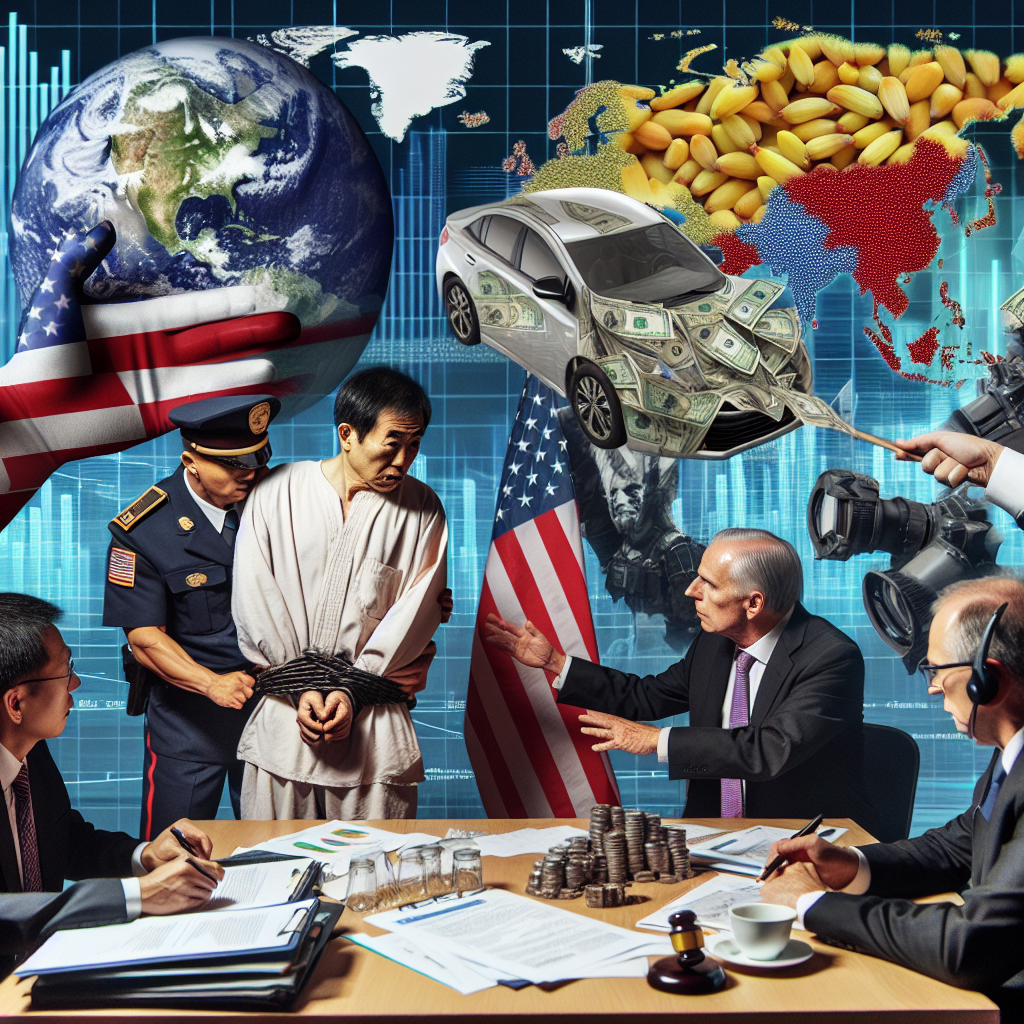
In the wake of the stunning arrest of Venezuelan President Maduro under Trump’s Hemisphere First initiative, the Chinese Communist Party invited Canadian Prime Minister Mark Carney for a state visit and to sign a series of agreements, including an electric car and canola seed swap program. Experts point out that as the CCP faces setbacks internationally and feels diplomatic pressure, it is attempting to sow discord between Canada and the US, although the reliability of China’s trade commitments remains in question.
Carney’s visit to Beijing, as reported by Xinhua News Agency, was at the invitation of Chinese Premier Li Keqiang. At the APEC summit in South Korea last October, Carney met with CCP leader Xi Jinping, who extended the invitation to visit China.
The report from Xinhua emphasized the “mutual reaffirmation of adhering to multilateralism” while criticizing the United States. Chinese Foreign Minister Wang Yi stated that Carney’s visit had “crucial and symbolic significance” for bilateral relations.
Carney’s visit marks the first by a Canadian Prime Minister to China in nearly a decade, with Sino-Canadian relations having been frosty for almost ten years. Commentary from outside observers often interprets the visit from the perspective of US-China relations.
Former City Councilor Shi Qing from Alberta expressed to the press that the CCP sees a rift between the US and Canada and is trying to exploit it to create a bigger divide.
“Rather than starting from a normal and stable relationship, it is a divisive scheme that seizes an opportunity in the crack.”
Professor Shen Rongqin from York University stated that the current international situation is unfavorable for the CCP. With Trump’s Monroe Doctrine aiming to eliminate the influence of China and Russia in the Western Hemisphere, the global authoritarian alliance, Iran’s preoccupation, the arrest of one of CCP’s key allies Maduro by the US, and Cuba losing its oil from Venezuela, China’s economy is on the verge of bankruptcy.
Shen indicated that the CCP is feeling pressure in its foreign affairs and needs Canada as a partner. The main objective may be to use this opportunity to strain US-Canada relations and prevent further setbacks for China internationally.
Of notable interest in the agreement between Canada and China is the electric vehicles and canola seed swap deal.
Following the meeting on the 16th, Carney announced that China’s annual export limit of electric cars to Canada would be 49,000 vehicles, with a tariff of 6.1%, gradually increasing to around 70,000 vehicles over five years. China will reduce the tariff on Canadian canola seeds from 84% to approximately 15%.
Under former Prime Minister Trudeau, Canada imposed a 100% tariff on Chinese electric cars, as well as a 25% tariff on steel and aluminum. In retaliation, China immediately imposed a 100% tariff on Canadian canola oil and canola meal, and a 25% tariff on pork and seafood.
Last August, China imposed additional high tariffs on canola seeds from Canada, effectively blocking Canadian canola from entering the Chinese market.
According to Chinese trade data, the total import value from Canada to China decreased by 10.4% last year to $41.7 billion.
China is Canada’s second-largest trading partner, but the trade volume still falls far behind that of the US. Over the past 12 months, bilateral trade between Canada and China amounted to approximately $80 billion, less than one-tenth of the US-Canada trade volume (around $1 trillion).
Shen mentioned that at the end of last year, China reached an agreement with Australia to allow the export of canola seeds to China. Canada faces difficulties as if Australia exports canola seeds to China, there will be immense pressure on Canada. For Carney, since initially imposing tariffs on Chinese electric cars was at the request of the US, and now with the strained US-Canada relations, it might be better to lower tariffs for Chinese electric cars to secure an opening for Canadian canola seeds, preventing Australia from taking over the market.
Shi Qing commented that China’s agreement to purchase Canadian canola seed is very risky. Did they fulfill their promise to purchase soybeans from the US? If the Canadian government encourages farmers to plant more canola seeds based on the agreement, it is a very risky move. China can always say they are not buying anymore; this rogue regime can do it at any time, tearing up the agreement if it displeases them, potentially without harming any interests.
“Canadian farmers could choose to grow other crops needed by other countries, there is no need to particularly focus on growing more canola just for China. Allowing themselves to be kidnapped is very disadvantageous.”
Prominent self-media personality Master Shen, on his self-media channel, stated that China will not genuinely open its market to Canada or provide significant investments. The demand for Canada’s energy and agricultural products is limited. Once China feels they are not getting enough benefits from Canada or no longer needs to use Canada in its game with the US, they could easily turn their backs.
“China is the problem itself, not the solution,” he said.
In recent years, the frequency, scale, and means of economic coercion by China have significantly increased, targeting a wide range of countries, becoming an increasingly common phenomenon (evidenced by Japan’s recent experience).
Shen noted that China has retaliated twice against Canadian canola seeds. Initially during the Meng Wanzhou incident, claiming pests were found in Canadian canola seeds, and now alleging Canada monopolizes canola seeds. Ultimately, these are just excuses.
Canada is the world’s largest exporter of canola seeds, with Australia being the second-largest. It is not feasible for China to simultaneously impose trade retaliation on Canada and Australia. In 2020, during the hostage diplomacy and the Meng Wanzhou incident, China quietly lifted the ban on Canadian canola seeds and imported them on a large scale, causing a surge in prices. At that time, China had just recovered from African swine fever and needed to rapidly develop the pig industry, requiring canola seeds as pig feed.
Canada’s promise to open its market to Chinese electric cars has garnered significant criticism.
Ontario’s Premier Doug Ford strongly criticized the deal, stating on social media: “There is no doubt that China (CCP) has now firmly established itself in the Canadian market and will fully exploit this advantage at the cost of Canadian workers’ interests.”
“Even worse, this unbalanced agreement by reducing tariffs on Chinese electric cars could potentially close the door for Canadian car manufacturers to enter the US market, our largest export destination.”
When questioned about Canada’s decision to import Chinese electric cars, US Secretary of Transportation Sean Duffy responded on the 16th, saying, “I believe they will reconsider this decision, and they will surely regret bringing Chinese cars into their market.”
US Trade Representative Jamieson Greer also believes that Canada will regret reaching this agreement.
Shen noted that amid overcapacity, Europe began imposing taxes on Chinese electric cars, while both the US and Canada imposed 100% tariffs. In this scenario, China direly needs to find a market for electric cars globally. Although the agreement might aid Canadian farmers, it could potentially harm Canadian auto workers in reality.
Shen stated that one of the USMCA agreement’s core industries is the automotive industry. While Trump mentioned not needing cars from Mexico and Canada, in reality, 50% of US auto components come from Canada and Mexico. Specific models are manufactured in Canada and then shipped to the US.
He mentioned that the USMCA agreement also states that when signing trade agreements with non-market economies, consent from the other two nations is required. The core focus of non-market economies is essentially China. Now that Canada has signed a trade deal with China, if the USMCA were to be renegotiated in the future, the US might voice dissatisfaction to Canada using this as leverage, potentially causing difficulties for Canada.
Shi Qing said that Canada will undoubtedly regret it, first and foremost because it will offend countries that have imposed sanctions on Chinese electric cars such as the US. Currently, as China’s economy is mired in difficulties, it is unlikely to provide substantial market share to Canada. Even short-term benefits would be challenging to achieve. Offending the US is certain; it could lead to the destruction of the North American Free Trade Agreement or result in worse treatment, causing significant harm to Canada.
He pointed out that secondly, Chinese electric cars are highly unsafe; incidents like spontaneous combustion or sudden lockups could occur in Canada. Even if they are manufactured in Canada, as long as their personnel manage them, prioritizing profit or speed, safety risks could arise sooner or later.
“In the future, when Canadians drive or encounter these cars on the road, as consumers or pedestrians, they will truly despair.”
Shi Qing stated that historically, China does not respect human rights or abide by rules. Previously, Chinese oil companies built oil tanks in Canada, flouting regulations and racing to win competition, resulting in the tanks collapsing before they were completed, causing the deaths of two Canadians.
He emphasized that Chinese electric cars should not be allowed into Canada at all, let alone allowing Chinese manufacturers to build electric car factories in Canada. As long as there is Chinese capital and management involved, safety and quality issues will persist. Furthermore, Chinese involvement will lead to non-beneficial competition, disrupting market order and potentially causing chaos if China triumphs, destroying Canada’s market and undermining quality industries, which is definitely not a good outcome.
Master Shen believes that for Canada, the surge in China’s overcapacity exports means that the trade deficit will further expand. Attracting Chinese companies to set up factories in Canada, essentially transforming Chinese manufacturing into Canadian manufacturing, is entirely unrealistic. The competitiveness of Chinese enterprises largely relies on China’s domestic low-cost advantages, inexpensive labor, and substantial government subsidies. Once factories relocate to Canada, these advantages are nullified.
The joint statement by China highlighted the talks as “promoting a new type of strategic partnership between China and Canada” and “agreeing to strengthen contacts at all levels.”
However, in an interview with reporters, Carney clearly stated that for countries with differing values, Canada would engage in “narrower and more targeted” contacts. He remarked, “We are very clear on our cooperation areas and where our differences lie.”
Shen mentioned that much of China’s cooperation with Canada is superficial, appearing very favorable on the surface but yielding much lesser results in reality.
He cited the example of the latest currency swap agreement between the People’s Bank of China and the Bank of Canada, exchanging 200 billion renminbi, equivalent to 30 billion Canadian dollars; this is the third time the two countries have entered into such an agreement.
Shen noted that after the first agreement between Canada and China, there was no exchange of the two currencies for five years. In the second agreement, although there was a 200 billion quota, only a few hundred billion renminbi were actually exchanged. With the third agreement now signed, how effective could you expect it to be?
Shen mentioned that China has signed such agreements with many countries aiming to challenge the US dollar. However, Canada did not have the intention to challenge the US dollar, so from the beginning, Canada viewed the agreement more as a formality.
Shen stated that Canada and the US’s aerospace and air defense are interconnected, and their defense is closely interdependent. Even if there are conflicts between the US and Canada, should there be a geopolitical conflict, Canada would stand with the US, not with China.
Master Shen remarked that the geopolitical competition between the US and China has entered a new stage. As America’s closest ally and neighbor, Canada cannot stay neutral or sit on the fence between the US and China. For a mid-sized country like Canada, the only correct choice is to firmly stand with its neighboring country.