
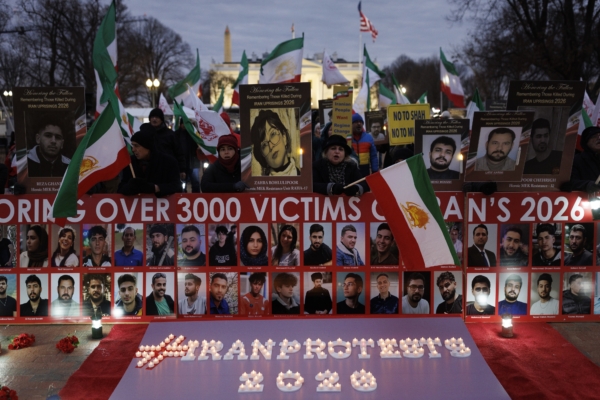
According to the latest data from human rights organizations, the death toll from the protests that erupted in Iran at the end of December last year has surpassed 3,000 people. Despite a nationwide internet shutdown lasting over 200 hours, communication has seen a slight recovery today. However, activists warn that this may signal Iran’s permanent disconnection from the global internet and the implementation of a “digital iron curtain”.
Based on statistics from the US-based “Human Rights Activists News Agency” (HRANA), following 20 days of protest activities, the confirmed death toll has reached 3,090 people, with another 3,882 cases still under verification. At least 2,055 people have been seriously injured, and the number of those arrested has risen to 22,123.
Reuters reported that the authorities’ severe crackdown seemed to temporarily quell the protests, with the streets of Tehran relatively calm for the past four days. However, residents reported the continued presence of drones flying over the city center.
Monitoring organization NetBlocks pointed out on the X social platform: “This morning, there was a slight improvement in Iran’s network connectivity. However, the overall connection capacity remains at around 2%, with no significant signs of recovery.”
This indicates that the majority of the population is still experiencing a blackout.
In a report, the organization “Filterwatch”, which monitors internet censorship in Iran, suggested that the Iranian government may intend to restrict internet access to a few selected individuals.
“We are entering a new era: accessing the internet is no longer a right but a privilege granted by the government,” the report stated. “In this closed internal network, only individuals on a strict ‘whitelist’ approved through rigorous scrutiny are allowed access to the outside world.”
Filterwatch stated that an Iranian government spokesperson, Fatemeh Mohajerani, hinted to local media that the disconnection from the international internet could last at least until the Persian New Year on March 20. Even after that, users are not expected to regain their previous access to the international internet.
The head of the organization, Amir Rashidi, said that the Iranian authorities intend to transform the current temporary internet blackout into a institutionalized, long-term, or even permanent governance tool.
“The authorities seem satisfied with the current level of network connectivity, believing that such a blackout measure helps control the situation,” Rashidi said.
Under this plan, apart from a few individuals approved through security checks, the majority of Iranians would be restricted to an isolated “national internet.”
This comprehensive control over the internet is seen as the culmination of a 16-year strategy by the regime. Experts from research institutions Project Ainita and the Outline Foundation pointed out that the whitelisting filtering system used in Iran “may be supported by technology exported from China.”
These high-performance devices from China, installed at various network nodes, enable the government to monitor individual users, block specific protocols and VPN tools, thus gaining full control over data flow.
This technology grants the Iranian government a level of digital control surpassing that of other authoritarian states.
Iran has been advancing the concept of a “national internet”, an internal parallel network isolated from the external world, since 2009. That year, following the re-election of former Iranian President Mahmoud Ahmadinejad, there were massive protests, leading authorities to briefly shut down the internet and later realize the high cost of a “total blackout.”
Researchers from the Outline Foundation and Project Ainita told The Guardian, “They just unplugged the power without much thought. They had never done that before.”
“That essentially plunged the entire internet into chaos, causing a lot of harm to themselves,” the researchers said.
In 2012, the Iranian government established the “Supreme Council of Cyberspace” and began planning for a domestic “intranet.”
Over time, authorities improved their internet censorship methods, such as blocking services like Facebook, Twitter, and Google during protests in 2012 while allowing other economically valuable services to continue operating.
Over the next 10 years, the Iranian authorities compelled online businesses, banks, and internet service providers to move their core infrastructure (data centers and offices) back to Iran. Authorities provided tax exemptions to cooperating entities and prevented refuseniks from conducting business in Iran.
In 2015, a group of researchers purchased server space in Iran using Bitcoin and began scanning the country’s IP addresses, discovering that Iran was constructing an internal, fully isolated internet network.
Filterwatch confirmed that following the outbreak of protests, the CEO of Iranian telecom company Irancell was reportedly dismissed punitively for allegedly delaying orders to cut internet connectivity, charged with “treason.”
Filterwatch indicated that the immediate impact of the internet blockade was evident within a few days of its implementation. Logistics data showed that e-commerce came to a standstill. For example, the private postal company, Tipax, which handled around 320,000 packages per day before the protests, saw its total shipments drop to less than a few hundred after the complete blackout. This disruption indicated a significant interruption in the supply chain.
A former US State Department official who had worked on internet censorship told The Guardian that Iran’s idea of permanently disconnecting from the global internet is “both reasonable and frightening,” but it also comes with a high cost.
“They can do this, it’s not entirely impossible, but observing the development of such events, the economic and cultural impact would be enormous. They might end up shooting themselves in the foot.”
The former State Department official pointed out that Iran’s recent demonstration of network control capabilities was quite astonishing, even exceeding other authoritarian regimes attempting to emulate it. However, whether Iran can permanently disconnect from the international internet remains to be seen.
“Digital rights groups issuing warnings are correct. However, this action will have serious repercussions for the Iranian authorities, and they will be held responsible for the economic damage,” the former official told The Guardian.