
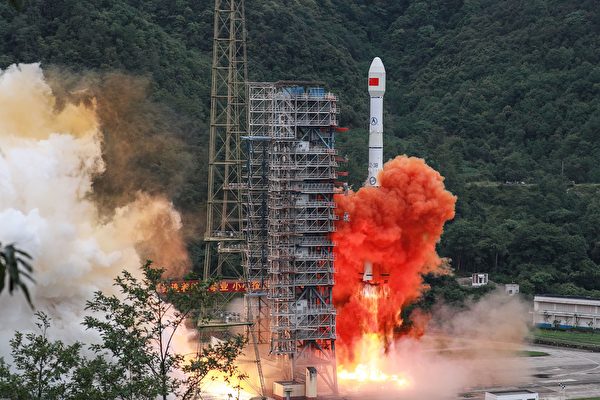
On January 17th, the Chinese Communist Party attempted to launch the 32nd satellite using the Long March 3B rocket, but the launch mission failed due to abnormalities during the rocket’s flight. On the same day, the Gu Shen Xing 2 commercial private carrier rocket also failed its maiden flight test mission at the Jiuquan Satellite Launch Center.
The official Xinhua News Agency reported that the launch mission took place at 12:55 AM on January 17th at the Xichang Satellite Launch Center, ending in failure. The specific reasons for the failure are currently under further analysis and investigation.
According to mainland media reports, the Long March 3B is a medium-sized liquid carrier rocket developed mainly by the China Aerospace Science and Technology Corporation No.1 Institute, using a three-and-a-half-stage parallel configuration. It is primarily used for launching missions into high Earth orbit while also capable of executing missions to low Earth orbit and deep space. The Long March 3B is one of the most commonly used high-orbit carrier rockets by the Chinese Communist Party and has previously undertaken numerous important satellite launch missions.
Furthermore, Xinhua News Agency later reported that at 12:08 PM on January 17th, the Gu Shen Xing 2 commercial private carrier rocket ignited and took off at the Jiuquan Satellite Launch Center, but the rocket experienced abnormalities during its flight, resulting in the failure of its maiden flight test mission. The specific reasons for this failure are also undergoing further analysis and investigation.
In recent times, there have been numerous launch failures in the Chinese Communist Party’s rocket launches. The domestically developed reusable carrier rocket, Long March 12A, suffered a failed recovery mission of its first stage during its inaugural test launch on December 23rd last year. On December 3rd, the Landspace Aerospace’s Zhuque 3 Y1 carrier rocket launched but encountered abnormal combustion during the first-stage recovery process, failing to achieve a soft landing at the recovery site.
The private enterprise Space Pioneer Technology’s Gu Shen Xing 1 failed to place a satellite into the intended orbit back in November last year.
Several aerospace industry professionals have indicated to reporters that due to the recurring incidents in rocket launches, there has been renewed discussion within the Chinese military about Feng Shui.
One insider mentioned that last year’s missions falling short of expectations led to increased discussions within the military and aerospace systems, with some attributing the issues to not consulting Feng Shui masters as per traditional practice.
It is said that before Xi Jinping came to power, related units would invite Feng Shui masters to examine the launch site and adjust equipment placement before each rocket launch. A brief ceremony would also be conducted with the burning of incense.
Additionally, individuals close to the military mentioned to reporters that following the recent rocket failures, some have raised concerns about not following the traditional practice of consulting Feng Shui masters. While this notion lacks scientific basis, it is still being discussed within the system.
Moreover, discussions among some individuals with military backgrounds and aerospace industry practitioners have explored recent failure causes, including power struggles and budget constraints within certain units.