
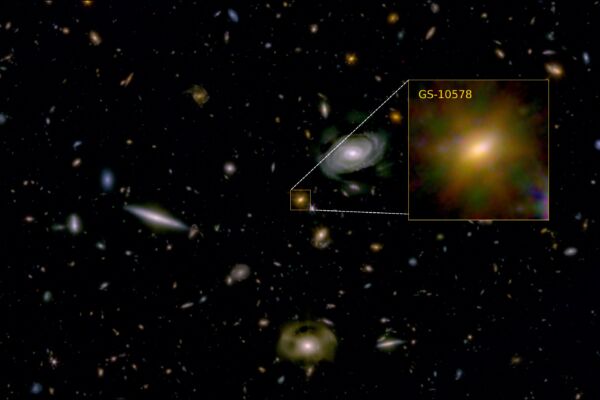
Astronomers have discovered a young galaxy in the early universe that has already died, succumbing to the relentless torture of a supermassive black hole, ultimately meeting an untimely demise. This marks one of the oldest dead galaxies found to date.
According to a press release from the University of Cambridge in the United Kingdom on January 12th, researchers at the university led a study using data from the James Webb Space Telescope and the Atacama Large Millimeter/submillimeter Array (ALMA) to examine a galaxy from the early universe, approximately 3 billion years after the Big Bang.
Named GS-10578, the galaxy is also known by the moniker “Pablo’s galaxy.” For the early stages of the universe, this galaxy had an exceptionally large mass, roughly 200 billion times that of the sun, with most of its stars forming between 12.5 billion and 11.5 billion years ago.
GS-10578 appears to have met an untimely demise as it ceased forming new stars, primarily due to a severe lack of the cool gas necessary for star formation. The central supermassive black hole in the galaxy seems to be the culprit, continuously heating the gas within and around the galaxy, preventing the replenishment of fresh gas and ultimately stifling star formation.
Researchers conducted nearly 7 hours of observations on the galaxy using ALMA, hoping to detect carbon monoxide—a tracer for cool hydrogen gas—but to no avail.
Lead author of the study, Jan Scholtz from the Cavendish Laboratory and Kavli Institute for Cosmology at the University of Cambridge, noted that despite these being some of the most in-depth observations of such galaxies by ALMA, minimal cold gas remnants were found. This suggests that the demise of the galaxy was a gradual process rather than a sudden catastrophic event.
Meanwhile, spectral observations from the Webb Space Telescope revealed that the supermassive black hole in the galaxy was expelling powerful neutral gas flows at speeds of up to 400 kilometers per second, carrying away gas equivalent to 60 solar masses annually. These data indicate that the remaining fuel in the galaxy will be depleted within a relatively short period of 16 million to 220 million years—much faster than the typical timescales of similar galaxies that usually require billions of years.
By reconstructing the galaxy’s history of star formation, researchers concluded that the net inflow of gas into the galaxy during its evolution was zero, indicating a lack of fresh gas replenishment. The black hole seems to have prevented the self-replenishment of the galaxy by repeatedly heating or expelling inflowing material.
Scholtz remarked, “You don’t need a major disaster to halt star formation in a galaxy, just preventing the inflow of fresh fuel is enough.”
This discovery helps explain the abundance of massive and unusually ancient galaxies observed by the Webb Space Telescope in the early universe, shedding light on phenomena previously unheard of before the telescope’s advent.
Scholtz added, “Now we know they are much more common than we imagined, and this ‘starvation effect’ may explain why they meet an untimely demise.”
The findings of this study were published in the journal Nature Astronomy on January 12th.