
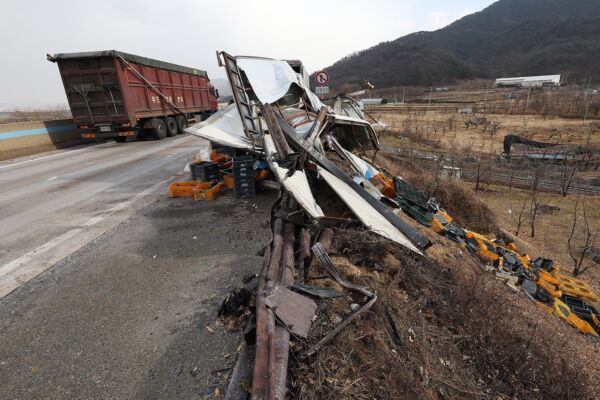
On Saturday morning (January 10th), a series of chain collisions occurred on a section of the Yeongdeok Expressway in Ryesan, South Korea, involving approximately 30 vehicles and resulting in at least 5 deaths with several others injured. Preliminary investigations suggest that the cause of the accident may be related to the sudden drop in temperature leading to the formation of a thin layer of ice on the road, commonly known as “Black Ice.”
One of the accidents reportedly took place around 6:20 am near the Namyangju Interchange. A 9.5-ton truck traveling towards Yeongdeok collided with a guardrail while attempting to avoid a vehicle parked on the road, causing it to plummet below the road surface. The driver of the truck died on the spot, triggering a chain collision on that section of the road.
Almost simultaneously, about 1 kilometer away in the opposite direction towards Cheongju, a trailer rear-ended a vehicle, leading to a multi-vehicle collision. One sedan was involved, resulting in the fatalities of all four occupants.
Local authorities have stated that they are currently investigating whether there is any connection between these two chain collision accidents.
Furthermore, around 6:35 am, an SUV collided with a truck near the interchange, crashed into the guardrail, caught fire, and all occupants inside the vehicle sustained burn injuries.
A significant number of personnel from the fire department were dispatched urgently to the scene for rescue operations, confirming that approximately 30 vehicles were damaged. Due to the accident, the section of the road near the incident location was temporarily closed in both directions.
With light rain falling at the time of the accidents and the minimum temperature in Namyangju dropping to -2.4 degrees Celsius that day, authorities speculate that the accidents were likely caused by Black Ice. However, the exact reasons still require further investigation.
According to data from the Korea Expressway Corporation, the slipperiness of a road surface with Black Ice is approximately 14 times greater than that of a regular wet road surface and even about 6 times more slippery than a road covered with snow, making it a common cause of major traffic accidents during the winter season.