
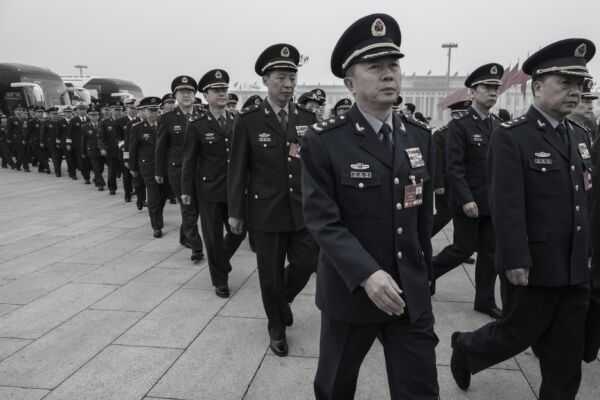
Recently, the news of the passing of Vice Admiral Wang Zheng of the Chinese People’s Liberation Army Navy at the age of 64 has saddened many. Wang Zheng had served in both the Air Force and Navy and had connections with several high-ranking military officials who have fallen from grace or faced rumors of misconduct.
According to a report by The Paper, Vice Admiral Wang Zheng, who had served as the former Deputy Political Commissar of the PLA Navy, passed away on the night of January 3, 2026, at the age of 64 due to ineffective medical treatment.
Born in 1961 in Jingxian, Hebei Province, Wang Zheng had held various positions within the Chinese Communist Party, including serving as the Director of the Propaganda Department of the Air Force Political Department and as the Political Commissar of the Air Force Research Institute from 2012 to 2014. In November 2014, he was transferred to the position of Director of the Political Department of the Jinan Military Region Air Force.
In January 2016, Wang Zheng took on additional roles as the Political Commissar of the Jinan Military Region Air Force Post-incident Office and Director of the North Military Region Air Force Political Work Department. During his tenure, he crossed paths with Air Force Commanders such as Ding Laihang (2016-2017) and Xu Xueqiang (2017-2021) and served under the leadership of Air Force Political Commissar Bai Wenqi (2016-2018).
Amidst the recent turbulence within the Chinese military, Vice Admiral Wang Zheng’s passing has raised speculation about the circumstances surrounding his death given the context of other high-profile military officials facing repercussions or coming under scrutiny.
The Chinese military’s purge in recent years has seen a significant number of high-ranking officials associated with both the Air Force and Navy facing disciplinary actions or falling from grace. The crackdown has extended to key figures in the military establishment, raising questions about the political implications and power struggles within the party.
The passing of figures like Vice Admiral Wang Zheng, together with reports of other military leaders such as General Xu Qiliang and Vice Admiral Wu Guohua, who have passed away under various circumstances, adds another layer of complexity to the ongoing shake-up within the Chinese military.
As the Chinese Communist Party continues its campaign to root out corruption and ensure loyalty within its ranks, the sudden demise of Vice Admiral Wang Zheng has once again put a spotlight on the inner workings of the military and the political dynamics at play within the leadership hierarchy.
Against the backdrop of these events, the Chinese public and observers both within and outside the country are closely watching how the leadership handles these internal challenges and what implications they may have for the future direction of the military and the party as a whole.