
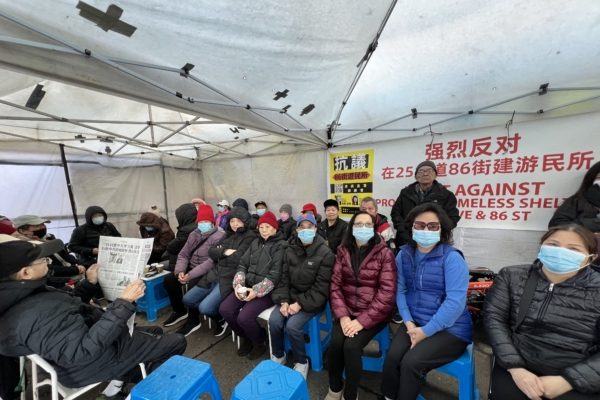
Brooklyn’s Chinese community’s opposition to the construction projects of vagrants has been making waves in the city’s administrative procedures recently. Following the Sheep’s Head Bay community’s complaint to the New York City Board of Standards and Appeals (BSA) regarding the vagrant construction project on Avenue U, which allegedly did not apply for rainwater discharge engineering permits as required by law, another similar case at 2501 Bensonhurst 86th Street is now officially entering the BSA review process due to a key legal dispute over the existence of a valid contract.
Represented by community residents Ma Sheng and Alex, the people submitted an appeal to the BSA on December 24, 2025, which was officially accepted on December 30, with the case number 2025-55-A. The case is currently awaiting the collection of all pertinent information by the BSA, with a public hearing expected to be scheduled in the coming months to half a year.
The central point of contention regarding the Bensonhurst 86th Street vagrant construction case revolves around a legal term – “Active Contract.”
According to Section 32-153 of the New York City Zoning Resolution, developer Sandu’s temporary hotel for vagrants essentially must apply for a “Hotel Special Permit” from the New York City City Planning Commission (CPC), which, after public review, allows for construction. While the provision includes an exemption clause for “vagrant shelters,” the precondition is that the facility must operate based on “effective city or state government contracts or other written agreements clearly designating public use.”
Residents point out that the New York City Department of Homeless Services (DHS) has not signed any formal contracts with the operator of the vagrant facility VIP, with only a letter of intent or memorandum expressing cooperation dated December 6, 2023. However, “intent” does not equate to a contract under the law and does not meet the statutory requirements to exempt the CPC Special Permit.
In a ruling on December 5, 2025, regarding the residents’ zoning challenge appeal, Keith L. Wen, the Deputy Director of the Department of Buildings responsible for regulations and zoning interpretations, admitted that the DHS letter “is not a written agreement” but believed it indicated that both parties were in the process of contract signing and agreed to require the DHS to submit a “third confirmation letter” before issuing a temporary or final certificate of occupancy (TCO/CO) to confirm the contract had been formally signed. Therefore, the DOB ruled that the project could still be approved at this stage and used this as the basis to reject the residents’ appeal.
Residents, however, question the DOB’s action as being in violation of its regulations because the CPC Hotel Special Permit can only “waive” and not “defer” under the law, leaving no legitimate space for a “contract first, building later” scenario. The Department of Buildings’ disregard for its own rules leads to a typical paradox in the “chicken and egg” institutional system.
Residents highlight that this case does not involve complicated architectural techniques or structural regulations but focuses solely on two issues: the existence of a valid contract and whether the DOB has the authority to approve building plans without a contract in place. Because of the clear points of contention, the BSA can readily see the core of the issue when accepting the case, enabling residents to advance the case even without hiring expensive lawyers.
Under the New York City Rules (1RCNY), zoning dispute cases cannot be directly brought to court, and parties must exhaust all administrative remedies; otherwise, even with sufficient reasoning, the court would dismiss the case on the grounds of incomplete procedures.
The complete procedure involves: residents challenging zoning with the DOB; after the DOB’s decision, residents must appeal within 15 days; once the DOB makes its final administrative decision, the case may then be appealed to the BSA; if the BSA’s ruling remains unfavorable, the parties can then proceed to court.
Residents must challenge zoning within 45 days of the DOB approving building plans; after the DOB’s decision, residents have 15 days to appeal zoning; within 30 days of the DOB’s final administrative decision, the case may be appealed to the New York City Board of Standards and Appeals (BSA); if the BSA’s ruling is still against residents, parties are eligible to file a judicial lawsuit within 30 days.
Residents revealed that during the most recent 15-day appeal window, the DOB briefly shut down the appeals platform, almost causing the community to permanently lose its appeal rights. After intervention and pressure from City Councilor Zhuang Wenyi and State Senator Chen Xueli’s offices, the platform was reopened approximately a week later, allowing residents to successfully file an appeal and receive the DOB’s rejection ruling about half a year later, officially obtaining the “ticket” to appeal to the BSA.
Currently, the 86th Street vagrant construction case has entered the BSA review stage, awaiting the submission of additional information from all parties, including the Department of Buildings, the developer, and residents. After the information is collected, the BSA will schedule a public hearing, during which all stakeholders, including elected officials and community representatives, can publicly express their views.
Residents stated that if the BSA rules in favor of the residents, the project would be overturned; if the developer still wishes to proceed with the hotel project, they would need to go through the entire legal process again, starting with applying for the CPC’s Hotel Special Permit, beginning with submission to the local community board for review, making the entire process lengthy and fraught with uncertainties.
If the BSA’s ruling is unfavorable to residents, the community will proceed through the judicial path, continuing to fight for their rights. The community urges professionals familiar with land use and zoning regulations to submit information to the BSA if they find any other procedural or legal disputes in the case, for review.