
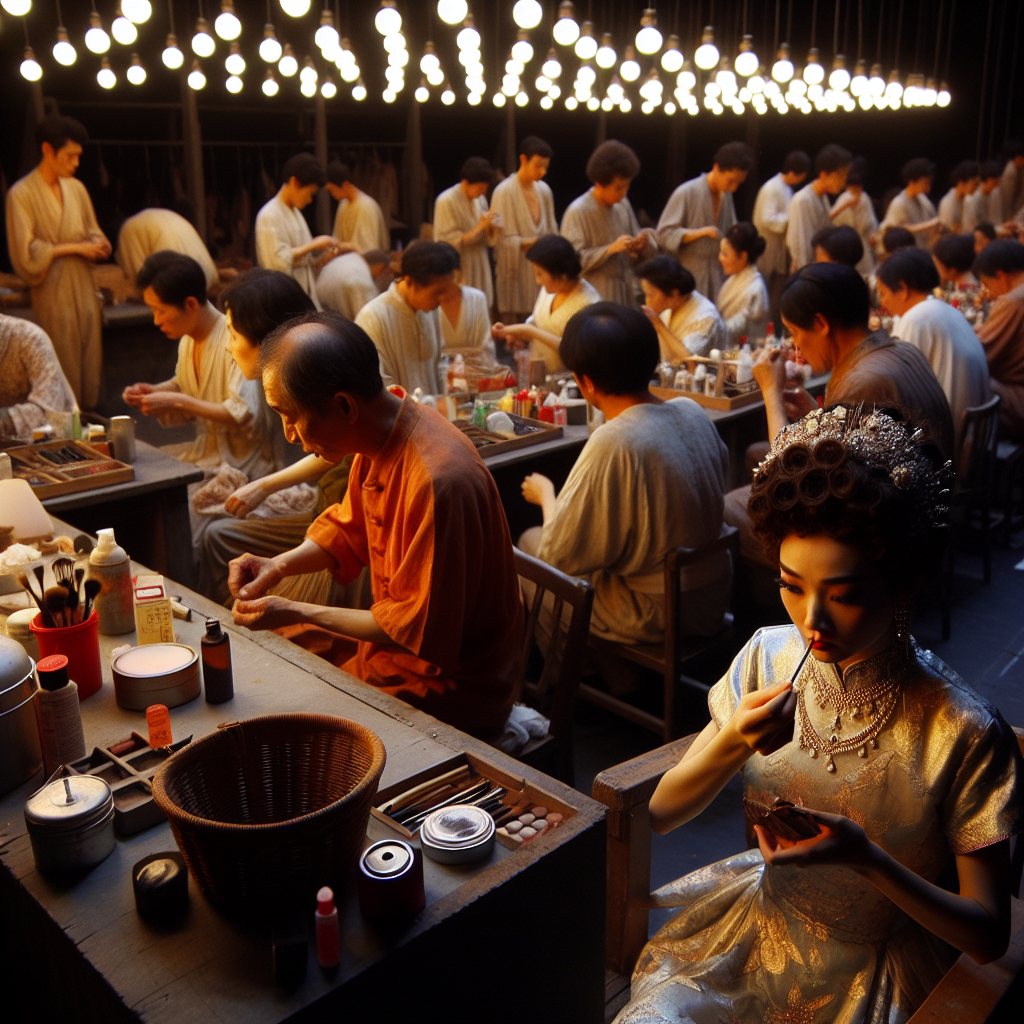
One day in early summer 1966, backstage at a theater in Beijing, under dim lighting, people were nervously preparing for the evening performance. Some actors were putting on makeup, some were getting dressed in costumes, and some were warming up their voices.
The star of the evening was the Peking Opera master Ma Lianliang. His makeup was done, his attire was almost perfect, ready as usual to warm up his voice. However, just as he was about to start singing, a broadcast in the backstage suddenly exploded, breaking the previously lively atmosphere. It was a criticism article published by Yao Wenyuan in the “Wen Hui Bao”, with sharp words like knives: Zhou Xinfang’s performance in “Hai Rui’s Petition” was labeled as “great poison”.
As soon as the words were spoken, Ma Lianliang’s hand trembled as if struck by lightning. Suddenly, he remembered the advice of a fortune teller before leaving Hong Kong years ago, his face turning pale in an instant, shouting three times, “It’s over! It’s over! It’s over!”
Why was the master so afraid? What did the fortune teller say to him? What fate would he face next?
Ma Lianliang, also known as Wenru, was born in 1901 and was one of the “Three Great Families” of Peking Opera during the Republic of China era. He was the founder of the “Ma School” in Peking Opera and a prominent figure among the “Four Great Bearded Men”.
He started performing on stage at the age of eight, graduated at 17, furthered his studies, and at 26, he established his own troupe, becoming a leading figure.
His performance style was elegant and graceful, every movement precise, while his singing voice was flowing and powerful, a perfect blend of strength and softness, stability and agility. The character of Zhuge Liang on the Peking Opera stage almost became his exclusive role. The excerpt “Borrowing the East Wind” that he performed has been handed down for a hundred years and is still a gem among the old male roles.
In Beijing, whether in the hutongs, university lecture halls, or professors’ small buildings, people sang the Ma School arias. He was not only a superstar on stage but also the “symbol of national drama” in the hearts of the Chinese at that time.
However, just as his career was thriving, the winds of fate began to shift silently.
After the end of the war, Ma Lianliang was once wanted by the Nationalist government for performing during the puppet regime era, forcing him to flee to Hong Kong. At that time, although he stayed away from political turmoil, his heart was with his elderly mother in Beijing.
In 1951, the situation changed. Both Taiwan and the mainland extended invitations to him. Faced with a dilemma, he leaned towards returning to Beijing – after all, his mother was nearly ninety years old, and how could he ignore her longing as a wanderer?
But how would the Communist Party treat artists like him? He was unsure. So, he asked his daughter working in Beijing to request a statement from Zhou Enlai.
Zhou Enlai’s reply was comforting: “All past grievances will be wiped clean,” “Any debts owed in Hong Kong will be compensated by the state,” “After returning, all aspects of life will be taken care of.”
Zhou Enlai also particularly reassured him, saying: “Don’t worry about the performances during the puppet regime. You are an actor, earning a living by performing, not a political figure.” These words were like a soothing balm, allowing Ma Lianliang to completely let down his guard.
Before leaving, he went to have his fortune told. The divination indicated that he would have fifteen years of good fortune. Without further inquiry, he felt it was a good omen. So, he took his wife and son and resolutely set off on his return journey.
However, he could not have imagined that this so-called fifteen years of “good fortune” would come to an abrupt halt in the turmoil of the Cultural Revolution.
Upon returning to Beijing, Ma Lianliang reestablished the “Ma Lianliang Troupe”, full of enthusiasm to start anew. In 1953, during the “Anti-US Aid Korea” period, he even volunteered to join the “Third Visiting Delegation to Korea” and performed in Korea for six months.
However, he forgot that the rules of the stage had changed.
In the traditional theater system, actors earned a living from performances, and even when performing for emperors, they received payment. So he naturally demanded his performance fees. Initially, his asking price was the equivalent of thousands of dollars today, but he gradually lowered it, even down to fifty yuan per show.
But in the eyes of the Communist Party, this was not regarded as “customary” but a political issue. “You perform for the most beloved people and still want money?!”
He faced criticisms within the troupe and later publicly apologized in the “Theatre Newspaper”.
Subsequently, like countless private enterprises nationwide, the Peking Opera industry was also “merged” with the public sector. Ma Lianliang’s troupe was merged into the Beijing Peking Opera II Troupe, where he became the head on paper but had actually lost his freedom.
In 1957, the “Anti-Rightist Movement” swept across the country, and intellectuals were on the front lines.
Due to the efforts of Beijing Mayor Peng Zhen, Ma Lianliang narrowly escaped, but his first disciple Li Wanchun was branded as a rightist.
He was pressured to take a clear stand at a criticism session. Ma Lianliang hesitated until the end before speaking just a few words and stepping down. After the meeting, he told his disciple in a low voice with regret: “Wanchun, I hope you don’t resent me. I didn’t want to criticize you; they made me say it. I heard that originally, I was supposed to be the rightist to be criticized, but they changed it to you at the last minute.”
Li Wanchun was sent to Inner Mongolia for a long period of reform through labor.
In 1959, the Beijing Peking Opera Troupe premiered “Zhao’s Orphan”, featuring the four leading actors Ma Lianliang, Tan Fuying, Qiu Shengrong, and Zhang Junqiu, receiving widespread acclaim. However, this play was singled out by Jiang Qing as “poisonous” because it focused on revenge, raising questions about whose suffering and whose enmity it comforted.
Afterward, traditional plays were banned, and revolutionary model operas took the stage. Ma Lianliang and other veteran artists deeply resented Jiang Qing’s model operas, but they dared not speak out.
In 1959, Mao Zedong praised the Ming Dynasty righteous official Hai Rui for “daring to speak the truth,” leading Wu Han to write “Hai Rui Dismissed from Office” and “On Hai Rui”. Coincidentally, when Ma Lianliang was searching for a new script, he collaborated with Wu Han, revising the script seven times, and staged “Hai Rui Dismissed from Office”.
At the end of 1960, “Hai Rui Dismissed from Office” premiered, with a full house at the Beijing National Culture Palace. Ma Lianliang played Hai Rui, and Qiu Shengrong played Xu Jie. The performance was a sensation, receiving rave reviews. Even Mao Zedong himself hosted a banquet at Zhongnanhai, praising Ma Lianliang.
Little did he know that this play would become a heavy burden hanging over his head in the future.
On June 4, 1966, as the story at the beginning of this article unfolded, when Yao Wenyuan’s criticism article was heard over the broadcast, Ma Lianliang’s heart plunged into the abyss.
He realized that while Zhou Xinfang performed “Hai Rui’s Petition” in the south, he had staged “Hai Rui Dismissed from Office” in the north. The two echoed each other, leading to being labeled as “counter-revolutionaries” in an instant.
So, in the backstage, he uttered those three words in despair: “It’s over! It’s over! It’s over!”
As expected, the next day at the Beijing Peking Opera Troupe, he was surrounded by big-character posters listing a basket of crimes: “traitor,” “theatrical tyrant,” “big rightist who escaped punishment,” “reactionary academic authority”…
He was detained in a dark room separated by stage props, brought out for criticism sessions, beaten, humiliated, and even forced to kneel.
Soon, the “Destroy the Four Olds” storm hit, and the Red Guards ransacked his home.
Ma Lianliang was a person who paid great attention to the quality of life. Over the years, he had collected many antiques and paintings, with carefully selected decorations and knick-knacks in his home, all of which were either taken away or scattered. He himself was left bruised all over.
One of the Red Guards who participated in the incident recalled that during the home search, they found Ma Lianliang holding onto something, and demanded he hand it over. Trembling, he took out the object. It was a jade snuff bottle, vividly carved from the inside, with a brilliant green color.
Ma Lianliang cherished this snuff bottle and begged the Red Guards, “Don’t destroy it. It’s a rare treasure, keep it and donate it to the country.”
Without a word, the Red Guard cursed and smashed the snuff bottle to pieces. Ma Lianliang collapsed to the ground, unconscious.
When he regained consciousness, Ma Lianliang lamented in the style of an opera, “I am like a dog without a family, how pitiful!”
On October 1, 1966, Ma Lianliang was allowed to return home for a day. But the home, located across from the National Ethnic Hotel in Xidan, had been occupied by the Red Guards, becoming the headquarters of the West City Inspection Team.
That midnight, the theater staff on duty heard someone knocking on the door. Opening it, they saw Ma Lianliang standing alone.
“Why are you here after midnight? It’s past twelve.”
Ma Lianliang, already in his seventies, helplessly said, “Our family’s Red Guards fought with the neighborhood Red Guards. When they make peace later and remember Ma Lianliang, they will beat me. I can’t take it, so I decided to come here.”
The tremendous mental and physical torture caused Ma Lianliang to age ten years in no time. The vibrant Ma San ye of the past vanished, becoming feeble, with a bent posture, using a cane to walk. His complexion was pale, his lower body swollen, with cold sweats.
These were signs of severe heart disease. However, in those tumultuous years when he was considered a serious target for political purges, no one dared to provide him with medical care for his condition. His illness worsened.
In December of that year, during lunchtime at the theater, Ma Lianliang bought a bowl of noodles, which he had barely touched before suddenly falling to the ground, throwing away the cane and food bowl.
He was rushed to the hospital for treatment. Seeing it was Ma Lianliang, the hospital staff hesitated to treat him, immediately calling their superiors, but the chain of command went up so high that authorization took time, and the hospital reluctantly admitted him.
Unfortunately, three days later, he passed away.
One of his disciples said, “Ma Lianliang was in good health; without this disaster, he would not have died.”
Ma Lianliang had not arranged for a burial plot before his death. As he was a target of criticism during the Cultural Revolution, his remains couldn’t be buried according to Islamic customs. The wife of his close friend, Mei Lanfang, buried his ashes at the Meijia cemetery at the foot of Xiangshan, but even on the tombstone, Ma Lianliang’s name couldn’t be used, only his courtesy name, Ma Wenru.
In 1979, twelve years after Ma Lianliang’s death, the Chinese Communist Party held a memorial service at Babaoshan, clearing his name and holding a ceremony for the placement of his ashes. However, during the ash placement, there were no ashes in the urn.
It wasn’t until 2001 that his tombstone in Xiangshan was changed to Ma Lianliang’s tomb.
Ma Lianliang’s secretary said, in his final moments, Ma Lianliang repeatedly expressed his deep sadness, “Why don’t they keep their promises?!”
Presumably, from the day he was criticized, he regretted his choices and believing the Communist Party’s words.
Such was the tragic life of Peking Opera master Ma Lianliang.
— Production Team of “Century Truth”