
In 2025, a wave of mass exodus from the Chinese cosmetics market unfolded with numerous international and domestic beauty brands closing their online flagship stores, dismantling offline counters, or halting operations in China. On January 1, 2026, French skincare brand Filorga announced through its Tmall official flagship store that it would cease operations by the end of January.
Filorga is a subsidiary of L’Oréal. The brand stated in its announcement that the reason for closure was “strategic adjustment”. Shortly after the announcement, the ordering channel on their Tmall page was closed, leaving only informational content.
According to incomplete statistics from the cosmetics industry vertical media platform Jumei, in 2025, over 30 domestic and international beauty brands in China closed their online channels, dismantled offline counters, or declared their exits. These statistics cover a wide range of international and domestic brands, including skincare, makeup, and personal care.
Former frontline salesperson and high-end client liaison, Wang Jiajia, told a reporter that the sales of foreign cosmetics brands in the Chinese market have significantly slowed down in recent years. “In the past, some high-end skincare brands had high repurchase rates, and customers were not very sensitive to prices, but the situation is different now. Some old customers are buying less frequently, and some are turning to products with lower prices or stronger alternatives.”
Jumei’s research shows that among more than thirty international brands, Japanese and Korean beauty brands make up the majority, close to 80%. These brands mostly closed their Tmall, Tmall International, or overseas flagship stores in 2025, with some also reducing or removing counters in department stores. The number of European and American brands is relatively small, mostly focusing on affordable makeup and primarily operating online.
In addition to international brands, domestic beauty brands have also faced shutdowns. According to incomplete statistics from Jumei, around 17 domestic beauty brands stopped operations or closed sales channels in 2025, involving non-core brands under major groups, collaborative research brands, and small and medium-sized enterprise brands. These brands mostly announced their ceasing of operations through public announcements.
Wang Jiajia mentioned that brands began cutting costs after a decrease in foot traffic at their stores. “Some brands started by reducing counter personnel, some simply removed counters or only kept their online channels. Eventually, even online sales couldn’t sustain, leading to direct closure of stores.” She noted that some brands had not introduced new products for several consecutive months before announcing their closure.
Last year, the closure or withdrawal of beauty brands mostly occurred on e-commerce platforms. Currently, many brands on Tmall, Tmall International, JD.com, and other platforms display “ceasing operations” or “ordering channels closed”, with some retaining their pages but no longer offering products for sale. Screenshots of these pages circulating on social media have become the primary source of information for consumers.
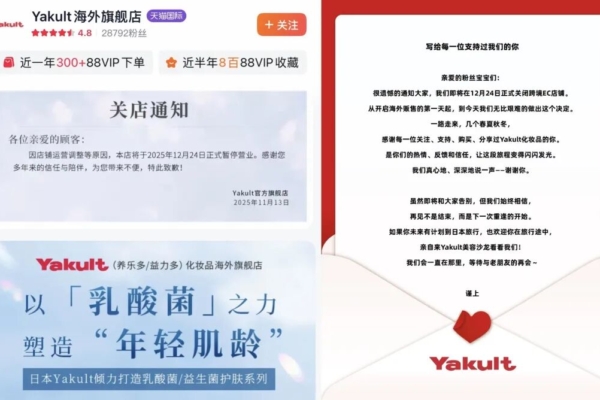
In December 2025, personal care brand Yakult under the Yakult group announced the closure of its Tmall International overseas flagship store, ending its cross-border e-commerce business in China and stating the conclusion of related sales arrangements in the Chinese market. The screenshot of this announcement was subsequently reposted by users, sparking discussions.
Guangzhou resident Cheng Xiaoli stated that she learned about Yakult’s closure through a screenshot shared in her social network. “I don’t usually pay much attention to brand announcements, but I found out about the store closure through someone’s shared screenshot.” She mentioned that upon clicking the link, the page had already shown the inability to place orders, only displaying closure announcements.
Cheng Xiaoli shared that similar situations have been quite common in the past year. Some overseas skincare brands have gradually disappeared from e-commerce platforms, with some left with blank pages and others no longer searchable. She noted that sometimes stores closed even before she had a chance to make another purchase. Cheng Xiaoli said that seeing closure screenshots nowadays elicits a more accustomed reaction.
Public financial reports also reflect the changes in some international beauty conglomerates in the Chinese market. Shiseido disclosed in its 2025 half-year report that sales in China and travel retail markets decreased by 12.4% year-on-year and mentioned in subsequent reports the impact of China’s consumption performance on overall revenues.