
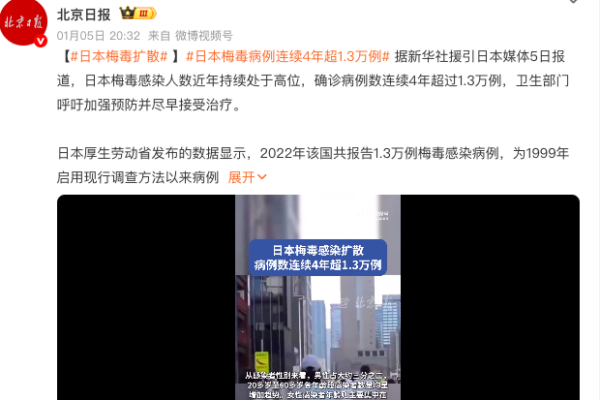
【Epoch Times, January 7, 2026】The topic of “Japanese syphilis” has been making waves on Chinese social media platforms in recent days. After the Chinese state-run Xinhua News Agency cited reports from Japanese media and official data from Japan, numerous official and local media accounts followed suit, leading to the rapid spread of related content on Weibo’s hot search. As the level of dissemination expands, public opinion gradually points towards “Japan being unsafe” and “not worth visiting.” However, experts believe that the effectiveness of recent opinion mobilization is weakening, making it harder to manipulate the public.
The Chinese Communist Party has always guided netizens to develop anti-American or anti-Japanese sentiments through opinion manipulation, particularly in foreign relations issues. According to Chinese state media Xinhua News Agency, citing reports from Japanese media, the number of confirmed cases of syphilis in Japan has exceeded 13,000 for four consecutive years. Data from the Japanese Ministry of Health, Labour, and Welfare shows that in 2022, the country reported about 13,000 cases of infection, surpassing 15,000 cases in 2023, and maintaining over 13,000 cases in both 2024 and 2025.
Following the release of the above data on official media platforms, it was quickly reposted on Weibo, short video platforms, and various local media accounts, leading to highly concentrated information dissemination. On Weibo, discussions related to “Japanese syphilis” continue to heat up, with the term “#Japanese young people showing off syphilis in groups” being widely shared. Some netizens commented, “Syphilis is being treated as a trend among some Japanese young people, with symptoms resembling cigarette burns, but this is a real disease.”
Through observation, it was found that a large amount of content in this round of dissemination is accompanied by video and image visuals. Some accounts describe scenes with phrases like “Japanese young people gathering to show off syphilis” and “Japanese trending syphilis makeup,” showcasing scenarios of young Japanese women exhibiting red spots on their skin and including captions like “Syphilis is spreading, early check-ups and treatments are crucial.” These visuals receive numerous reposts on social media platforms, becoming crucial trigger points for pushing emotional narratives.
Addressing this phenomenon, Mr. Zhao, a scholar of literature and history residing in Japan, stated in an interview that when the Chinese Communist Party is in a passive position in foreign relations, it often mobilizes public opinion to pressure foreign countries. “This approach may not be explicitly called sanctions, but through guiding emotions, the public naturally accepts certain behavioral changes, such as reducing travel, boycotting products, or ceasing to purchase goods from that country.”
From the evening of January 5, after the Xinhua News Agency’s client app released reports related to syphilis in Japan, the discussion direction in Weibo’s hot searches and comment sections quickly shifted. The topic swiftly transitioned from disease prevention and control to moral judgments on Japanese society and the young population. Numerous comments connected syphilis infections with “collapse of values,” “deviant culture,” and “social disorder,” further extending to a broader negation of Japan’s overall national image.
In the numerous reposts and comments, expressions like “shameless,” “Japan is unsafe,” and “don’t go to Japan” frequently appeared, gradually forming a highly consistent echo of public opinion. Some accounts presented more intense criticisms in the discussion. The Weibo account “Grasping Technology” posted under the related topic, describing the syphilis infections among young Japanese people as a “trend,” and further criticizing Japan’s societal values and industrial conditions. Such content garnered high interaction and was repeatedly cited in the discussion dissemination.
Some netizens connected the issue of syphilis infections to Japan’s historical and political topics, viewing the current social problems as long-term accumulations. In the comment section, public health issues quickly shifted to a comprehensive denial of national morals and social structures, with the discussion clearly deviating from the disease itself.
Mr. Zhao believes that the focus of such opinion manipulation lies not in a single event but in creating a long-term psychological expectation. “They continuously reinforce negative impressions through inflaming populist emotions, and over time, many people might feel that avoiding is the safer choice.” He added, “The effects of this method often last longer than administrative orders.”
Earlier, Japanese Prime Minister Sanae Takai made clear statements in public on Taiwan, security, and policy towards China, advocating for a more definite stance on regional security affairs, leading to multiple public responses and dissatisfaction from China. Subsequently, such statements, through China’s Ministry of Foreign Affairs and official media outlets, continued to ferment in China, further intensifying the opposition between the two sides in terms of public opinion.
Yao Yong, a scholar on Sino-Japanese relations, mentioned in an interview that this form of communication is not new. “They are accustomed to changing public psychological expectations through risk narratives, using emotions to drive behavioral choices.” He noted, “But a significant change recently is that many people have not fully accepted these so-called ‘advice,’ and still choose to purchase air tickets to Japan, indicating that the effects of public opinion mobilization are diminishing, and the public is not as easily manipulated anymore.”
Yao Yong pointed out that similar opinion manipulations had occurred multiple times in the past. “It used to be nuclear wastewater, and now it’s syphilis. The topics change, but the authorities’ logic remains the same.”