
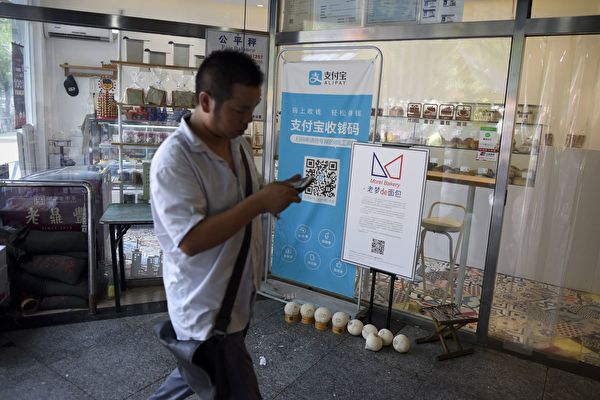
Recently, internet users in Taizhou, Jiangsu Province, disclosed that some communities in the area have been exploiting temporary job seekers to register accounts on behalf of others. This operation involves centralized registration of e-commerce accounts, payment accounts, real-name authentication, and bank card binding. However, the accounts and devices are subsequently taken away, and the individuals who provided their information do not have control over the accounts’ subsequent usage, bearing the related risks on their own.
Multiple residents of Taizhou have reported to journalists that this phenomenon has been ongoing in various residential areas in Hailing District of Taizhou City, including the Xianglong Community. Every day, labor companies or intermediaries can be seen recruiting individuals in the vicinity of these communities and taking them to nearby temporary workspaces for operations.
According to participants’ descriptions, the entire process is completed within 5 to 20 minutes. Individuals are asked to register an idle fish account and additionally register two Alipay accounts on-site. For each person registered, the participant can receive a reward of 100 yuan, and the labor intermediary responsible for recruitment can also earn the same amount.
Residents who are aware of the on-site situation have told journalists about several abnormal aspects during the registration process. Participants are asked to complete the real-name authentication of Alipay accounts without a clear understanding of the specific usage, as well as to bind their own bank card numbers. However, the phone number used for registration and receiving verification codes does not belong to the participant but was prepared in advance by the studio staff. After the real-name authentication is completed, the mobile device linked to the account is immediately taken away, and then handed over to the “superiors” for unified processing, preventing participants from further logging in or managing related accounts.
One resident said, “During the whole process, those involved do not know what the accounts will be used for, only knowing that ‘registration is enough’, and the phone and account are taken away immediately.”
An informant named Mr. Wang, who is familiar with the situation, disclosed to journalists that due to personal information security concerns, he cannot publicly share the evidence he holds at the moment. However, he is well aware of the specific location of the related studios and information about the labor intermediaries involved in recruitment. He urged the media to pay attention to and expose the situation, calling it “a local tumor.”
Local rights activist Mr. Sun told journalists that such situations have existed in the area for a long time, and there have been reports to the police, but relevant authorities did not intervene. He mentioned that this kind of operation, known as the “account production line,” essentially belongs to a part of the fraudulent chain, mainly targeting middle-aged and elderly women as well as those engaged in casual labor or temporary work.
Mr. Sun explained that these operations are typically carried out by labor intermediaries who recruit people in communities to complete registrations, real-name authentication, and bank card binding. Subsequently, the accounts are collected centrally, and the actual usage of the accounts does not occur locally. If the accounts are used for illegal activities, the responsibility often falls on the individual who provided their information, requiring them to bear the legal consequences themselves.
Police reports from various parts of mainland China over the past year have shown that acts similar to “proxy registration, proxy real-name authentication, and proxy bank card binding” are often front-end processes for telecommunications fraud, illegal transactions, and money laundering activities.
A legal professional named Mr. Han from Hunan, in an interview, stated that even if individuals did not directly participate in subsequent operations, they could still face consequences, such as account freezing or being held legally responsible for aiding cybercrime, if their real-name accounts are used for illegal activities.
Multiple public notices and industry analyses have mentioned that with the tightening of platform risk control measures, there has been a significant increase in the demand for real-name accounts in the black market industry in recent years. Some offenders have started obtaining account resources through labor intermediaries and the community casual labor market, making such activities more covert. Some interviewees view this phenomenon as posing new challenges to grassroots labor market regulation, personal information protection, and platform supervision responsibilities.
Mr. Han pointed out that these operations often rely on residential areas or temporary offices, with high mobility and small individual amounts, making them less likely to attract regulatory attention. He said, “At first glance, it seems like scattered part-time work, but with people participating every day, it will eventually establish a stable source of accounts.”
He believes that there is a possibility of collusion between individual law enforcement officers and offenders in such illegal activities. “Why do we keep hearing about telecom fraud every day but never seem to completely eradicate it? It can be understood as someone providing protection behind the scenes.”
Dai Nong, who has been closely monitoring local gray industries, stated that so-called “proxy account registration” is not isolated cases but a fixed operational model that has been established. In this system, accounts are no longer seen as personal tools but as resources that can be repeatedly acquired and circulated.
Dai Nong told journalists that the core purpose of this structure is not efficiency improvement but to push the risks to the lowest level possible. In this chain, ordinary people who only participate in the registration steps often bear the legal consequences, while upstream operators remain highly concealed.
Against the backdrop of the increasing demand for casual work positions, several interviewees believe that when registration, usage, and responsibility are deliberately separated, it is ultimately the normal participants who bear the risks. This separation also complicates the delineation of responsibilities between platforms and regulatory bodies. Behind seemingly simple temporary work lies an unequal allocation of risks.