
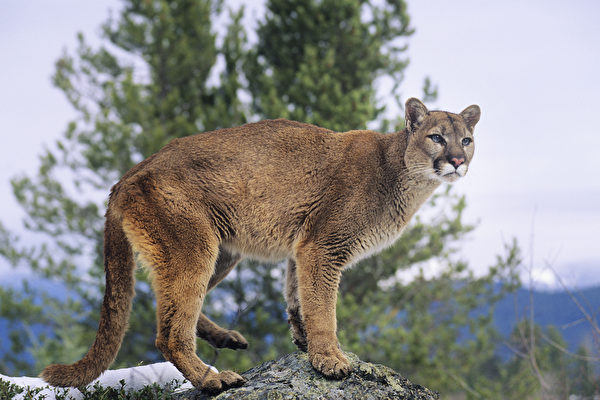
New Year’s Day in Colorado witnessed a fatal mountain lion attack on a woman several weeks ago, after a man had previously fought off a mountain lion.
Authorities confirmed that on New Year’s Day, a lone hiker was attacked and killed by a mountain lion on a remote trail in Colorado. However, this hiker was not the first person in the area to encounter a mountain lion attack in recent weeks.
Local resident Gary Messina recalled an incident on a dark morning on November 11th when he was running along the same trail. He suddenly spotted two glowing eyes in the nearby bushes. Just after taking a photo with his phone, a mountain lion lunged at him.
He threw his phone at the lion, kicked up dirt, shouted loudly, but the lion kept trying to circle around behind him. After a few minutes of a harrowing struggle, he broke off a club-sized stick from a fallen log and struck the lion’s head, which made the lion finally retreat.
He told the Associated Press, “It was about to shred me to pieces. I was terrified and fought back, but couldn’t escape. I tried to retreat, but it kept pouncing on me.”
Messina suspects that the lion he encountered was the same lion that attacked the woman on New Year’s Day.
Kara Van Hoose of the Colorado Parks and Wildlife stated that the wounds on the body of the woman found on the Crosier Mountain trail on Thursday (January 1st) “matched a mountain lion attack.”
The Larimer County Coroner’s Office mentioned that an autopsy is scheduled for next week to determine the victim’s identity and cause of death.
Van Hoose revealed that Messina, a 32-year-old from nearby Glen Haven, reported the incident to the authorities a few days after the attack. Warning signs were subsequently posted along the trail in the Crosier Mountain area to alert people about these animals.
These warning signs were later removed.
On Thursday afternoon, two hikers discovered the victim’s body about 100 meters (100 yards) away from them on the trail, with a mountain lion nearby. They threw stones at the lion to scare it away.
One of the hikers was a doctor and checked the victim but found no pulse.
Later in the day, wildlife officials tracked and killed two mountain lions in the vicinity, one at the scene and another nearby.
Animal autopsies will help determine if these two animals attacked the woman and if they had any neurological diseases like rabies or avian flu.
Van Hoose mentioned that the search for a third mountain lion reported in the area was ongoing on Friday, and the nearby trails remained closed during the search. Whether to hunt down this mountain lion will depend on the situation.
In the eastern region of Rocky Mountain National Park, mountain lions are often spotted as the area provides a good habitat for these animals: remote location, dense forests, rock outcroppings, and varied elevations.
Mountain lions, also known as cougars, can weigh up to 130 pounds (60 kilograms) and can grow over 6 feet (1.8 meters) in length. They primarily prey on deer.
Colorado estimates having 3800 to 4400 of these animals in the state, classified as a big game species that can be hunted.
Instances of such animals attacking humans are extremely rare.
In 1997, a 10-year-old boy was fatally attacked and dragged away by a mountain lion while hiking with his family in Rocky Mountain National Park.
Colorado’s most recent fatal attack occurred in 1999 when a 3-year-old boy went missing in the wilderness, and his tattered clothing was found over three years later.
Last year in Northern California, two brothers were stalked and attacked by a mountain lion while trying to fend it off, resulting in one of them being fatally bitten.
According to data provided by the California-based Mountain Lion Foundation, Thursday’s fatal mountain lion attack will be the fourth deadly mountain lion attack in North America in the past decade and the 30th since 1868, not all of which have been confirmed to be caused by mountain lions.
Animal rights protection organizations state that the majority of attacks occur during the day and in areas where human activities are frequent in mountain lion habitats, indicating that lions are not actively seeking prey. About 15% of these attacks result in fatalities.
Byron Weckworth, Chief Conservation Officer of the Mountain Lion Foundation, mentioned, “As more people live, work, and recreate in areas overlapping with wildlife habitats, interactions between humans and animals may increase not because mountain lions are becoming more aggressive, but because the overlap is growing.”
Weckworth advised that it’s best to travel in groups to reduce the risk, keep children close, and avoid lion’s most active dawn and dusk periods. When encountering a lion, maintain eye contact, make yourself look bigger, and slowly back away; never run.
(This article was based on reports from the Associated Press)