
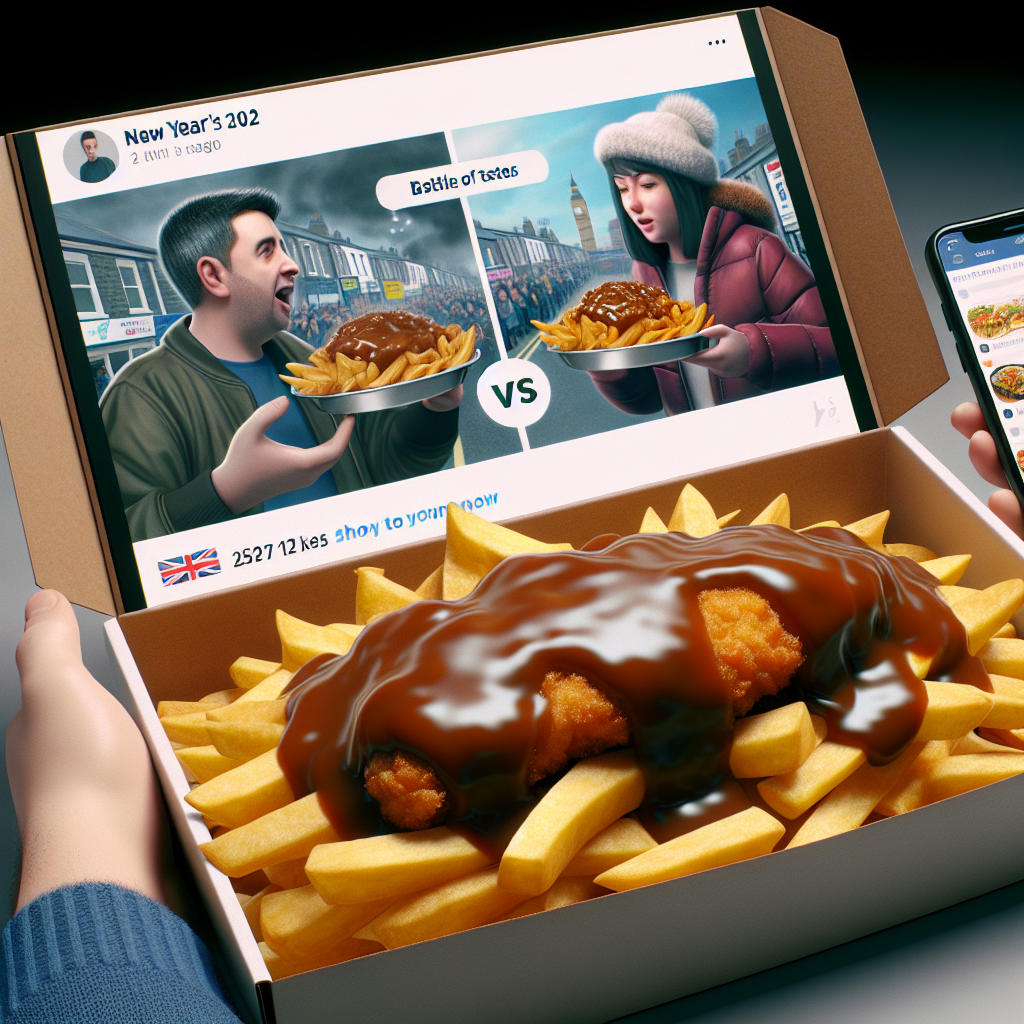
On New Year’s Day in 2026, if you happened to open the X social media platform, you might have stumbled upon a transatlantic “battle of tastes.” On one end of the screen, British netizens were enthusiastically showcasing their idea of soul food: a box piled high with fried chips, drenched in thick curry sauce, otherwise known as “British-style Chinese food.” Meanwhile, on the other end of the screen, American netizens were left puzzled, with comments in the discussion section ranging from surprise to disbelief, “Why are there chips in Chinese food? And what is that cement-like sauce?”
For Americans, Chinese takeout is often associated with dishes like General Tso’s chicken, Crab Rangoon, and the iconic white folded paper boxes. However, in the UK, it’s a completely different story.
According to CNN’s observations, British Chinese takeout and its American counterpart have almost no similarities. This contrast is starkly evident in the specific dishes, eliciting various reactions from American netizens on social media, ranging from surprise to “shock”:
Americans prefer white rice, while the British insist on having a serving of “Salt and pepper chips”;
America has sweet and spicy General Tso’s chicken, while the UK boasts enormous “Sweet and sour chicken balls,” which are deep-fried chicken chunks wrapped in a thick batter resembling ping pong balls;
British Chinese takeout includes a popular snack called “Crispy Seaweed,” but many American netizens were surprised to discover that it is actually crispy fried “shredded cabbage.”
In a video clip from social media, an American netizen tried pouring curry sauce over stir-fried noodles with a half-skeptical expression, then raised their eyebrows in admission, “This does add something, I’m hooked on curry sauce now, folks.”
To understand why British Chinese takeout has evolved into these “rich and flavorful delicacies,” one must trace back to Manchester in the 1950s.
Reportedly, legendary figure Lily Kwok from Hong Kong arrived in Manchester and, in order to establish herself in a foreign land, combined the essence of Singaporean laksa and Indian spices she had learned during a 35-day sea voyage to develop a “cement-like thick” curry sauce.
Her granddaughter, Helen Tse, confirmed to CNN that this creation was designed to allow the sauce to cling tightly to the British-favorite chips. It was through this extremely localized product that she successfully launched the family business.
Different from the Chinatown culture in the US, Chinese in the UK scattered to avoid competition, leading to this community being in a long-standing cultural “invisible” state. In a bid to shed the label of being at the “bottom rung,” Helen Tse once switched professions to become a lawyer, but ultimately decided to return to the family business with her sisters.
In 2004, they reopened the restaurant “Sweet Mandarin,” aiming to revive the glory of their grandmother’s former business. Helen Tse stated, “We are back, we have restored the family’s reputation.” This was not only a revival of the business but also a restoration of family dignity.