
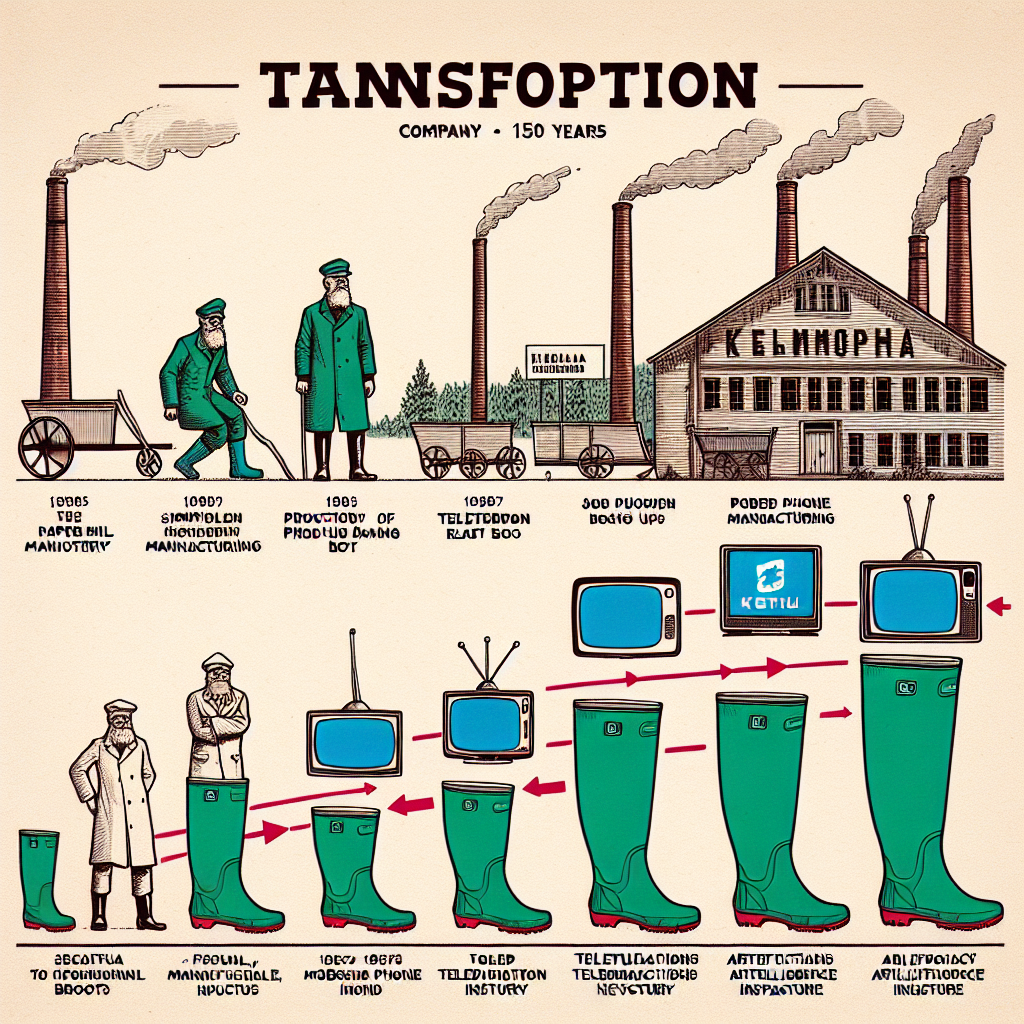
Nokia, the Finnish company with a history of over 150 years, has undergone multiple transformations, evolving from paper mills, rain boots, and televisions to mobile phones, and now focusing on telecommunications networks and artificial intelligence (AI) infrastructure. Its ability to continuously reinvent itself has created a unique corporate culture of constant adaptation.
How did Nokia manage to rise from the ashes of being a former mobile phone giant to becoming a sought-after AI investment target like NVIDIA?
When people think of durable mobile phones, the iconic Nokia 3310 comes to mind – a phone known for being virtually indestructible. From the mid-1990s to 2008, Nokia dominated the global mobile communication market, pioneering the era of text messaging and making appearances in Hollywood movies like “The Matrix” and “Charlie’s Angels.” By the year 2000, Nokia’s market value reached approximately 286 billion euros, with a nearly 40% share in the global phone market, contributing around 4% to Finland’s GDP alone.
However, Nokia’s fortune took a turn for the worse. The company missed the boat on the smartphone revolution, underestimating the impact of Apple’s iPhone and Samsung’s Android phones. Faced with significant market share losses and strategic missteps, Nokia decided to sell its entire phone business to Microsoft in 2014. This pivotal moment shocked many in the industry and led to a rapid decline of the Nokia phone brand in the eyes of consumers.
Under the leadership of CEO Rajeev Suri at the time, Nokia shifted its focus to the “network equipment” business, acquiring shares in a network company jointly held with Siemens and making this segment account for about 90% of the company’s revenue. In 2015, Nokia further solidified its position in the European telecommunications infrastructure sector by acquiring Alcatel-Lucent for 15.6 billion euros.
However, facing increasing competition from Chinese telecom equipment manufacturers like Huawei and ZTE, who quickly captured market share with low-cost strategies, Nokia saw its market share in European telecommunications networks gradually eroded.
With its core business under threat once again, Nokia embarked on its second transformation within a decade. Under the leadership of CEO Pekka Lundmark, the company accelerated its focus on emerging technologies such as cloud services, data centers, and optical networks.
In 2024, Nokia acquired optical network equipment company Infinera for 2.3 billion US dollars, enhancing its capabilities for high-speed data transmission between data centers and router products.
In April 2025, new CEO Justin Hotard shifted the company’s focus towards the “super investment cycle in data centers” driven by artificial intelligence (AI), with an emphasis on fiber optics and routing technologies to support high-speed data flow between the cloud and data centers.
This strategy quickly caught the attention of Silicon Valley. US chip giant NVIDIA announced a 1 billion US dollar investment in Nokia and established a strategic partnership in AI networks. Encouraged by this news, investors believed that Nokia successfully aligned itself with the AI wave, leading to a 25% increase in its stock price in a single day.
Today, Nokia has a market value of around 32 billion euros, still a far cry from its heyday with the 3310 brick phone.
Analysts caution that due to the high volatility of AI infrastructure investments, intense competition, and reluctance of telecom operators to overly rely on a single supplier, the future returns on AI investments for network operators remain uncertain.
In response to these transformation challenges, Hotard expressed, “There is a kind of spirit… some call it relentless determination. But I believe the path to survival is not always straight; we must constantly adjust our course.”
Shaz Ansari, professor of Strategy and Innovation at the University of Cambridge, told the Financial Times that a company’s ability to successfully transform “stems from its inherent agility in business: how it deals with failures and how it reallocates resources.”
“Nokia possesses a rare ability to survive when a company is in distress,” Ansari said. “Not only can it pivot across product lines, but it can also undergo a thorough transformation across industries.”