
At the end of 2025, there has been a trend in multiple regions in mainland China where private hospitals and clinics voluntarily apply to withdraw from the medical insurance system, downgrade their hospital level, or reduce the number of beds. Analysts attribute this trend to the squeeze on private hospitals and operational difficulties.
According to public announcements by local health departments and open data from medical institutions, in recent times, provinces such as Shaanxi, Sichuan, Anhui, and Hunan have issued notices regarding adjustments in hospital grades and operational scales by several private medical institutions. These adjustments involve downgrading from secondary to primary level or terminating medical insurance service agreements while retaining their practice qualifications.
In Baoji, Shaanxi, for example, it was publicly declared by the local health department that Baoji Gaoxin Traditional Chinese Medicine Hospital, a private hospital in operation for over 15 years, voluntarily applied to downgrade from a secondary comprehensive hospital to a primary one, reducing the number of beds from 80 to 20. Similarly, another private hospital in the area, operating for over 15 years, also downgraded its level and reduced bed capacity, and all related changes were officially announced.
In response to this trend, a media professional named Mr. Wu, who has long been tracking the healthcare sector, told reporters that whether a hospital retains its medical insurance qualification is no longer just a matter of patient sources but reflects a systemic shift in attitude towards private medical institutions. He noted that continuous investments are required in staff allocation, equipment upgrades, internal audits, and billing management, as according to current regulations, some hospitals are being asked to reevaluate their participation in the medical insurance system.
He added, “Running hospitals now requires higher equipment standards and higher guarantees compared to before. In essence, why can’t private enterprises do anything else and must be involved in running hospitals? Fundamentally, it is about mistrust and exclusion towards them.”
In Guangyuan, Sichuan, Guangyuan Dermatology and Urology Hospital was adjusted from secondary to primary level. Founded in 2002, this non-profit private specialized hospital originally had 203 beds. Similarly, Anhui Huainan Modern Hospital, established in 2013 as a non-profit private hospital, with a standard capacity of 102 beds, voluntarily applied to adjust its level from a secondary comprehensive hospital to a primary one. A gynecological specialized hospital established in 2008 in Hunan also recently downgraded from a secondary specialist hospital to a primary one.
Dr. Huang Hongfa, a practicing dentist at a dental clinic in Changsha, pointed out that after changes in the medical insurance payment system, hospitals have significantly less room to maneuver in patient care. He explained, “Previously, you would bill each procedure and medication separately, ensuring payment for each. But now, it’s different. Each disease type has a fixed budget, different diseases have assigned points, and the hospital’s annual expenses are capped, so any excess costs have to be borne by the hospital.”
Dr. Huang continued, saying that many disease types now have clear restrictions on medication use, treatment pathways, and length of hospital stay. “For complex cases or longer treatment periods, the hospital starts losing money. If the scale isn’t reduced, the pressure will only increase,” he concluded.
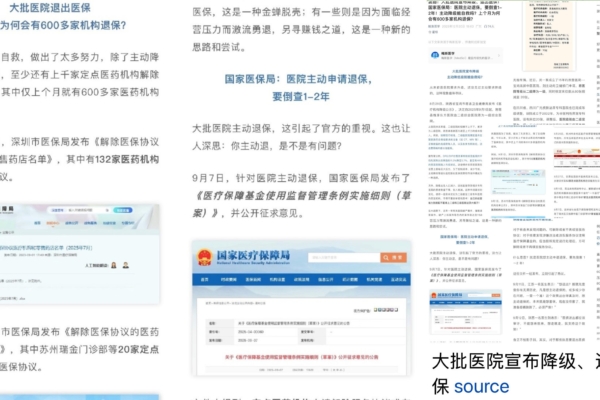
Public data indicates that since the second half of 2025, numerous designated medical institutions across China have been terminating their medical insurance service agreements. In just the latter half of the year, over 600 medical institutions have left the medical insurance system nationwide, with the majority being private medical facilities. This figure comprises the total number of institutions announced in public notices by various local medical insurance departments.
The Communist Party’s Shenzhen Medical Insurance Bureau announced on September 1st that they were terminating the medical insurance service agreements with 132 designated medical institutions. Similarly, on the same day, the Suzhou Medical Insurance Bureau revealed a list of over 20 designated medical institutions with terminated service agreements. The Hangzhou Yuhang District Medical Insurance Management Service Center issued a notice on August 29th that five medical institutions had voluntarily applied to terminate their basic medical insurance service agreements.
In western and northeastern regions, the Gansu Jiuquan Medical Insurance Department announced the termination of service agreements with 52 designated medical institutions on August 27th; while the Qingdao Medical Insurance Department released lists on August 11th, involving 67 designated medical institutions; and in Jilin Province, the medical insurance department disclosed on August 7th the termination of service agreements with 121 designated medical institutions.
Mr. Zhang, a hospital administrator at a private hospital in Taixing, Jiangsu, expressed his views to reporters, stating, “The restrictions on medical insurance are becoming tighter, particularly affecting private hospitals. To maintain medical insurance qualifications, continuous financial injections are required. When drug prices increase and patients have to pay more out of pocket, fewer people seek medical care. With the need to pay salaries to doctors and update equipment, while revenues decrease and expenses remain the same, how can we sustain the operation? Hence, many hospitals opt to withdraw from medical insurance altogether.”
Multiple industry studies indicate that the shift from item-based payments to disease-based or per capita calculation in China’s medical insurance system has increased the operational pressure on private hospitals concerning equipment, staff, and cash flow. Research data shows that after the DRG/DIP reform (based on Disease-Related Groups or disease point values, setting medical insurance payment ceilings for each disease type), the average profit margin of private hospitals dropped from 11.3% to 5.7%, with approximately 40% operating at a loss.
Regarding medical institutions voluntarily withdrawing from medical insurance, the National Healthcare Security Administration of the Communist Party of China previously issued regulations stating that institutions applying to terminate medical insurance service agreements would be subject to close scrutiny of medical fund usage for the past 1 to 2 years, with the termination of agreements not absolving them of any prior responsibilities.