
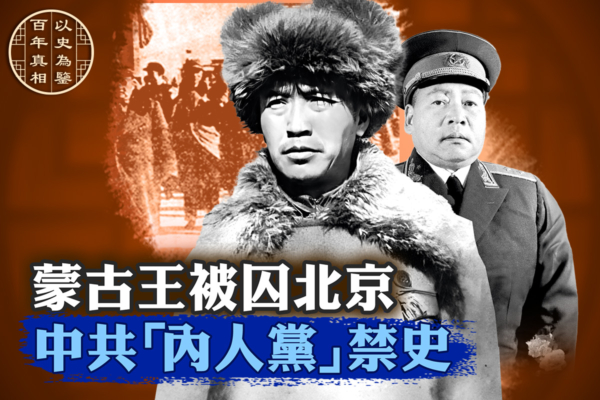
Today, we will delve into one of the most tragic miscarriages of justice during the Cultural Revolution in Inner Mongolia – the “Neiren Party” incident.
This “Neiren” does not refer to one’s own wife, but to the abbreviation of the “Inner Mongolian People’s Revolutionary Party”. This party did exist at one point, but it had long vanished during the Cultural Revolution.
Thus, this was a completely fabricated persecution that affected millions of people, with tens of thousands of deaths, mostly among the Mongolian ethnic group. It brought deep suffering and indelible trauma to the land of Inner Mongolia and the Mongolian people.
In May 1966, the Cultural Revolution swept across China, under the guise of “eliminating class enemies,” unleashing a nationwide political storm that spared no one, including Inner Mongolia.
In Inner Mongolia, the first target of the storm was the then Party Secretary of the autonomous region, Ulanfu. Ulanfu was a loyal follower of the Communist Party of China, had studied in the Soviet Union, fought alongside Deng Xiaoping, and was one of the founding generals of the CCP.
Ulanfu was of Mongolian descent, hailing from Inner Mongolia, so he had governed Inner Mongolia after the CCP took power, even being dubbed the “Mongolian King.”
However, during a meeting of the Central Committee of the CCP in June and July, Ulanfu was publicly denounced and criticized. He was accused of opposing Mao Zedong’s ideology, promoting ethnic separatism, establishing an independent kingdom, and even labeled as the “biggest capitalist-roader in the party” and a “counter-revolutionary revisionist.”
By August 16, the Central Committee of the CCP officially stripped Ulanfu of all his duties, placed him under house arrest in Beijing, and banned him from returning to Inner Mongolia. His downfall was not just a personal tragedy but also marked the beginning of a comprehensive purge in Inner Mongolia. Ulanfu’s “crimes” became the authorities’ excuse to demand the complete eradication of his “poison,” paving the way for a persecution campaign against the so-called “Neiren Party.”
In 1967, Mao Zedong appointed Teng Haiqing, the Deputy Commander of the Beijing Military Region, as the Acting Commander of the Inner Mongolia Military Region, subsequently serving as the head of the Autonomous Region’s Revolutionary Committee. Upon assuming office, Teng Haiqing promptly initiated the “digging up of Ulanfu’s black line and purging Ulanfu’s poison” campaign, known as “Dig and Purge.” The core of this campaign was to unearth the so-called “Neiren Party.”
The concept of the “Neiren Party” originated in 1925 during the period of the First United Front between the Nationalists and Communists, where a Inner Mongolian People’s Revolutionary Party was formed and dissolved in the 1930s; reappeared after the victory of the War of Resistance Against Japan in 1945, but later pledged allegiance to the CCP, ceasing activities in 1947.
In 1963, an anonymous report was sent to the Inner Mongolian Public Security Bureau claiming the existence of a “new Neiren Party.” This baseless accusation was taken as fact by the CCP. During the “Dig and Purge” campaign, this fictitious organization was portrayed as a vast counter-revolutionary network posing a threat to “national security.”
Teng Haiqing extensively propagated lies about the “new Neiren Party,” alleging its members were lurking in every corner of Inner Mongolia, plotting separatist activities.
Simultaneously, the authorities employed harsh tactics, using various forms of torture from ancient and modern times to coerce detainees into admitting they were members of the “Neiren Party.” Countless individuals were detained, interrogated, and even forced to implicate others.
A deputy secretary of the Party Committee at Inner Mongolia University, under torture, identified 16 senior officials as the core of the “Neiren Party,” leading to more innocent individuals being implicated, spiraling the fabricated case out of control.
The Public Security Bureau, military districts, and local agencies were all involved in “digging up” the Neiren Party, with over 3,500 supposed members uncovered in the Inner Mongolia Military Region alone. The entire Inner Mongolia fell into a climate of fear where everyone felt endangered.
In one county of Xilinguole League, an Organizational Department official of the Party Committee was subjected to prolonged interrogation. After 285 days, he was coerced into confessing that over the span of ten years, he had joined various parties such as the “Neiren Party,” “Shawozi Party,” “Freedom Party,” “Unity Party,” “Youth Party,” and “Genghis Khan Party,” absurd accusations that astounded onlookers.
The Inner Mongolia Geological Bureau’s approach was to investigate how many Mongolian employees there were because all Mongolians were considered part of the “Neiren Party.” There was no need to inquire if someone was part of the party; they were simply required to confess to their alleged crimes. Consequently, to apprehend eight Mongolian staff members, the Geological Bureau established 24 action teams, with 8 tasked with arrests, 8 conducting house raids, and 8 carrying out aggressive interrogations.
Under Teng Haiqing’s command, the movement to dig and purge the “new Neiren Party” rapidly spread from the capital Hohhot to various leagues, banners, counties, townships, and villages, wherever Mongolians resided, the “Neiren Party” could be found. Many accused “Neiren Party” members suffered brutal physical torture and psychological humiliation.
According to official records, 346,000 people were detained, 16,200 died, and 81,800 were disabled. However, some scholars believe the actual numbers may be much higher, estimating up to 800,000 arrests, 500,000 disabilities, and 50,000 deaths.
In this movement, the Mongolian people became the primary targets of attack. Many communities were stigmatized as “black households,” with even ordinary herders unable to escape the turmoil.
The consequences of this movement were devastating, tearing apart families, fracturing communities, and destroying their culture. In 1968, Zhou Enlai’s niece, Zhuo Bingjian, was shocked to find that out of the local squad in Xilinguole, only three households were considered “red,” while the rest were labeled as “Neiren Party” black households.
The social order in Inner Mongolia was on the brink of collapse, with the military and government agencies paralyzed, and the public’s suffering left unspoken.
By the end of 1968 and the beginning of 1969, the “digging and purging” movement reached its peak, leading to a strong backlash against the injustices in Inner Mongolia.
Countless victims bearing petitions, letters from deceased relatives, and blood-stained garments, overcame numerous obstacles to flock to Beijing to seek redress. Beijing’s train station, Zhongnanhai, and the Nationalities Affairs Committee were swamped with petitioners from Inner Mongolia, presenting their evidence and tears to expose this disaster.
The wave of public outrage forced the top CCP leadership to take notice. However, Mao Zedong refused to admit any wrongdoing in the “digging and purging” campaign, acknowledging only its “overexpansion” and shifting the blame onto Teng Haiqing.
In May 1969, Mao Zedong issued the “5.22 Directive,” criticizing the “overexpansion” error of Teng Haiqing. Subsequently, Teng faced multiple “criticize Teng” conferences where he confronted the accusations of the victims.
Originally, Mao intended to sacrifice Teng Haiqing to alleviate the social discontent and ethnic conflicts in Inner Mongolia. However, this failed to quell the fury of the Inner Mongolian people, as petition events continued without end.
Even more worrying for Mao was the paralysis of the military in Inner Mongolia, with senior military officers in local military divisions openly defying the Inner Mongolia Revolutionary Committee. Government agencies were besieged, weapons and ammunition were seized, resulting in a power vacuum in Inner Mongolia. Faced with this crisis in Inner Mongolia, the CCP leadership, in turn, began to apply the brakes on “criticizing Teng Haiqing.”
To prevent the situation in Inner Mongolia from worsening, the CCP implemented three major measures:
Firstly, to divide and rule Inner Mongolia. Hulunbuir League was incorporated into Heilongjiang Province; Zhalainuoer League was allocated to Jilin Province; Chifeng League went to Liaoning Province; Bayannur League belonged to Ningxia Hui Autonomous Region; Alxa League was assigned to Gansu Province.
Secondly, full military control was imposed on Inner Mongolia. The Beijing Military Region Commander, Zheng Weishan, and others established the Inner Mongolia Front Command Center to streamline leadership in Inner Mongolia. Additionally, several military units were deployed to station in Inner Mongolia.
Thirdly, senior officials in Inner Mongolia were sent to attend study sessions. All cadres above the section chief level in Inner Mongolia were required to participate in “Mao Zedong Thought Study Sessions” held in various locations in Hebei Province. These study sessions lasted over two years.
The Inner Mongolian people’s resistance was crushed by the CCP. However, during the military administration period, the hunt for “Neiren Party” members and the “digging and purging” continued, with the old cases remaining unresolved and new injustices being fabricated.
After the end of the Cultural Revolution in 1976, the CCP began to redress the wrongs and falsities.
By 1980, the CCP eventually acknowledged the falsehood of the “Neiren Party” case, recognizing that there was no such thing as the “new Neiren Party.” However, the CCP shifted all the blame onto Mao’s wife, Jiang Qing, who was Vice Chair of the Central Cultural Revolution Group, and Kang Sheng, Mao’s right-hand man in the Cultural Revolution.
In reality, the primary person responsible for this injustice was Mao Zedong.
Mao launched the Cultural Revolution aiming to overthrow his most significant political adversaries within the party, namely Liu Shaoqi and Deng Xiaoping. Liu and Deng were labeled as the top two capitalist roaders within the party.
During the Cultural Revolution, Mao also initiated the so-called “Criticism of Revisionism, Defend Against Revisionism.” “Revisionism” referred to Soviet revisionism. Before the division into Inner Mongolia and Outer Mongolia, Mongolia shared a border with the Soviet Union, maintaining a close relationship. After the start of the Cultural Revolution, Inner Mongolia became an important region in Mao’s “defend against revisionism” campaign.
Because Mao was the highest decision-maker in the Cultural Revolution’s attack on the “Neiren Party,” following the end of the Cultural Revolution, when the Inner Mongolia Autonomous Region Party Committee demanded severe punishment for Teng Haiqing, the CCP Central Committee determined that he was merely a policy executor of the Cultural Revolution and considering his previous contributions as a veteran Red Army member, decided not to hold him accountable.
From 1975 to 1980, Teng Haiqing was transferred to the Deputy Commander of the Jinan Military Region until his retirement.
So, did anyone ultimately take responsibility for this massive miscarriage of justice?
A man named Ulanba was sentenced to fifteen years in prison. He was a cadre of the Inner Mongolia Cultural and Art Federation and a writer. The Prosecutor’s Office claimed he had provided the “Inner Mongolian People’s Revolutionary Party member list” and other materials to Teng Haiqing’s office.
Ulanba was imprisoned. Some Mongolians regarded him as a “traitor.” Others saw this as a “miscarriage of justice,” shifting the blame for the killings of tens of thousands of Mongolians onto one Mongolian man who ended up either dead or in jail.
In court, his lawyer argued that the Cultural Revolution was a political movement launched by the CCP, and Ulanba was answering the CCP’s call. He was just a participant, not the architect of the political movement. If everyone is equal before the law, then those high-ranking officials of the Communist Party, such as Teng Haiqing, should be standing on the defendant’s stand. Ulanba was merely a sacrificial lamb, a scapegoat.
Translation and rewriting by [Your Name, news reporter].