
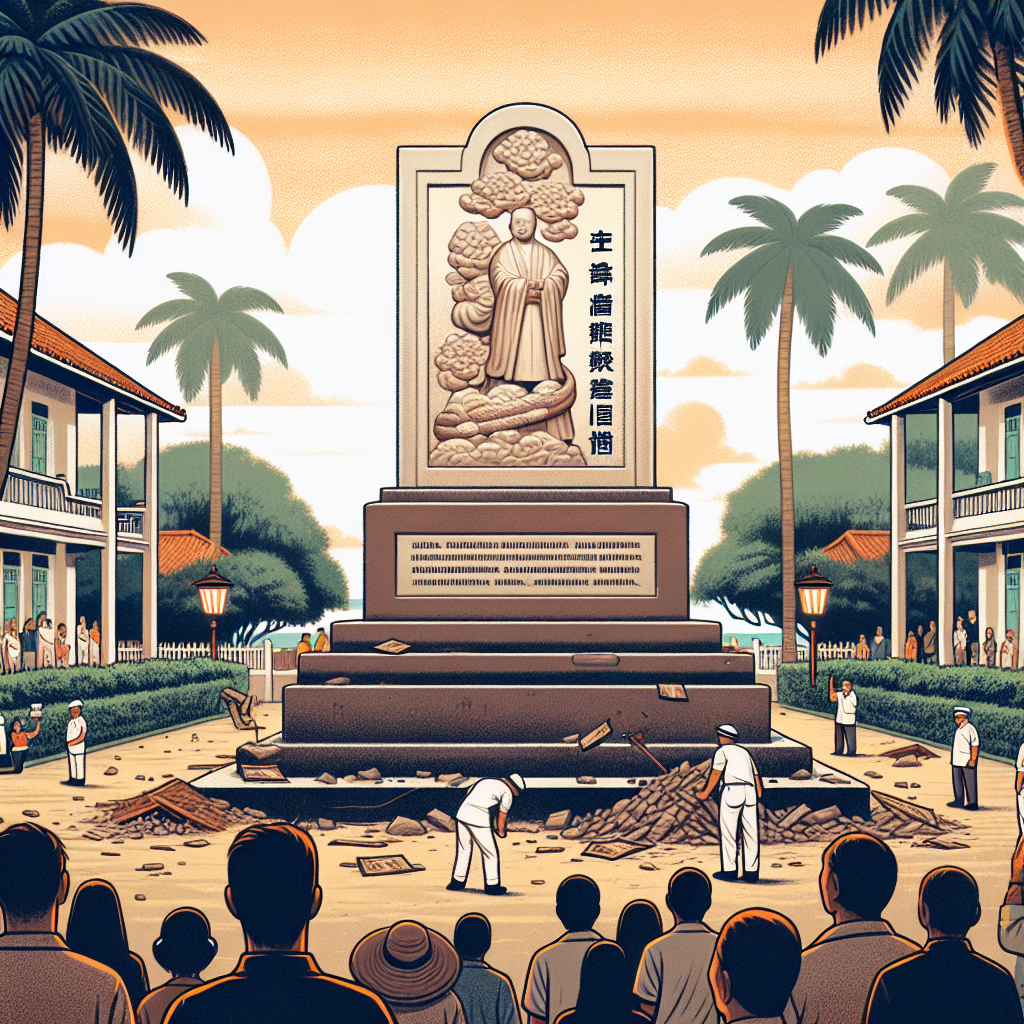
Panama Demolishes Monument Commemorating Chinese Arrival 100 Years Ago, Purely Internal Affair
Panama’s demolition of a monument dedicated to the arrival of Chinese immigrants a century ago is purely a local matter within Panama’s jurisdiction. The Chinese Communist Party’s decision to sensationalize this issue, which is completely unrelated to them, appears to be part of its efforts to compete with the United States for control of the Panama Canal.
In recent days, the Chinese Communist Party has turned a seemingly small event into a controversy by magnifying the demolition of a Chinese-style structure by the Arraiján Municipality in Panama. Situated in the China-Panama Friendship Park at the Pacific entrance of the Panama Canal, the structure composed of a Chinese archway with two stone lions at the front, a monument, and a Chinese-style pavilion was forcefully demolished by the local government on the night of December 27, 2025, triggering significant diplomatic and political tensions.
The structure, which featured the Chinese characters for “China-Panama Park” on the archway and commemorated the 150th anniversary of the Chinese arrival in Panama in both Chinese and Spanish on the monument, was located at the “Amerix Bridge Viewpoint,” overlooking the Panama Canal and the Amerix Bridge. The Arraiján Municipality claimed that the archway posed structural risks due to a lack of maintenance over the years and that its 20-year land lease expired in 2024, prompting the decision to dismantle it to facilitate a new park construction project.
The most vehement reaction to this incident came from the Chinese Communist authorities. The Chinese Ambassador to Panama, Xu Xueyuan, rushed to the demolition site, expressing “great sorrow and anger,” stating that the demolition was a blow to the 300,000 Chinese residents in Panama and had damaged the friendly feelings between the two countries. The Chinese Ministry of Foreign Affairs conveyed severe discontent and issued a formal protest. Ministry spokesperson Lin Jian demanded Panama to thoroughly investigate the matter, promptly rectify the erroneous actions of the local government, and swiftly dispel the negative impact.
The monument was erected in 2004 to commemorate the 150th anniversary of the Chinese arrival in Panama and their contributions to the construction of the Panama Canal and the national development, symbolizing significant cultural significance.
The first question to address is who built this structure? A largely undisputed claim is that the archway was funded by the Chinese community organizations in Panama. Differing claims suggest whether the Chinese government had contributed.
According to the Chinese side, they provided assistance, as the Overseas Chinese Affairs Office of the Chinese Communist Party stated that the monument was funded by Chinese community groups, with the Chinese government providing support for its construction. Another unreliable claim suggests that the monument was built by both the Chinese Communist Party and the Panamanian authorities.
At the time of the monument’s construction in 2004, Panama still maintained diplomatic relations with the Republic of China (Taiwan), making it impossible for the Chinese government to co-build with the Panamanian government or provide public funding. It could only have been supported indirectly through Chinese community groups. Therefore, some argue that the Chinese support was merely symbolic.
Ultimately, the most plausible scenario is that the Chinese community organizations in Panama, as legitimate registered entities, applied for a 20-year land lease with the Arraiján Municipality and constructed the archway and monument with self-raised funds. In other words, it was a contract or agreement between a local organization in Panama and the Arraiján Municipality, entirely a domestic affair of Panama with no involvement from the Chinese Communist authorities or even the Panamanian government.
Claims by the Chinese Overseas Chinese Affairs Office that the monument is an “official tribute from Panama to the contributions of the Chinese over the past century” are evidently misleading.
Next to consider is the lack of relation between Chinese involvement in Panama’s railway and canal construction and China-Panama friendship.
On March 30, 1854, 694 Chinese laborers who set sail from Shantou on the ship “Sea Witch” arrived in Panama, with a total of twenty thousand Chinese laborers involved in the construction of the Panama Railroad across two oceans. In 1881, thousands more Chinese laborers participated in the construction of the Panama Canal. These individuals were not officially dispatched by the Qing government; rather, they sought opportunities for survival. Contrary to the mainstream Chinese Communist Party’s propaganda, this is considered part of the history of Overseas Chinese hardships.
At that time, the country of Panama did not even exist, so where does the China-Panama friendship come into play? The monument commemorates the historical contributions of the Chinese to Panama’s development, not China-Panama friendship, with no relevance to the Chinese government and certainly no basis for the Chinese ambassador’s expressions of sorrow and anger or the disruption of friendly sentiments between the two nations.
Panama initiated anti-Chinese policies in 1941, confiscating 80% of Chinese-owned small businesses in Panama, forcing Chinese to change their names or hide. Anti-Chinese sentiments persisted for over forty years until Noriega took control in 1983 and began opening doors for the Chinese. These were the new Chinese immigrants in Panama. Panama lacked prominent higher education opportunities; unlike the United States that had welcomed many state-sponsored students, the new immigrants mostly engaged in grocery stores, laundromats, and restaurants, with no connection to the Chinese Communist Party.
Prior to 2010, Panama consistently advocated for Taiwan’s Republic of China to participate in international organizations and affairs at the United Nations. It seems unlikely that the Chinese Communist Party would construe this period as part of China-Panama friendship, right?
Therefore, the so-called China-Panama friendship touted by the Chinese Communist Party refers to the friendship between the Chinese Communist regime and Panama, only dating back to the establishment of diplomatic relations in 2017.
The jurisdiction of the Chinese ambassador does not extend to Chinese Panamanians who have become Panamanian citizens. It likely includes Panamanian residents who remain Chinese citizens, perhaps mainly employees of Chinese companies operating in Panama, with no direct association with the archway monument.
Furthermore, the Chinese community originally secured a 20-year lease for the monument, which expired in 2024. Before the demolition, Chinese community groups had attempted to raise funds for renovation and maintenance, but received no response from the municipal authorities. Shouldn’t the priority have been to secure a lease renewal?
Naturally, local Chinese community organizations expressed strong dissatisfaction and protested against the demolition of a landmark with historical value without prior consultation by municipal authorities, which is understandable. However, as the lease had expired, the local government had the right to repurpose the land, an issue that needs to be resolved between the Chinese community and the municipal government.
Nonetheless, this remains a domestic affair of Panama, unrelated to the Chinese Communist authorities. While the Chinese government can easily claim to represent the 1.4 billion Chinese nationals domestically, they have no authority to represent the 300,000 Chinese residents in Panama, most of whom are Panamanian citizens. Who authorized the Chinese Communist Party to speak on their behalf?
The demolition occurred against the backdrop of U.S. pressure on Panama to curb Chinese influence around the canal. Some analysts believe this reflects Panama’s shifting policy alignment towards the United States.
However, the decision to demolish was made by the Arraiján Municipality, whereas foreign policy is a matter at the national level, with local governments primarily focused on local interests rather than diplomatic concerns.
The Arraiján Municipality’s considerations would have been primarily related to their relationship with the Chinese community organizations, likely without foreseeing intervention from the Chinese Communist authorities in Panamanian local affairs. Even the Panamanian government shares this perspective.
Earlier this year, as the Trump administration began monitoring Chinese influence around the Panama Canal, President Mulino of Panama, when questioned about the Chinese edifice during a press conference in Panama City, denied the notion that the site was a larger geopolitical pawn and stated its future was purely a local matter. However, following the demolition, he strongly condemned it as an “unforgivable act of irrationality,” officially ordering the Ministry of Culture to collaborate with Chinese community groups to immediately rebuild and restore the archway at the original site on the 28th.
This demonstrates inconsistency in the president’s stance before and after the event, suggesting that the decision was possibly influenced by pressure from the Chinese Communist authorities. After all, a mere archway should not be enough to prompt an action from a country’s president.
Panama’s Chinese community, including the Panama Chinese Association established in 1943 which raised funds for the monument construction, has no relation to China-Panama friendship, even if most Chinese descendants in the Chinese community originate from mainland China and include pro-Communist individuals or are affiliated with the united-front system.
The incident takes place against the backdrop of Beijing’s strong interference in the sale of two ports near the Panama Canal, coinciding with Trump’s pursuit of Monroe Doctrine principles to counteract Chinese and Russian influence in the Americas.
On December 17th, U.S. Ambassador Kevin O’Reilly, during a visit to Panama City, praised joint operations with the Panamanian Public Security Ministry, including drug enforcement operations and search and rescue efforts. The U.S. emphasized its maritime security partnership with Panama.
Prior to this, talks on selling the two ports near the Panama Canal had reached an impasse, with China insisting on having the state-owned COSCO Shipping Group hold the majority stake and veto power over port operations, threatening to veto the deal otherwise.
In this context, the Chinese Communist Party has inflated a purely internal Panamanian matter with no relevance to themselves into a major issue supposedly jeopardizing China-Panama friendship, evidently applying pressure on Panama to showcase their strength and influence in the country.
In reality, this is a challenge to the United States from China. However, China’s actions regarding the ports and the monument only validate Trump’s concerns about Chinese control of the Panama Canal, showing that the battle between the U.S. and China for influence in the Americas is just beginning.