
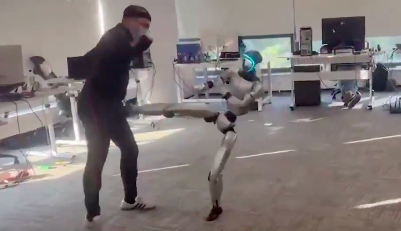
In China, incidents of “out of control” robots are on the rise, sparking discussions and concerns about the potential dangers. A video showing a Chinese-made robot kicking a staff member during a motion simulation test recently went viral, garnering various reactions. Tesla’s Elon Musk even responded with a “laughing” emoji in the comments section. Some expressed worries about the robot’s “violent tendencies.”
The video, believed to be from a Chinese company called Yunshu Technology, depicts a staff member demonstrating combat moves while the robot imitates the actions. When the staff member kicks, the robot follows suit and accidentally hits the staff member, causing apparent pain. Interestingly, the robot also mimics a squatting motion. The video quickly circulated online, with users commenting on the comical yet concerning nature of the incident.
Reactions online ranged from amusement to alarm: “The most hilarious thing I’ve seen today.” “Even robots are rebelling now.” “The robot has developed self-awareness and seemed to observe the last two steps before lifting its foot.” “The thing humans feared most has happened.” “There definitely needs to be a rule prohibiting kicking people in sensitive areas.” “I have watched many robot training videos, and among all robots, these (Chinese) robots seem the most chaotic, often displaying violent behavior.”
Tesla’s Chief Engineer, Wes Morrill, shared the video on December 26, prompting Musk to react with a “laughing” emoji in the comments section. Morrill jokingly mentioned regretting not including Isaac Asimov’s Three Laws of Robotics in the robot’s programming, referring to the science fiction author’s principles that robots must not harm humans and should obey them.
This is not the first instance of Chinese-made robots exhibiting erratic behavior. In May of this year, another video surfaced showing a Chinese robot wildly flailing its arms during a test, causing panic among nearby operators. Reports suggest the incident took place in a Yunshu Technology laboratory in Hangzhou.
Furthermore, at a “Humanoid Robot Marathon” held in Beijing Economic and Technological Development Zone on April 19, technical limitations such as stability issues while walking were evident among the 20 participating teams. Despite meticulous preparations, the humanoid robots experienced problems like falling on flat ground, circling around at the starting point, and losing control. Some robots couldn’t even start properly, while others collapsed after a short distance.
Previous incidents involving Yunshu robots include a performance mishap during a show in Tangshan, Hebei, where a robot unexpectedly “attacked” audience members. Another incident in late December 2024 saw a Yunshu humanoid robot struggling to stand at an exhibition, eventually collapsing and convulsing in front of spectators.
In September of this year, a report by the prestigious tech and engineering publication IEEE Spectrum cited information security personnel pointing out serious vulnerabilities in Yunshu robots. Not only were they potentially transmitting telemetry data to Chinese servers, but they were also susceptible to being “infected” via Bluetooth and turned into a “zombie network.” This could allow attackers to control a large number of robots. The researchers also discovered that telemetry data from Yunshu robots was being sent to Chinese servers, potentially including audio and video recordings.