
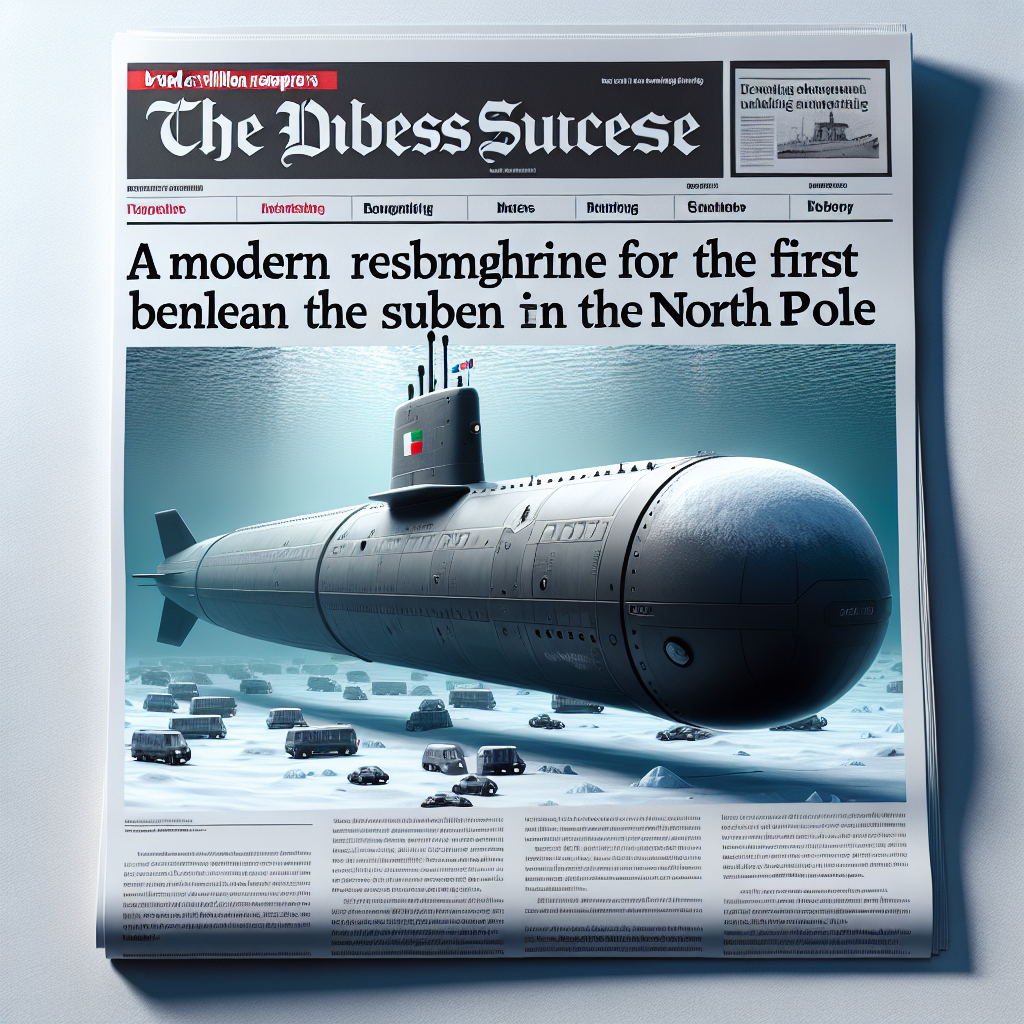
In December 2025, China’s research submarine navigated for the first time in the North Pole ice depths in the summer, sparking concerns in Europe and America about its military expansion under the guise of “scientific research”.
According to a report by The Wall Street Journal on Tuesday, Western ocean strategy experts and military officials said that Beijing’s mastery of Arctic navigation technologies signifies the ability to access rich natural resource data, shorten shipping routes between Asia and Europe, and potentially bring Chinese nuclear submarines closer to the United States and NATO territory. The surveillance and defense of the Arctic route by Europe and America are weaker compared to the Suez Canal, Panama Canal, or routes around South Africa.
The U.S. Department of Homeland Security stated in a report in November that the frequency of Chinese military and scientific vessels appearing near Alaska reached a new high, indicating a rapid growth in Chinese activities in the “High North” Arctic region.
China’s research and commercial vessels are often accused of having military cover. In the past, Chinese vessels conducted intelligence gathering or marine research in foreign waters without permission, actions that violate international law.
Twenty years ago, China began marine scientific research activities in the South China Sea under the guise of “research” and published academic papers. According to intelligence officials from the United States and Pacific allies, Beijing has been using the research findings since 2013 to construct artificial islands in the South China Sea and quietly deploy military bases for the Chinese Air Force.
In 2025, ship tracking data analysis released by maritime analytics company Windward found that the Chinese fishing research vessel “Songhang” was “intentionally lingering” near an undersea cable in the Pacific Ocean. The report suggests that the vessel’s activities were not solely related to “fishing” as claimed but likely associated with seabed mapping or surveillance activities.
Experts mentioned in the report by The Journal that China’s actions in the Arctic might be aimed at providing data for its navy, especially for submarine navigation and anti-submarine warfare training. If the Chinese navy enters the Atlantic via the Arctic from the Pacific, it could shift the global maritime power balance and extend Pacific threats to the NATO region.
Alexus Grynkewich, the top military leader of the North Atlantic Treaty Organization (NATO) and a U.S. Air Force general, told The Journal, “Beijing is becoming increasingly aggressive across the entire ‘High North’ region.”
Grynkewich elevated NATO members Denmark, Sweden, and Finland under the command of the NATO Allied Command Transformation in the North Atlantic and Arctic region to enhance defense and respond to joint activities by China and Russia in the area.
Western military officials warned that Russia is now allowing China to expand its presence and influence in the Arctic, which could backfire in the future. They highlighted that Chinese vessels operating north of Russia could put Moscow in a passive position, especially in cases of conflicting national interests and the rupture of the so-called “unlimited partnership relationship”.
Currently, Russia possesses the largest icebreaker fleet with over forty icebreakers. China added its fifth icebreaker to the fleet in 2024.
With assistance from Finland, China launched its first domestically built icebreaker in 2019. However, in 2024, China completed and deployed its first independently designed icebreaker within ten months, causing concerns among Arctic nations.
Hunter Stires, a U.S. Navy strategic expert, told The Journal, “China’s actions in the High North pose a direct challenge to Russia, no less than to any other major power.”
To counter the new threats, the U.S. and its allies are training more Arctic forces and intensifying anti-submarine patrols originating from Iceland and other locations.
President Trump reached a shipbuilding agreement with Finland to expand the U.S. icebreaker fleet and pressured Denmark to enhance defense around Greenland and its vicinity. Currently, the United States only has two icebreakers in service, and the Trump administration has initiated orders for more icebreakers.