
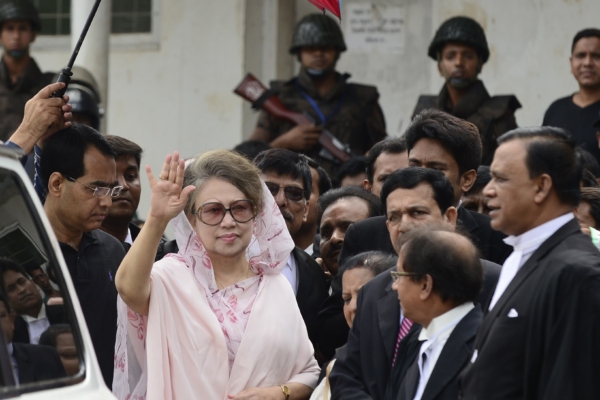
Bangladesh Nationalist Party (BNP) announced on Tuesday (December 30) that Bangladesh’s first female Prime Minister, Khaleda Zia, passed away at the age of 80 while hospitalized in Dhaka.
The party stated on Facebook, “Our beloved national leader has left us. She passed away early this morning at 6 am.”
Zia’s passing marks the end of an important chapter in Bangladesh’s political history that lasted for over thirty years. Over the decades, she and her long-time political rival, Sheikh Hasina, alternated in power, engaging in fierce political confrontations that deeply shaped the country’s political landscape. Her death also signifies Bangladesh’s transition towards the next crucial crossroads of democratic transformation.
Since a large-scale protest in August 2024 forced Hasina, who had been in power for a long time, to flee to India, Bangladesh is currently being governed by an interim government led by Nobel Peace Prize laureate Muhammad Yunus.
Following Zia’s death, Yunus mourned her, calling her a “symbol of the democratic movement.” Zia played a crucial role in the political movement of the 1980s opposing military rule and advocating for the restoration of parliamentary democracy.
Doctors reported that Zia’s health had been deteriorating for a long time in her later years, suffering from advanced liver cirrhosis, arthritis, diabetes, and heart and thoracic diseases. She had traveled to London, UK for treatment in early 2025 and returned after about four months; however, her condition continued to worsen since being hospitalized again on November 23, ultimately leading to her demise.
Zia’s political career began in 1981 when her husband and then-president Ziaur Rahman was assassinated in a failed military coup. Zia, who had previously little involvement in politics, was then persuaded by senior party members to enter politics and gradually became a key figure in Bangladesh’s anti-military rule movement.
In 1991, Zia led BNP to victory in the elections, becoming Bangladesh’s first elected female Prime Minister. She served two terms from 1991 to 1996 and from 2001 to 2006. During her tenure, she promoted economic liberalization, export-oriented policies, and expanded access to education, especially for girls.
However, her second term saw recurring corruption allegations and criticisms of her failure to effectively curb radical forces, leading to a polarized political evaluation of her performance.
After political turmoil in 2006, Bangladesh was briefly under a caretaker government supported by the military. In 2018, Zia was sentenced to ten years in prison for her involvement in a corruption case related to an orphanage fund. BNP claimed the charges were politically motivated to weaken the opposition, while the Hasina government denied the accusations.
Subsequently, she experienced imprisonment and house arrest. In August 2024, the Hasina regime fell amid student-led protests, and Zia was released from house arrest. In early 2025, the Supreme Court of Bangladesh overturned the convictions of Zia and her eldest son Tarique Rahman, clearing the way for Tarique to enter politics.
At the time of Zia’s death, Bangladesh is preparing for parliamentary elections in February 2026. BNP is currently considered one of the main competing political parties. Her son, BNP acting chairman Tarique, who had been in exile in the UK for nearly 17 years, returned to Dhaka on December 25, greeted by party supporters. There is speculation on whether Tarique can unify internal forces and lead BNP in the upcoming elections in the “post-Zia era” amidst a transitional political environment.
Zia is expected to be laid to rest in Dhaka on Wednesday, beside her husband Ziaur Rahman. With the passing of this key political figure, the focus of Bangladesh’s political arena will now shift towards the elections in February next year, testing whether this young democratic nation can overcome long-standing opposition and embark on a new political chapter.