
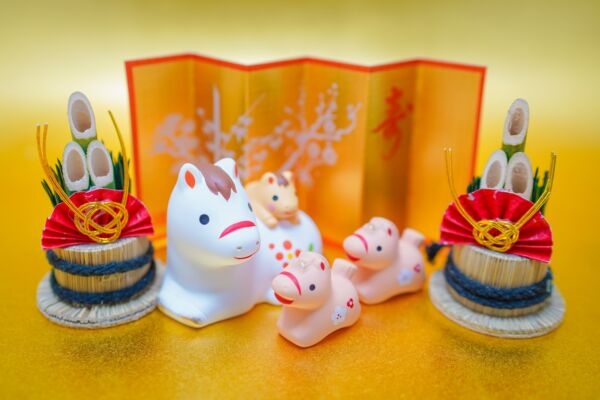
As the Chinese New Year approaches, traditions such as preparing for the Lunar New Year fair, spring cleaning, and decorating for the festive season are not only prevalent in the Chinese cultural sphere but also in Japan. In Japan, the New Year, known as “Shogatsu,” spans from January 1st to 3rd according to the Gregorian calendar, marking one of the most important holidays of the year for the Japanese people.
Starting from late December, households in Japan begin thorough cleaning of their homes, inside and out, while also adorning them with decorations symbolizing wishes for a smooth-sailing new year, each carrying its own auspicious significance.
One distinctive feature in Japan leading up to the New Year is the display of “Kadomatsu,” which is typically placed at the entrance of homes and businesses between December 13th and 28th. Similar to the concept of couplets in China, Kadomatsu consists of two sets of decorations on each side of the entrance, symbolizing the welcoming of the deity of the year into the home, as it was believed in ancient times.
Originally made from evergreen trees such as pine, cedar, and bamboo, Kadomatsu has evolved into predominantly bamboo and pine decorations. Modern Kadomatsu often features three bamboo stalks as the centerpiece, surrounded by pine branches and secured with straw ropes.
In Japanese tradition, the “Shimekazari” or New Year decorations are essential items for making wishes for the upcoming year. Comprised of various elements, each symbolizes different meanings, with kombu representing health, as its pronunciation is similar to the Japanese character for “joy.” Shirobai, a type of green fern, signifies passing the year with a sincere and pure heart. Yuzu leaves are symbolic for ensuring the continuity of offspring, while mandarin oranges represent prosperity for generations to come.
“Mochi” decorations, in the form of Kagamimochi or round rice cakes stacked on top of each other, are prominent offerings used for deity worship and hold a central significance in Japanese New Year decorations. Believed to be where the deity resides after descending to Earth, Kagamimochi is also thought to bestow people with divine power when consumed as an offering.
The name “Kagamimochi” is derived from the ancient round bronze mirrors used in Japanese rituals, resembling the circular shape of one of the Three Sacred Treasures, the “Yata no Kagami.” Its round form also signifies the wish for familial completeness. The Kagamimochi consists of two flattened round rice cakes stacked atop each other, with an orange placed on top, symbolizing prosperity for generations to come.
“Hama-ya,” or decorated arrows used in Japanese shrines and temples, are traditional charms believed to dispel misfortunes and evil energies, heralding good luck and peace. Adorned with bells and Ema charms at the feather end and often enshrined alongside a “Hamabow,” Hama-ya symbolizes the seizing of good fortune to welcome happiness for the New Year.
Signifying wealth and good fortune, “Kumade” in Japan primarily refers to a fan-shaped bamboo rake originally used as a farming tool but evolved into a lucky charm for attracting prosperity. Adorned with gold coins, mallets, and other auspicious ornaments, Kumade is a popular New Year decoration.
“Hagoita,” traditional Japanese battledores used in the sport of Hanetsuki, have transformed into decorative items for the New Year, carrying the symbolism of warding off misfortunes. The surfaces of Hagoita are often intricately painted with vibrant colors depicting various figures like traditional Kabuki performers, carrying both elegance and meaning.
“Otoshidama” is the Japanese equivalent of the Lunar New Year’s red envelope tradition. While not a decorative item, it is an indispensable part of the New Year celebrations. As the Lunar New Year approaches, bookstores, hundred-yen shops, and supermarkets offer a variety of cute and diverse “Otoshidama” envelopes, symbolizing blessings and encouragement.
Nevertheless, Japanese red envelope envelopes are usually white or light-colored, with the amount varying based on relationships and ages, symbolizing well-wishes and support.
Japanese culture abstains from the number “9” due to its similar pronunciation to the word for “suffering” in Japanese. Additionally, December 31st, known as “Omisoka” in Japanese, is traditionally associated with the preparations for a funeral vigil, hence seen as disrespectful to the deities during the decoration period, leading to the avoidance of December 29th and 31st.
Among the various dates, December 28th is considered particularly auspicious in Japanese beliefs. The number “eight” in Japanese carries the connotation of widening towards the end, signifying progress and entering a good phase. Therefore, many families choose to display their New Year decorations on this day to welcome good fortune.